- Thursday, 14 May 2026

Election spending Rs. 150 billion immediate boost to national economy
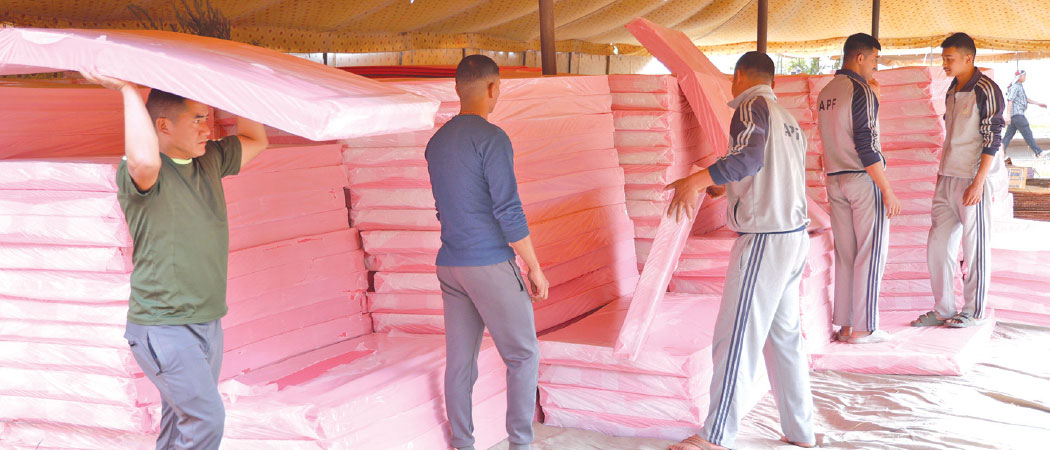
Photo: RSS Election materials being transported to districts.

Kathmandu, Feb. 15: A café in Bardaghat of Nawalparasi (West) has been busy for the last four weeks. The owner said that it remains open till midnight as a political party has made it an alternative meeting venue for voters and its candidates. It has increased the business.
“Sales have reached almost 1.5 times compared to that of the normal times. I hope it will be more than double in the final three weeks of the campaign,” said the elated owner. The café has already hired two additional staff and procures more meat, vegetables and liquor.
Aabritti Chhapakhana, a company offering creative and printing services in Kathmandu, is busy in designing and printing campaign materials for various candidates from across the country. However, the restriction on printing multi-colour promotional materials and posters has significantly downsized the business. “Unlike in the past, you can’t now print multi-colour materials. But business has gone up due to the elections,” said Kedar Adhikari, Director of Aabritti. But creative designing promotional content for social media and other online publication have secured a good amount of business.
Although the formal campaign for the March 5 elections for the House of Representatives (HoR) will begin from Monday, political cadres and candidates have begun to hold their meetings to discuss their strategies and increase public relations, and manage materials for it. In the course, they have created a business for local businesses.
Economists have estimated that about Rs. 150 billion is likely to be mobilised during the upcoming elections. While it will not make long-term contributions to the economy, it will make the market vibrant in the short-term.
Hotels and cafes, food producers and distributors, printers and designers, transportation services, fruit and vegetable producers, and tailors are witnessing a significant rise in their business across the country.
Our Saptari correspondent Binaya Karna reported that there has been a notable rise in the businesses of restaurants, printing, groceries and printers. “The number of customers at tea shops, snack outlets and eateries has increased after political parties and candidates’ teams began visiting villages. From morning until evening, snack sales have doubled compared to earlier,” said Sagar Sah, a snack shop operator from Rajbiraj Municipality-7.
Likewise, there has also been a notable rise in the printing of election campaign materials. Increased orders for posters, pamphlets, banners and flags have created employment not only in printing presses but also in paper supply, ink production and design services.
The transport sector has likewise benefited from the election. With increased movement of candidates and their supporters, the use of jeeps, motorcycles and e-rickshaws has risen across Tarai. In addition, increased consumption of local vegetables, fruits and other produce has encouraged farmers. As their produce is being sold in the local markets, they are getting good price.
Rs. 150 billion’s election market
According to economist Keshav Acharya’s rough estimates, about Rs. 150 billion will be injected into the market during the election period – about Rs. 33 billion from the government, and about Rs. 15 million from each of the 3,406 candidates filing their candidacy, and also a significant amount from the political parties and supporters.
Meanwhile, voters also make economic contributions through their travels, lodging and fooding as they travel to their home-town to cast votes.
Although the Election Commission (EC) has put a ceiling on the candidates’ expenditures with a mention of different expense titles, the past practice has shown that many candidates put a lot of money into their campaign way beyond the limit. “I spent about Rs. 15 million in one-and-a-half months before the general elections in 2022 but my competitor spent almost Rs. 40 million and secured victory,” a Nepali Congress leader who lost 2017 elections shared in condition of anonymity.
Some top leaders from the major political parties have long been complaining that the elections have been expensive while some of them turned away from contesting elections.
Nepali Communist Party (NCP) Coordinator Pushpa Kamal Dahal Prachanda had said publicly a few years ago that it had become very difficult to win an election without a thick purse. Likewise, CPN-ULM leader Prithvi Subba Gurung had said that the actual election expenses are way above that reported to the EC.
In 2020, then Nepal Communist Party leader Ram Karki had said that it’s impossible to win the election without spending about Rs. 250 million. He even went on to say that he was ready to sell his post of the lawmaker if anyone would pay for his expenses made during the election campaign. NC leader Dr. Shashank Koirala said that he spent almost Rs. 60 million in 2017 elections.
“It is true that a few independent and fringe party candidates will spend a small amount during the election, most of the candidates enter the election frays with sound financial planning and backing,” said Acharya.
According to a reporting on the monitoring of the election candidates’ campaign expenditures during 2017 elections conducted by Samuhik Abhiyan, 57 per cent of the candidates spend more than the limit prescribed by the EC while 90 per cent of them reported significantly lower figures in the expenditure statements submitted to the EC compared to the costs tracked by the monitoring project.
Likewise, more than two-thirds of the candidates exceeded the expenditure limits within the individual prescribed categories.
Major election expenses are made on transportation, food (including meat, vegetables and fruits), fast food, flex and printing, house rental, digital marketing and content creation.
Former Finance Minister Surendra Pandey said that the election market is comprised of two aspects – election market and candidates’ market, and both have to be managed financially.
A short-term economic uptick
Experts also say that the Rs. 150 billion spent during the elections make an impact worth Rs. 300 to Rs. 400 billion as it quickly moves from consumers to producers to raw materials suppliers to importers. Likewise, election is the occasion when there is a country-wide expenditure and local economy is also strengthened for a while.
A large amount of it moves out of the country. Diesel, petrol and other petroleum, fruits, mutton, flex materials, rice, pulses, spices and clothes are imported. In addition to that, many candidates in Tarai region use Indian vehicle and send the money out of the country in rental payment. Election expenditures from the parties and candidates are likely to contribute to about Rs. 5 billion to government revenue, according to Acharya.
But these economic activities don’t leave a long-term impact. Most of the money spent locally quickly moves to the market and economic centres in the major cities. Especially, increased cash-flow quickly evaporates from the smaller towns and market areas.
Illegal money makes its way to market
While many economists and election experts openly said that the illegally owned money comes into the market during the elections, former Finance Minister Surendra Pandey said that could be true in case of few candidates. “I don’t think that black money is brought into the market during elections. Many candidates crowdsource their election expenditure and collect a significant amount,” he said.
However, he didn’t deny of interest-backed support from some businesspersons who wish for the policy influence in their favour. Such financers pay less attention to the small parties and candidates and pay directly to the parties and their top leaders. Prachanda once had lamented that since his party’s size shrunk significantly, no businessman was willing to offer them financial support or donations.
But Acharya said that this is the season when illegally amassed money makes it way to the market which is good for the local and national economy.
Use of money is directly related to the integrity of candidates and political parties. It’s also about power of ideas versus power of money which has its impact on post-election corruption.
Election or political financing also has its connections with possible money-laundering, indirect promotion of smuggling and corruption. Economists say that more money can finance more propaganda and advertising, thus, manipulating public opinion in the short-term.
Crowdsourcing in practice
Leader of the NCP, Lekhnath Pandey, who is contesting election from Gorkha Constituency 2, said that he is planning to spend less money than the limit prescribed by the EC which is Rs. 2.9 million. “I don’t maintain two accounts. I am set to set a national standard that you can manage your election activities at a modest cost,” he said while adding that his estimated spending is about Rs. 2.4 million.
This budget doesn’t include the expenditures made by the party leaders and cadres in managing food, snacks and rally expenses for him.
Many candidates from the major political parties, including the new ones from the Rastriya Swatantra Party (RSP), have begun crowdfunding their elections. Many of them have appealed people in and out of the country to donate small amount of money in order to make them able to finance their election.
Pandey is raising Rs. 100 to Rs. 1000 from his party members and well-wishers. However, party members or supporters who run a business and who are employed abroad provide additional support as well.
According to leaders, those who offer financial support to the candidates remain loyal to them during the elections with many of them campaigning in their favour. Campaign period should be reduced to a maximum of 10 days to two weeks in order to bring down the election expenses by the candidates and political parties.
Effort to control expenses
The EC has issued fresh directives for the first time mandating the candidates to accept donations in their bank accounts and make expenditures from the same account. But in absence of robust tracking mechanism, its implementation is under scrutiny.
Now, political parties and candidates are required to conduct all election-related financial activities through dedicated bank accounts to ensure transparency and traceability. All transactions must be made in Nepali currency using formal banking instruments.
Donations above Rs. 25,000 must be deposited into the campaign account, while those exceeding Rs. 100,000 require full donor identification and tax details. The EC has prohibited funding from government bodies, government-linked entities, public limited companies, educational institutions, NGOs, foreign sources, and anonymous donors. The measures aim to regulate campaign financing, prevent illicit funding, and promote accountability and transparency in the electoral process, said the EC.
According to the directives, the chief of the relevant Treasury and Accounts Controller Office has been tasked as the Election Code of Conduct Monitoring Officer. But they lack the system and equipment for monitoring and tracking the candidates’ expenses.
Spokesperson of the EC, Narayan Prasad Bhattarai, said that the election body will strictly implement the code of conduct and bank account procedure.
He also maintained that candidates and parties not adhering to the prescribed procedure would be punished. “Even a general punishment like publishing notice about their malpractice and a small fine can create awareness in the voters so as not to vote those candidates again,” said Bhattarai.
However, civil society members say that there should be strict measures to those going against the code of conduct such as punishment like restriction from contesting elections and scrapping candidacy.
Digital transaction is a likely solution.
“If we could make all transactions digital and track the expenditures digitally, reckless expenditures by the candidates could be checked,” said Pandey while adding that until the physical currency continues to circulate in the market, controlling would be tiresome. All transactions should be cashless, he said.
Digital transactions and its thorough audit will bring the candidates of various economic hierarchy to the same level.
There should be policy reform for the digitalisaiton of election expenditures, maintain comprehensive details of the properties of the candidates, and record procurements made by the parties and candidates, suggested Pandey.
Experts also suggested for third-party monitoring as the EC doesn’t have human and logistic resources. Integrated efforts by the Ministry of Home Affairs, the Ministry of Finance, the Commission for the Investigation of Abuse of Authority, and the intelligence agencies, and crowdsourcing of information about malpractice and misuse of money can be effective.