- Saturday, 6 June 2026

Patan Hospital goes fully digital
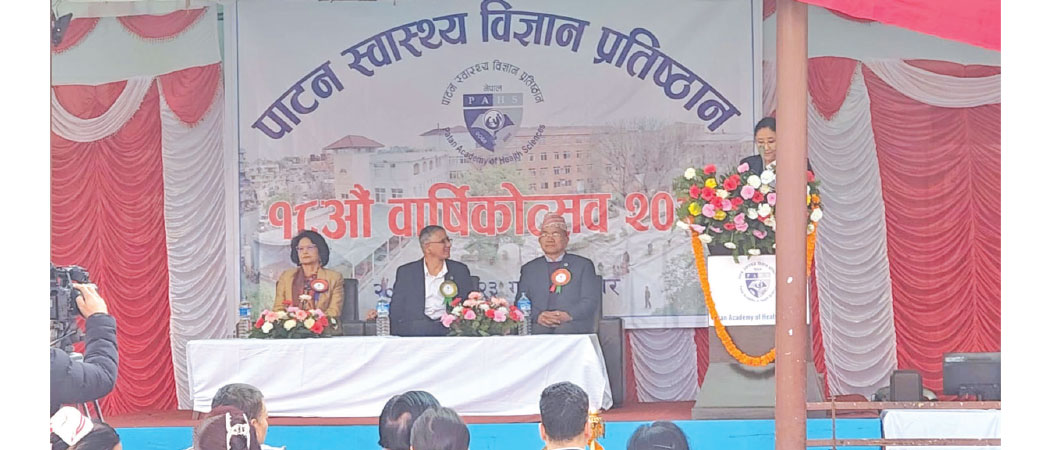

Kathmandu, Feb. 7: In a milestone move, the Patan Hospital has digitalised all of its services including emergency, outpatient department and inpatient department.
The hospital located in Lagankhel of Lalitpur has emerged as the country’s first state-run multi-speciality hospital to fully digitise its services, marking a major transformation in public healthcare delivery.
Minister for Health and Population Dr. Sudha Sharma Gautam launched the digital services at the 18th anniversary programme of the Patan Academy of Health Sciences (PAHS) organised at the hospital in Lalitpur on Friday.
Developed over a decade through sustained effort and close collaboration with medical professionals, the hospital’s integrated digital system streamlines everything from administration to clinical treatment into a single platform.
With the launch of digital services, patients’ records maintained in the past seven decades could be accessed via mobile devices or computers. The system is developed and maintained by D-Code, a Nepali software developer company.
“One of the most notable changes is the introduction of mobile-based access to prescriptions and medical reports. After consultation, patients can now view prescriptions, medication details, and test results directly through their online accounts or mobile applications, eliminating the need to carry physical files,” Registrar of the PAHS Prof. Dr. Paras Kumar Acharya said at the programme.
The hospital has also implemented an online payment system, allowing patients to settle bills using QR codes and cards. This removes the need to queue at cash counters and enables patients to proceed directly to pharmacies or diagnostic services after consulting doctors.
Another feature allows patients to download X-ray, CT scan, and MRI reports remotely through a digital portal. This reduces congestion in radiology department and offers greater convenience—an innovation considered groundbreaking among Nepal’s public hospitals, the hospital informed.
The system further integrates major government service platforms, including Health Insurance, the Social Security Fund (SSF), supports schemes for underprivileged citizens and the Inland Revenue Department’s API (Application Programming Interface).
“This integration enables eligible patients to access government benefits without additional paperwork or administrative delays,” said the developer.
D-Code said that the software used in the PAHS is free and open-source platform as per the policy of the government.
The hospital has made both the software and its source code publicly available, allowing other public and private hospitals to adopt, customise, and implement the system at no cost.
“This is not just software; it reflects 10 years of institutional experience and operational learning. Other hospitals no longer need to invest millions in research—they can adopt our model and digitise their services immediately,” said a member of the development team.
Designed to manage the daily load of more than 2,000 OPD visits and over 600 admitted patients, the system is now expanding towards artificial intelligence (AI) integration. The hospital has begun incorporating AI tools to enhance disease diagnosis, workflow efficiency, and medical data research.
Patan Hospital is also preparing to launch its own mobile application, which will further improve patient access to healthcare services.
Dr. Acharya informed that the digitalisation of the health services at the PAHS was conceptualised one and a half decades ago in 2011. He also appealed to all public and private health institutions in Nepal to use the open-source software and save a large amount of budget and effort to create another one.
Addressing the anniversary programme, Minister Dr. Gautam appreciated the quality human resources production and service delivery of the PAHS. She said that while basic health services are guaranteed by the constitution and its responsibilities are lied at the local governments, they are yet to realise this responsibility and act accordingly.
“It is unfortunate that insurance payment is due for the last three years at the Patan Hospital. I request all the governments to make their contributions to the insurance fund in order to make the programme a success,” said the Minister.
The hospital is waiting to receive Rs. 311.24 million in insurance dues from the government. Other dues include Rs. 56.88 million for services to the poor people.
Meanwhile, the PAHS has earned Rs. 3.08 billion in the last Fiscal Year 2024/25 and made a profit of Rs. 163.61 million.
The hospital is set to launch bone marrow transplant service from this year. A recently prepared master plan of the hospital also includes launching cardio-thoracic surgery, radiation therapy and transplant services in the near future.






-original-thumb.jpg)