- Sunday, 3 May 2026

Int'l ICT workshop begins in capital
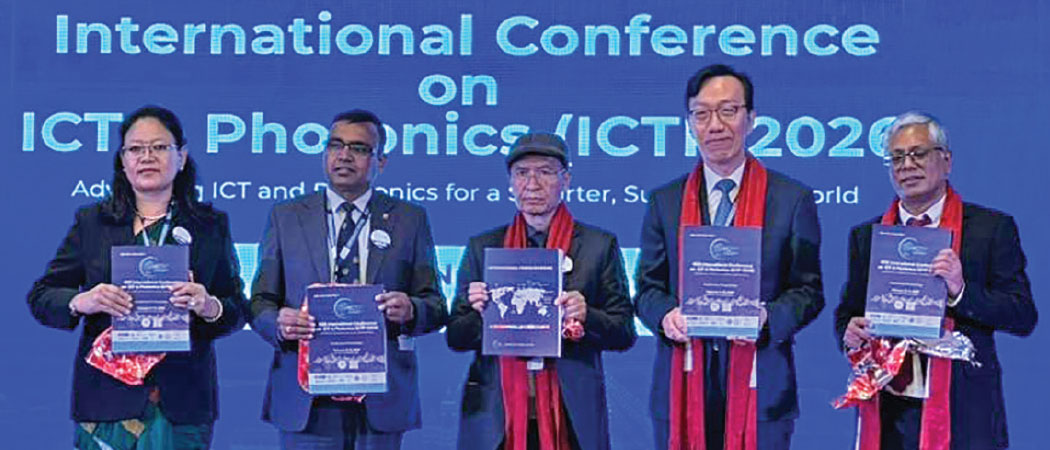
Photo: TRN Korean Envoy Tae-young Park and officials during a formal session in Kathmandu.

By A Staff Reporter,Kathmandu, Feb. 13: The IEEE International Conference on ICT and Photonics (ICTP 2026) and the KAIST Global Digital Innovation and Impact (GDI) workshop began on Thursday at Hotel Centric in Kathmandu, bringing together researchers, academicians, innovators, and students from Nepal and abroad to foster collaboration in digital innovation and emerging technologies.
ICTP 2026 marks a historic milestone as the first-ever IEEE (Institute of Electrical and Electronics Engineers) conference organised in Nepal.
The three-day conference is jointly organised by Research and Innovation Center Nepal (RICON) and Nepal Engineering College (affiliated to Pokhara University), with technical sponsorship from the IEEE Nepal Chapter and IEEE Photonics Society Nanjing Chapter, co-organised by KAIST (Korea Advanced Institute of Science and Technology) Global Digital Innovation.
More than 200 national and international researchers, academicians, innovators, and students are attending the workshop.
Addressing the workshop, Tae-young Park, Ambassador of the Republic of Korea to Nepal, congratulated the organisers for hosting this landmark scientific event and described it as “a proud and significant moment for Nepal’s scientific and academic community.”
He commended the efforts of Conference Chair Prof. Bikash Nakarmi, Dean Prof. Dr. Seung Hun Han of KAIST’s Graduate School of Global Digital Innovation (GDI), and the organising committee for successfully convening a global platform for dialogue and collaboration.
The Ambassador highlighted the importance of holding ICTP 2026 alongside the Global Digital Innovation & Impact Workshop led by KAIST GDI, with the support of the Ministry of Science and ICT of the Republic of Korea.
He said that such collaboration reflects the growing partnership between Nepal and Korea in science, technology, and digital innovation.
He added that the ICT sector remains one of the priority areas of bilateral cooperation between Nepal and the Republic of Korea.
The government of the Republic of Korea, through the Korea International Cooperation Agency (KOICA), has been continuously supporting the Government of Nepal in strengthening its ICT infrastructure and digital capacity.
The Government Integrated Data Centre (GIDC), the primary data centre of the government of Nepal located in Singha Durbar, Kathmandu, was established with significant financial and technical assistance from the Korean government. The GIDC is responsible for storing, managing, and backing up public data.
Similarly, the Disaster Recovery Centre (DRC) in Hetauda, also supported by the Korean government, serves as a backup system for the GIDC and is designed to minimise data loss resulting from natural or human-induced disasters, including earthquakes.
Another milestone initiative supported by the Korean government is the establishment of a modern Cyber Bureau for Nepal Police through USD 8 million KOICA grant.
This project aims to enhance digital forensic capabilities and combat the rising threat of cybercrime, with the facility expected to become operational around the end of 2026.
The Ambassador also expressed encouragement to young researchers and students participating in the conference, noting that they are the future leaders who will shape the digital world.
Emphasising the transformative role of ICT, photonics, artificial intelligence, and digital governance, he stated that technological advancement—guided by sound policy and strengthened by international cooperation—can serve as a powerful driver of sustainable and inclusive growth.
He reaffirmed the Republic of Korea’s commitment to sharing its development experience, supporting capacity building, and enhancing cooperation with Nepal in digital transformation and innovation-driven development.

-square-thumb.jpg)




-original-thumb.jpg)