- Wednesday, 3 June 2026

Regulation Of Pesticides Saves Lives
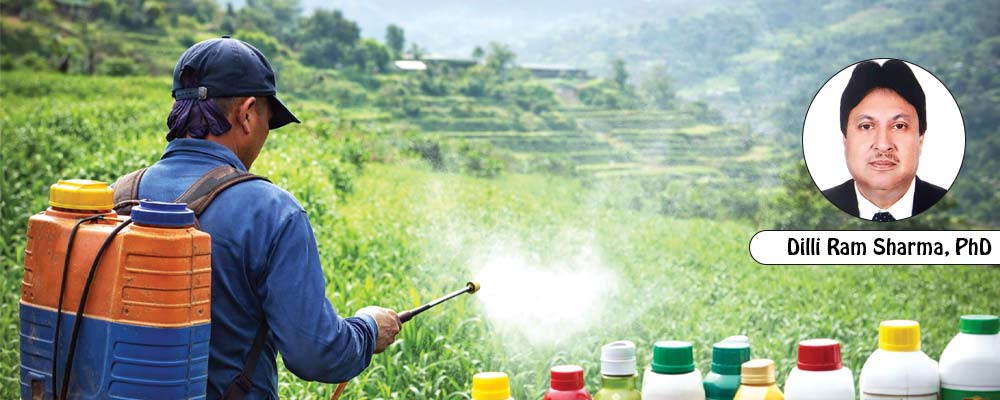

Pesticides remain a major public health concern in Nepal, impacted by an agriculture-centric economy, easy access to lethal substances and weak regulation. The easy availability of pesticides is increasing both occupational exposure and their misuse for self-harm.
Restricting access to highly hazardous pesticides (HHPs) has been shown globally to reduce preventable deaths without negatively affecting agricultural productivity. Nepal has taken regulatory steps to manage hazardous pesticides and to monitor their impact on public health outcomes.
Farmers increasingly rely on chemical agents to control insect pests, weeds, and crop diseases. For crop protection, Nepal imports more than 1,664 metric tonnes of approximately 179 types of pesticides annually. The extensive availability of these agricultural chemicals has also contributed to misuse for self-harm, making pesticide ingestion one of the most common methods of suicide in the country. Suicide rates have remained alarmingly high across the nation, with a record 7,223 deaths reported in the fiscal year 2023/24—an average of nearly 20 deaths per day. Poison ingestion, predominantly involving pesticides, accounts for about 15 per cent of these deaths. Historical trends indicate that fatal pesticide self-poisoning increased dramatically over the decades, rising nearly thirteenfold as national suicide rates escalated from the 1980s onwards.
According to hospital case records and forensic data, organophosphorus insecticides, phosphine gas from aluminium phosphide, and combinations like organophosphorus insecticides and cypermethrin continue to dominate the pesticide self-destruction scenario. However, the proportion of deaths from certain banned chemicals like dichlorvos and aluminium phosphide has reduced in recent years following regulatory interventions. Though pesticide regulation and banning have been effective in reducing the number of deaths from specific chemicals, there are certain issues that need to be addressed. These include the continued use of highly hazardous pesticides in the informal market, poor regulation of sales, and the public health burden in the country.
From the 1980s until the early 2010s, the widespread availability of HHPs, combined with limited regulation and easy household access, contributed to a steep rise in fatal pesticide poisonings. Long-term analyses indicate that pesticide-related self-harm deaths increased more than tenfold during this period. However, since around 2017, a notable shift has been observed.
The proportion and number of deaths resulting from the ingestion of pesticides have gradually reduced with the strengthening of regulatory actions, policy focus on the prevention of self-harm, and the use of robust national and international research evidence. The recent national statistics indicate that the overall number of deaths resulting from intentional self-harm remains a concern, yet the proportion of deaths resulting from pesticide poisoning has reduced significantly compared to previous years.
The progress made by Nepal in the reduction of pesticide-related deaths has been strongly supported by the collaborative efforts of the national government, local experts, and international research centres such as the Centre for Pesticide Suicide Prevention (CPSP) and the University of Edinburgh. Since 2017, CPSP, led by researchers affiliated with the University of Edinburgh, has worked closely with the Department of Agriculture, police and national forensic laboratories, subject experts, and academic partners to generate policy-relevant evidence on pesticide poisoning deaths.
CPSP-supported studies systematically analysed police records, forensic toxicology data, and hospital case series to identify which specific pesticides were most frequently involved in fatal self-poisoning. Importantly, this research demonstrated that removing selected pesticides was associated with substantial reductions in poisoning deaths without negative impacts on overall agricultural productivity—a finding that helped address concerns among policymakers and agricultural stakeholders.
The University of Edinburgh provided sustained technical leadership, methodological rigour, and international credibility, ensuring that data were analysed using globally accepted epidemiological approaches. Through continuous engagement, capacity building, and policy dialogue, CPSP’s efforts have been among the most influential external supports to Nepal in linking pesticide regulation with prevention of fatal self-harm. However, despite these achievements, there is a need to address the challenges. For instance, the weaknesses in the national mortality surveillance, lack of identification of specific toxic agents, easy access to banned pesticides, and the lack of adequate mental health servic es remain some of the challenges to be addressed.
To achieve further success, there is a need to continue the collaboration between agricultural regulators, public health officials, forensic experts, mental health professionals, and international research partners. In addition, there is a need to enhance the enforcement of pesticide regulation, toxicological reporting, community-based mental health services, and the development of evidence-based policy pathways.
In conclusion, the experience of Nepal, with the support of national experts and international research partners such as the CPSP, shows that the regulation of pesticides is a powerful public health intervention.
By continuing to invest in the development of evidence-based policy, surveillance, and intersectoral collaboration, the country has the opportunity to further reduce preventable deaths. In particular, the studies carried out to identify the most hazardous pesticides, to monitor the patterns of intentional poisoning, and to assess the effects of regulation on deaths from pesticides have provided the much-needed evidence to inform policy decisions, such as the banning of certain pesticides.
To ensure the continued success of the policy, there is a need to carry out regular studies on pesticide poisoning. This requires the continued collaboration between international research organisations, universities, and national experts from various sectors, including regulatory agencies, forensic labs, hospitals, and academic institutions.
(The author is a former director genereal at the Department of Agriculture.)




-square-thumb.jpg)