- Monday, 8 June 2026

Stronger Voice For Climate Justice

From erratic and devastating monsoon rains to the emergence of unheard-of diseases, from hostile weather phenomena to rising threats of glacial lake outburst floods, and with agricultural output hit by droughts, Nepal has found itself in unprecedented throes of a climate crisis. Adverse impacts, scientifically attributed to rising global temperatures, have been experienced with increasing severity over the years, despite the fact that this country has a negligible role in the emissions of greenhouse gases that cause global warming.
As Nepal faces climate-induced disasters of increasing intensity, there is a pressing need to raise a stronger voice in global forums to assert its position for climate justice. On March 31, 2019, the Bara and Parsa districts were lashed by a tornado. This was the first such phenomenon recorded in Nepal's weather history, and it claimed the lives of more than two dozen people while destroying around 1,000 houses. The loss of lives and properties was unprecedented, as the housing infrastructure was considered strong enough to withstand a windstorm of that intensity. Scientists have attributed this event to climate change.
Bursting of a glacial lake
On August 16, 2024, a flash flood rushing down the mountain slope devastated Thame village in Solukhumbu district. A large portion of the village was wiped out by debris and sludge, displacing dozens of people. This disaster was the result of the bursting of a glacial lake, which scientists call a glacial lake outburst flood (GLOF). The International Centre for Integrated Mountain Development (ICIMOD) confirmed that the flash flood was caused by the outburst of Thyanbo glacial lake located at an elevation of 4,750 metres up in the mountain.
The occurrence of GlOF events is not fiction. Real disasters are taking place before our eyes. Dozens of glacial lake outburst floods have hit the mountain regions of Nepal so far, the latest being at Thame in the Sagarmatha region. There have been 26 major GLOF events since 1977, including the Dig Tsho glacial lake outburst in the Khumbu region in 1985, which destroyed Namche Small Hydropower Plant and swept away about a dozen bridges. When the water volume in a glacial lake increases, the natural embankment of rocks, gravel and ice cannot hold the weight and gives way. The sudden release of water down the steep slope can be highly destructive.
In mid-June 2021, when the monsoon season had just started, a massive flash flood in the Melamchi River in Sindhupalchok district destroyed the Melamchi Water Supply Project that supplies water to the Kathmandu Valley. It also devastated settlements, marketplaces, large swathes of farmland, and vital infrastructure like bridges and roads. Over two dozen people were killed, while more than 600 others from 500 households were displaced. The water intake structure of the project was buried under a huge debris heap of boulders and gravel. Twenty bridges, including seven motorable ones, were destroyed.
Be it caused by an avalanche, excessive high-altitude rains, or a burst of lake water up in the mountains, the ultimate blame has been put on catastrophic weather phenomena triggered by global temperature rise. This disaster caught everyone by surprise as it was unheard of for such excessive rains and flash floods to come in mountain regions at the very beginning of the monsoon. Scientists have observed changes in the dynamism of monsoon activities over the decades. Patterns of monsoon arrival and withdrawal are becoming increasingly irregular.
The phenomenon of intense rainfall and prolonged droughts has had a negative impact on agricultural production, public health, the economy, and water resources, in addition to causing damage to vital development infrastructure. Natural ecosystems and biodiversity have been critically disrupted. The cost of losing the life-sustaining environmental system and biological diversity is so high that no financial payment can make up for it. The losses caused by climate impacts will be immense and will pose serious challenges for future generations. Taking concrete actions to reverse the risks of climate change would be an act of justice to posterity.
Scientists at ICIMOD say that there are over 25,000 glacial lakes across the Himalayan mountain region, and 47 of them are in Nepal. They pose a potential danger of bursting at any time. The flash flood can bring untold destruction to the downstream community settlements and vital infrastructures such as roads, bridges, irrigation canals and water supply projects. Powerhouses and electricity transmission lines are also under threat. With glacial melts accelerating as a result of temperature rise, more lakes are in the process of formation, while the existing ones are getting deeper and wider.
It is hard to predict when the bursting will happen, but the hot season and an earthquake are likely to trigger a catastrophe. Some skeptics dismissed climate change warnings as a mere hoax or an alarmist talk. But scientific research and observations made over decades and years have established its fact. Evidence shows the adverse impacts are increasing in scale and intensity. Climate scientists have warned that matters are growing from bad to worse with every passing year and called for the urgency of global action to mitigate the dangerous CO2 emissions.
Large responsibility
The larger responsibility naturally falls on those nations that have more role in emitting greenhouse gases into the atmosphere. Climate mitigation measures include putting a cap on the very source of emissions, and adaptation solutions involve providing financial resources and clean technologies to vulnerable countries like Nepal to deal with immediate impacts. There is a need to put in place an agreement in which polluters pay to redress the climate-induced sufferings of the communities and countries that have become the victims of the trouble that is not of their making. This is seen as the real essence of climate justice.
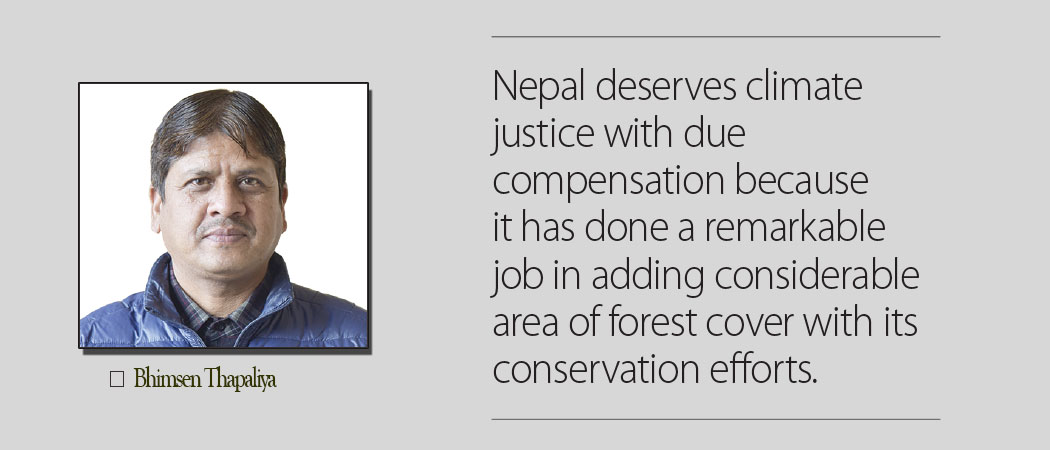
Nepal deserves climate justice with due compensation because it has done a remarkable job in adding considerable area of forest cover with its conservation efforts. Nepal’s conservation track record stands laudable in sharp contrast to those countries that have resorted to destructive logging for immediate financial gains and those that have burnt massive amounts of fossil fuels to attain material luxuries.
(The author is the former Editor-in-Chief of this daily.)
-square-thumb.jpg)