- Sunday, 3 May 2026

Minister Khanal urges shift toward domestic goods consumption
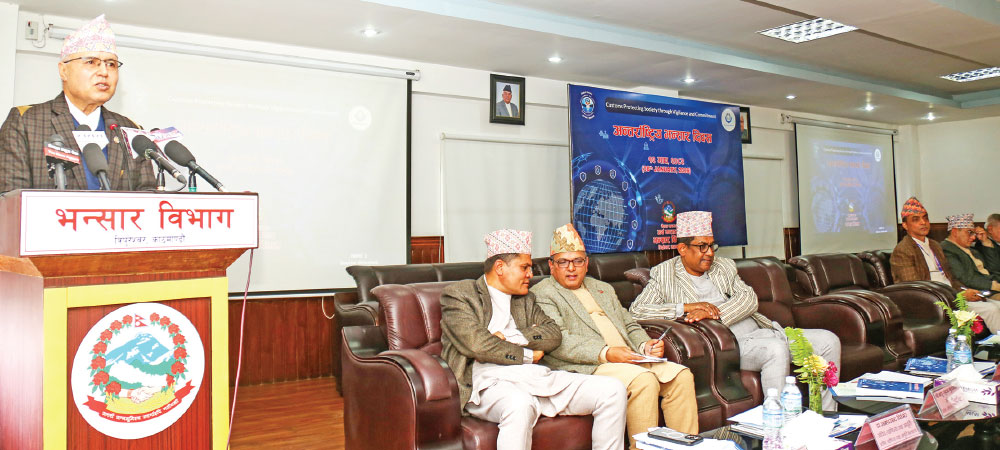

By A Staff Reporter,Kathmandu, Jan. 27: Finance Minister Rameshore Prasad Khanal has stressed on the need to shift Nepal’s economy toward consumption of domestically produced goods rather than reliance on imported goods.
Addressing the 74th International Customs Day on Monday, he clarified that improving the nation's economy would be challenging without increasing domestic production. He highlighted that policies promoting local manufacturing should take precedence over encouraging import-driven consumption when devising customs strategies.
He also noted that unnecessary imports of domestically replaceable goods should be regulated through legislation. Minister Khanal stated that priority has been given to the effective implementation of the Customs Act and the prompt introduction of Customs Regulations. "A new Customs Act has been introduced to facilitate the private sector and make customs administration more systematic. Regulations to implement the Act, brought to facilitate trade, are being approved by the Council of Ministers,” he said.
In response to complaints about the severity of penalties under the Customs Act, Khanal mentioned that efforts should be made to create a situation where penalties are rarely necessary. He stressed that collaboration among the private sector, the Ministry of Finance, and the Department of Customs is essential to achieve this.
He assured that the Ministry of Finance would support improvements in customs administration to enhance its efficiency in promoting trade. Khanal also mentioned the urgency of implementing a comprehensive customs reform strategy. While some private sector demands are being gradually addressed, he acknowledged that criticism is a natural part of initial reform phases. He stressed that reform is an ongoing process requiring strong leadership.
During the event, a system was launched to issue Certificates of Origin (COO) exclusively through the Nepal National Single Window System. Khanal inaugurated this system, under which Certificates of Origin with QR codes will now be issued online.
Trade Facilitation is the primary function of customs, according to Finance Secretary Ghanshyam Upadhyaya, who urged the implementation of practical reforms, including an online valuation system to standardise valuations across different customs offices.
Secretary at the Ministry of Industry, Commerce and Supplies Dr. Ram Prasad Ghimire, emphasised that customs should not only collect revenue but also facilitate trade and streamline supply chains. He outlined that the customs administration plays a vital role in border security, trade facilitation, public health, and supply chain management.
Ghimire also mentioned that while the customs reform and modernisation strategy is being developed, a long-term focus should be given alongside annual programme milestones. Federation of Nepalese Chambers of Commerce and Industry President Chand Prasad Dhakal stressed the importance of policies that foster entrepreneurship, prioritising revenue generated at customs points. "Moving towards customs valuation based on transaction value is positive,”
Dhakal stated. “Online Certificates of Origin also meet private sector needs, making customs procedures more efficient and based on real data." Considering that many countries cap cash transactions at USD10,000, and Nepal’s limit is only Rs. 500,000 (roughly USD 3,500), he called for a review.
Kamlesh Kumar Agrawal, President of the Nepal Chamber of Commerce, added that the maximum import transaction value through letters of credit, multinational companies, and GST bills should be fully recognised for low-risk imports. He also noted that due to India's reduced GST rate, similar adjustments should be made in Nepal to remain competitive.
The introduction of the transaction value system, replacing reference values at customs, was welcomed by the private sector. He recommended maintaining the maximum customs rate at 25 per cent to combat illegal imports facilitated by Nepal's open borders. He also urged the government to reconsider the recent reduction of the cash transaction limit from Rs. 1 million to Rs. 500,000, citing its adverse effects on traders.
“Timely improvements in customs administration are crucial for facilitating international trade and ensuring transparency. An efficient system will also reduce illegal trade and boost revenue,” he concluded.
Appreciating the government’s move to implement an online valuation database, he underscored the importance of joint responsibility among government officials, customs officers, and entrepreneurs for its success. Director General at the Department of Customs, Shyam Prasad Bhandari, remarked that the customs reform and modernisation plan has positively impacted trade facilitation, revenue collection, IT deployment, and organisational strength. He added that the online customs valuation database, initially launched at Biratnagar Customs Office, has now been adopted nationwide. Success depends on consistent support and cooperation from customs agents and the business community.
The event also honoured outstanding employees and customs agents. The celebration of the 74th International Customs Day included various programmes on Monday, with the theme being ‘Customs Protecting Society through Vigilance and Commitment.’