- Sunday, 3 May 2026

Icebreakers vital to Greenland are made only by allies or rivals
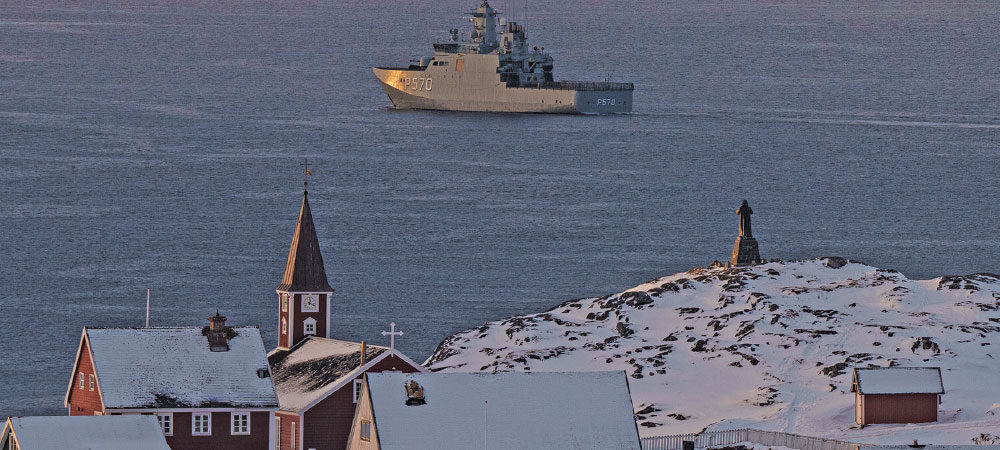
Military vessel HDMS Knud Rasmussen of the Royal Danish Navy patrols near Nuuk, Greenland, on Thursday, Jan. 15, 2026. Photo: AP

Brussels, Jan. 26: The cold, hard reality facing any U.S., NATO or European plans for Greenland is the ice. It chokes harbors, entombs minerals, and freezes shorelines into minefields of white and blue shards that threaten ships all year.
And the only way to break through all that is, well, with icebreakers: enormous ships with burly engines, reinforced hulls, and heavy bows that can crush and cleave ice.
But the United States has only three such vessels, one of which is so decrepit as to be barely usable. It has entered agreements to obtain 11 more, but can only source additional ships from adversaries — or allies it has recently rebuffed.
Despite toning down his rhetoric, U.S. President Donald Trump seems set on the U.S. owning Greenland for security and economic reasons: to keep what he calls "the big, beautiful piece of ice" out of the hands of Moscow and Beijing, to secure a strategic Arctic location for U.S. assets, and to extract the island's mineral wealth including rare earths.
Without specifying any plan, he told world leaders gathered in Davos, Switzerland, on Wednesday that "to get to this rare earth you got to go through hundreds of feet of ice."
Yet there is no meaningful way to do that — or anything else in the semiautonomous Danish territory — without icebreakers' crucial ability to cut trails through frozen seas.
Even if they decided to surge U.S. material into Greenland tomorrow, "they would have two or three years gap in which they're not really able to access the island most of the time," said Alberto Rizzi, a fellow at the European Council on Foreign Relations.
"On a map, Greenland looks surrounded by sea, but the reality is that the sea is full of ice," he said.
If the U.S. wants more icebreakers, there are only four options: the shipyards of strategic adversaries China and Russia or long time allies Canada and Finland, both of whom have recently weathered blistering criticism and threats of tariffs by Trump over Greenland.
Icebreakers are expensive to design, build, operate and maintain and require a skilled workforce that can only be found in certain places like Finland, with expertise forged in the frigid Baltic Sea.
Finland has built roughly 60% of the world's fleet of more than 240 icebreakers and designed half the remainder, Rizzi said.
"It's very niche capabilities that they developed as a necessity first and then they have been able to turn it into geo-economics leverage," he said.
Russia has the world's largest fleet with about 100 vessels, including colossal ships powered by nuclear reactors. Second comes Canada, which is set to double its fleet to around 50 icebreakers, according to a 2024 report by Aker Arctic, a Helsinki-based icebreaker design firm.
"Our design and engineering work order books are pretty full at the moment and the near future looks promising," said Jari Hurttia, business manager at Aker Arctic, as he describes rising interest in the firm's "unrivalled special competence which is not available anywhere else in the world."
China currently has five compared to the U.S. three, and is rapidly building more as they expand their ambitions in the Arctic, said Marc Lanteigne, a professor at the University of Tromsø in Norway who teaches often at the University of Greenland in Nuuk.
"China is now in a position to develop indigenous icebreakers, and so the U.S. feels it must do the same," he said.(AP)