- Thursday, 4 June 2026

Devkota's Yatri Message
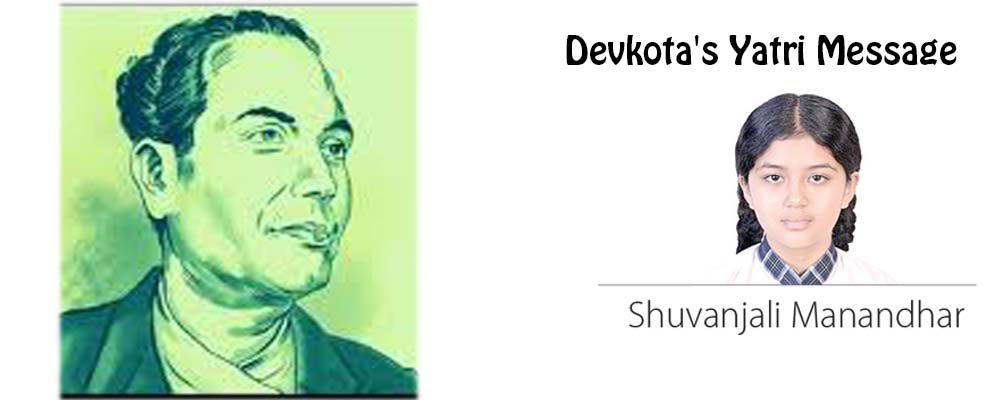
Nepal, from time immemorial, has been known as a multicultural, multiethnic, and multireligious country. During the era of its modernisation, people were largely religious, strict in religious norms, and had strong beliefs that were even superstitious. Those who did not follow these socially accepted norms and rules were often singled out. As decades passed, society gradually transitioned into a more pluralistic one, allowing greater personal liberties.
During the era of Laxmi Prasad Devkota, society was predominantly Hindu, and he himself belonged to an ‘upper Hindu Brahmin’ class. Society expected the same religious conformity from him as well. When it came to the worship of Hindu gods, however, Devkota had a different perspective. People at that time believed that performing physical puja of gods was the only way to please Him. Devkota did not strongly believe in this idea and was therefore viewed differently by society. Some even thought he was an atheist—a much-feared social stigma. Devkota’s writings, however, did not reflect atheism. One such example is his famous poem Yatri. In the poem, he expressed what true worship of God should be.
In Nepal, there are many famous temples and shrines on hilltops, such as the Manakamana, Pathibara, Muktinath, Palanchowk Bagwati, Gosaikunda, and others. Every year, many people visit these temples and shrines even though reaching them is very difficult. People spend a great deal of time and money because they deeply believe that by visiting these temples and worshiping the gods there, they will obtain good health, happiness, and prosperity.
One day, Devkota was travelling through the hills, where he met some people who were also journeying to a famous hilltop temple. Some of these pilgrims were weak and unable to walk by themselves, so they had hired porters to carry them on their backs. These porters, hoping to earn some money, had taken on the extremely difficult task of transporting human beings up the steep hills. It was a very pitiful sight for Devkota.
With his tender heart, Devkota felt deep sympathy for the porters. He also wondered why so many people were going to temples to worship gods instead of performing humane acts for those in need—which he believed to be the true form of worship, rather than praying before stone idols. During this journey, the idea of his famous poem Yatri came to his mind.
Devkota begins the poem by saying: “Oh dear fellow pilgrims, may I ask which temples you wish to visit, what offerings you wish to make there, and which heavenly abode you hope to reach by riding on another human being?”
Devkota then compares the human body to a temple in which God resides: “Our muscles and skeleton resemble the temple’s walls, the brain resembles its roof, and our senses are its doors. The network of nerves and veins are the pathways inside the temple. The human body itself resembles a complete temple.”
He further says: “You only need a beautiful heart, and the Lord will reside within it and provide you with a golden crown.” Devkota wonders why people take such hardships to reach distant temples: “Since God resides within you, there is no need to search for Him elsewhere. Seek Him in the depths of the human soul, not on the surface of the physical world.”
He continues: “Dear friends, God is travelling with you, but He kisses only those hands that serve fellow human beings.” Devkota also says: “Listen to the voice of God in the songs of birds and in the cries of people in pain. God cannot be physically seen nor found only in temples.” Finally, Devkota urges everyone: “Dear friends, meet your God by serving the needy selflessly—care for the sick, clean their wounds, and offer them love and compassion. Your selfless deeds will make God smile upon you, and you will attain what you seek by visiting His temple.”
Grade:IX, St. Mary’s School, Jawalakhel







-original-thumb.jpg)
-original-thumb.jpg)