- Saturday, 6 June 2026

Internal Democracy Ensures Parties' Future
 Sagar Ghale
Sagar Ghale
Sagar Ghale
In the present context, the primary role of political parties should be to integrate fair competition, accountability, and transparency within themselves, protecting the rights and interests granted by democracy.
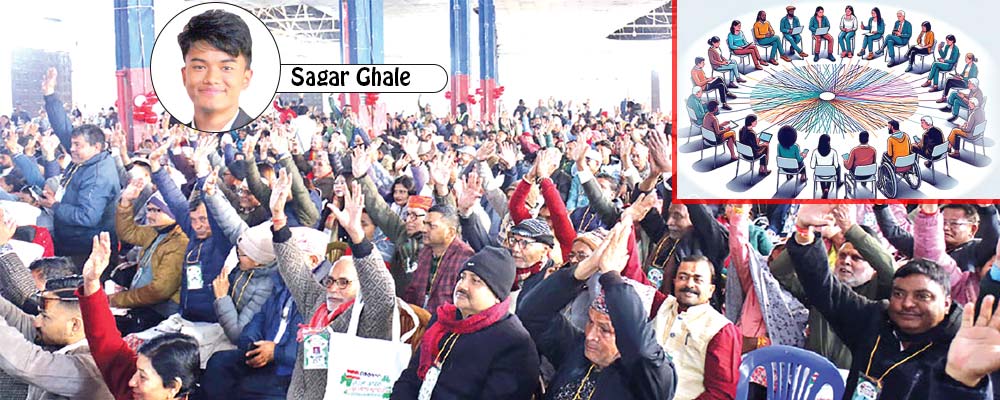
In countries that have adopted a democratic system, political parties are considered the key actors of democracy. Political parties often engage in debates and advocacy claiming that they themselves are democratic. To further strengthen and empower this system, the presence of internal democracy within political parties is essential. If political ideology is not limited merely to ideas but is also implemented in practice, the state system will experience stability. To safeguard the foundation of internal democracy, all political parties must develop strategies to implement their principles, policies, and ideals in practice.
Political parties are regarded as the carriers of democracy. Whether internal democracy exists within parties or not can be examined from various perspectives. In Nepal, criticisms are frequently raised that political parties formed so far have failed to translate their ideas, policies, and strategies into practice. Even today, major decisions within parties are largely controlled by top and senior leaders. This creates a high risk of erosion in ideological adjustment and inclusiveness. Similarly, when a single individual exercises absolute authority within a political party, it reflects not democratisation but the embrace of authoritarianism.
Backbone of democracy
When political parties—considered the backbone of democracy—fail to practice internal democracy, democracy itself becomes weaker. There is a legal provision requiring leadership selection processes to follow democratic procedures and regulations. Political parties use general conventions as a medium for selecting leadership. Although conventions are formally recognised as the main route for leadership selection, citizens commonly observe that senior leaders always struggle with leadership transfer. Thus, despite conventions being legally and theoretically established as a means of leadership transition, their full implementation is rarely seen.
Article 269 of Nepal’s Constitution provides provisions related to political parties. It states that a party’s statute must ensure the election of federal and provincial office bearers at least once every five years. However, it also mentions that if special circumstances arise and elections cannot be held within five years, provisions allowing elections within six months shall not be restricted. The Political Parties Act, 2017 (2073 BS) stipulates that while conducting elections, nominations, or appointments in party committees, participation must be ensured based on proportional inclusion reflecting Nepal’s social diversity.
It mandates at least one-third women’s participation. The Act also requires parties to submit details of elected central and provincial committees to the Election Commission, granting the Commission authority to monitor whether required procedures have been followed. While the Constitution obliges parties to hold regular conventions, the Act seeks to make the process more inclusive and transparent by mandating women’s representation and granting oversight powers to the Election Commission. If parties fail to comply, action may be taken under constitutional and legal provisions.
Despite this, political parties appear to proceed arbitrarily. Instead of discussing new ideas, policies, and ideals during conventions, parties often become entangled in power bargaining and disputes over who remains in authority. What makes political parties internally democratic? Some scholars have compiled a list of characteristics representing internal party democracy in terms of party-member relations, party structures, and institutions.
These characteristics include the ability of party members to select leadership and candidates for public office; equal and proportional representation of minorities within parties; protection of members’ fundamental rights—including protection from unfair expulsion; access to party management information and transparency, particularly financial accountability; and freedom of expression and association within the party.
Factionalism within political parties prevents consensus-based discussion and decision-making. If such divisions exist within a single party, it is unrealistic to expect different parties to unite and work selflessly for citizens and national interests. As a result, internal party democracy weakens, and senior leaders begin treating parties as personal property, preventing political parties from remaining clean and principled.
When parties focus solely on elections, internal conflicts are sidelined. By adopting nepotism and favoritism while selecting electoral candidates, parties fail to realize that they are pushing the entire nation backward. Instead of transferring leadership to capable representatives based on the needs of the time, rewarding those who show loyalty and flattery inevitably degrades internal democracy.
Another essential quality within political parties is accountability, which must be demanded internally. Party workers should scrutinize the decisions and plans made by the central committee and assess their impact. This would make top leaders more responsible and accountable. However, attempts to suppress raised questions, expose internal conflicts, or silence dissenting voices through disciplinary action are undemocratic practices that only fuel political instability and hinder democratic growth.
Some political parties tend to blame the political system itself. They fail to understand—or choose not to implement—the need to reform their own behaviour to stabilise the political system. Inability to adapt to changing times has also created problems in leadership transfer. Despite constitutional and legal provisions mandating conventions as leadership selection mechanisms, the same old faces have dominated for decades. By sidelining potential young leaders, the youth increasingly complain that politics offers them no future.
The political landscape has long debated whether leadership dominated by aging figures can adapt parties to changing times. Discussions on how to attract youth toward politics remain rare. Since the implementation of federalism, governance has reached villages, with elected representatives addressing local issues. In such circumstances, engaging rural youth in discussions about politics and current national conditions, and teaching them to assess future challenges, can reduce the growing distance between political parties and youth.
Establishing internal democratic structures within political parties requires participatory decision-making and discussion. When central committees incorporate the ideas and analyses of grassroots leaders and party workers, inclusiveness in decision-making increases. This prevents criticism that decisions are overly centralized. Differences in opinion and analysis within parties claiming to be democratic indicate the persistence of undemocratic practices. Party autonomy and diversity are also crucial for democracy.
Democratic practice
To make leadership selection processes transparent and inclusive, there is no alternative to embracing democratic practices. Elections alone cannot sustain democracy. If public aspirations and commitments lack stability and leadership remains unaccountable, public trust in political parties will inevitably decline. Likewise, without commitment to internal democracy and rule-based operation, democracy cannot move in the right direction. Leaders must engage with citizens even more after winning elections than before, to restore declining public trust.
Political parties play a central role in shaping democratic governance. They must adopt participatory and inclusive practices. In the present context, the primary role of political parties should be to integrate fair competition, accountability, and transparency within themselves, protecting the rights and interests granted by democracy. Restoring democracy within their own structures is the most appropriate way for parties to advocate for a democratic system.
Photo second source: instagram.com
(Ghale is currently pursuing BALLB at National Law College, Kathmandu.)