- Saturday, 6 June 2026

Sacred Shrines Of Lubhu, Lalitpur

Lubhu is a picturesque settlement located on the outskirts of the Kathmandu Valley, rich in history, culture, and religious significance. While Kathmandu’s core urban areas remain the primary destinations for tourists, visitors often limit their stay to a few days. Tourism activities are largely confined to Patan Durbar Square, Bhaktapur Durbar Square, Kathmandu Durbar Square, Swayambhunath, and Pashupatinath. However, destinations on the periphery of the valley—endowed with unspoiled natural beauty and deep cultural value—offer immense potential for meaningful and longer tourist engagement.
Located approximately six kilometres from Gwarko in Lalitpur, Lubhu and Lamatar now fall under Mahalaxmi Municipality. The two settlements share striking similarities in terms of history, culture, and social structure. Lubhu is primarily a suburban Newar settlement, with Brahmins, Chhetris, Tamangs, and other ethnic communities also residing in the area.
Visitors to Lubhu are welcomed by an artistically crafted Narayan Temple. A stone inscription within the temple highlights its historical and religious importance. Historically, Lubhu was a strong and fortified settlement during the reign of Yakshya Malla. Kotdanda, a hillock near the Shankhadevi Temple, once served as a fortress for the Malla kings of Patan during times of conflict. Even today, remnants of palace structures can be seen at Kotdanda. The site also offers panoramic views of the Himalayan range, underscoring its potential to be developed as a tourist destination similar to Nagarkot or Dhulikhel. Despite political commitments made in the past to develop Kotdanda as a tourism hub, these promises remain unfulfilled.
The spiritual significance of the Lubhu–Lamatar region is well documented in the Skanda Purana and Nepal Mahatmya, which mention several temples and pilgrimage sites in the area. Key attractions include Gobhateshwor Mahadev, Mahalaxmi, Mahabhairab, Sasambhu Mai, Shankhadevi, Shringarishi Cave, Kamdhenu Cave, and Gaushringa. These sites are believed to have been places of meditation for rishis and sages during prehistoric times. Shringi Rishi and other sages are said to have meditated here.
The Govrateshwor Mahadev Temple is one of the most revered cultural heritage sites of Lubhu. The Skanda Purana (Himavatkhanda, Nepal Mahatmya, Birupakshya Tirtha Yatra) mentions Govrateshwor in Goshringa Tirtha (verse 133). According to local belief, the divine cow Kamdhenu once lived here and travelled daily to Pashupatinath to offer milk. One day, exhausted, she fell asleep and woke in panic after missing her ritual. In fear, she defecated at the spot from which Lord Pashupati Mahadev emerged. The deity reassured Kamdhenu that she could offer her milk at that very place. Later, villagers discovered a Shivalinga at the site and began worshipping it, eventually building the Govrateshwor Temple—adding a unique spiritual distinction to Lubhu.
The Kamdhenu Cave lies a ten-minute walk southwest of Lakuri Bhanjyang, near the origin of the Goshringa River. Loca l belief holds that the river began flowing after Kamdhenu struck the ground with her horns. Offering water from this river to Govrateshwor Mahadev is believed to grant salvation.
The Magha Mahatmya chapter of the Skanda Purana recounts that Goddess Parvati performed ablution at the Goshringa pilgrimage site, near the Tilku and Shingmati rivers, and worshipped Govrateshwor. Unfortunately, floods and landslides in 1994 caused significant damage to Kamdhenu Cave and Shringi Rishi Cave. Their restoration should be a priority for local government authorities.
Shringi Rishi, born to Rishi Vibhandaka and Mrigika, is believed to have performed the Putreshti Yagya for King Dasharath, resulting in the birth of Rama, Bharat, Lakshman, and Shatrudhan. Social worker Kumar Paudel notes that the place name Sisneri is derived from Shringari, distorted over time. Local residents also mention that the twelve-yearly Singh Asta Mela, once held near Kamdhenu and Shringi caves, has since been relocated to Godavari—indicating a historical linkage between the regions.
The origin of the name Lubhu is rooted in Newari folklore: “Lu” means gold and “Bhu” means land—thus referring to land protected and “covered in gold” by Chhatrapal Bhairab. Another legend states that Queen Ganga, wife of King Shivasingh Malla, sold her gold plates to support the settlement of Patan residents in the area, hence naming it Lubhu.
Historian Dr. Carprunch, in The Kathmandu Valley, records that King Harihar Malla initiated a fair dedicated to Mahalaxmi and Mahabhairav for the wellbeing of his children. During this fair, statues of Ganesh, Mahalaxmi, and Kumari are placed on a cot and carried through different settlements of Lubhu, symbolically blessing the community.
The oldest shrine in Lubhu is the Devi temple located near the Mahalaxmi campus. According to folklore, fodder collectors once witnessed gods and goddesses dancing in the meadow. When they returned with others to witness the spectacle, the dancers had transformed into statues.
This divine revelation led villagers to worship Mahalaxmi, Mahabhairav, and associated deities. Mahalaxmi is revered as the “mother of all mothers” and is considered one of the nine sacred Devi shrines of the Kathmandu Valley. The one-storey, open-air, square-shaped pagoda-style temple stands as a testimony to Newari religious architecture.
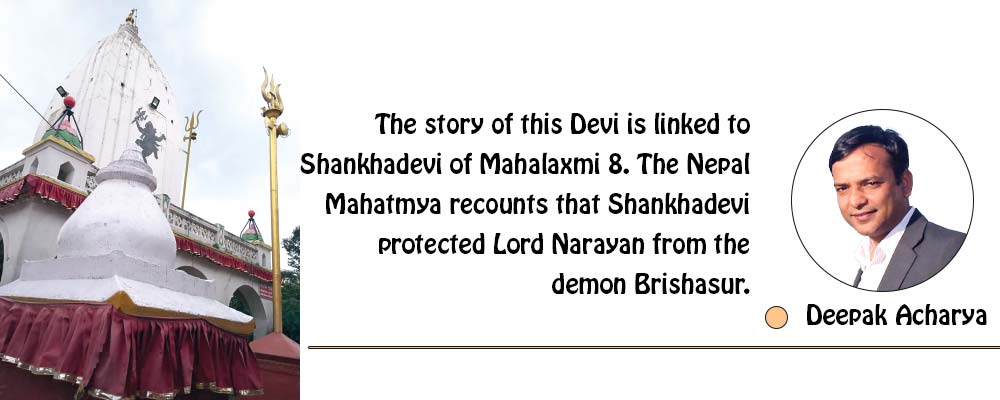
The story of this Devi is linked to Shankhadevi of Mahalaxmi 8. The Nepal Mahatmya recounts that Shankhadevi protected Lord Narayan from the demon Brishasur.
An integrated development plan that holistically links the religious and historical heritage sites of Lubhu and Lamatar could significantly promote the region as a vibrant cultural and spiritual tourism hub.
(The author is the Chief at Community Information Network.)
-original-thumb.jpg)


-original-thumb.jpg)
-original-thumb.jpg)