- Monday, 25 May 2026

Historical Canvas Of Transatlantic World
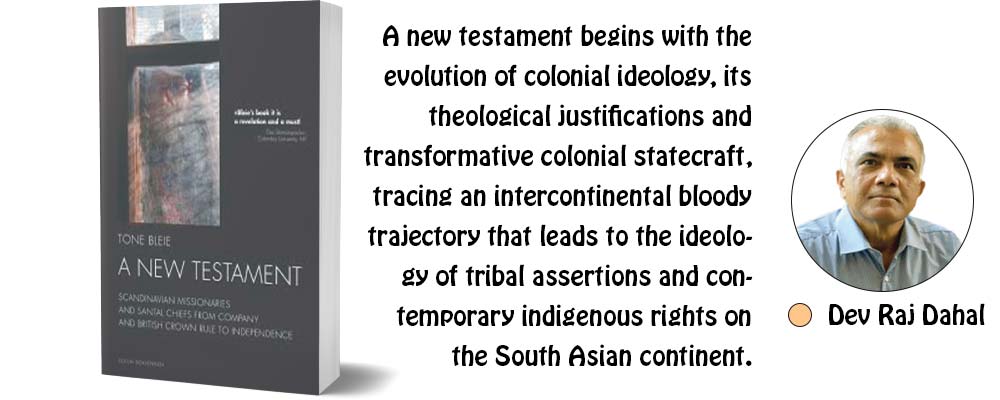
The book A New Testament is authored by the Norwegian scholar and development practitioner Tone Bleie. A versatile professional, originally trained in social anthropology at the University of Bergen, Bleie holds a chair at the University of Tromsø in an interdisciplinary subject: public politics and cultural understanding. Having earlier published on Nepal’s political and cultural ethno-history, rural development and critical issues of peacebuilding, this time she offers readers an intricate, strangely neglected historical canvas of a vast Transatlantic world.
She gleans insights from public and private historical archives of Asia, Europe and America, collections of European scholars, custodians of oral history, and her field observations and interviews with marginal farmers and forest dwellers, tribal chieftains, retired Scandinavian missionaries and civil society leaders from Eastern India, Nepal and Scandinavia. The author situates and enriches the modern-day political debate on ethno-nationalism, multiculturalism and the post-secular emancipatory turn. A new testament begins with the evolution of colonial ideology, its theological justifications and transformative colonial statecraft, tracing an intercontinental bloody trajectory that leads to the ideology of tribal assertions and contemporary indigenous rights on the South Asian continent.
The latter discourse provided the tribal people with the scope to form NGOs to defend forests, lands, culture, self-governance and church-sponsored or rebellion-based nationhood. Fitting into this grand account is the Santhal mass rebellion of 1855-56. Its leaders craved to save their fading forested world, restore their golden kingdom and the coexistence of living, ancestors and deities (p. 136), ideas not unfamiliar with millennialists and post-millennialists’ supernatural dawn. The author frankly admits that the Transatlantic Santhal Mission acted as an agent of religious globalisation, but also of constitutional reforms, technology transfers, and church nationalisation. These transformative forces expanded under uneven conditions of bargaining power (p. 46).
Subaltern voices
A variety of subaltern voices are informed by post-colonial critique and critical studies. Local converts made Lutheran Christianity blossom and forged an alternative road of social mobility to competing values of caste and tribe. A new testament clearly offers a critical reflection of ecological, economic, legal, political and social history of the highly neglected tribal zones of Santhals, Boro and Bengalis of East India, Northern Bangladesh, Eastern Nepal and the Himalayan hills of Tibet, Sikkim and Bhutan. It exposes how the Santhal mission (1867-2001 CE) infused transformational impact on the local society through livelihood projects, agrarian reforms and social skills growth. This exonerated people from feudal tax burden, supported by mission-founded local market places and export of its Assam tea to European markets.
Innovation, aptly termed “the four Ms”: mission, merchants, migration and machines, shaped Santhals' perception of their modernity, an economic, legal and cultural enlightenment. The author likens this to a gigantic transnational generationally woven drapery with a weft of shifting designs and colours on a hidden solid warp – the material base – of landed mission property. The author also debunks the gap between ideals of Christian Puritan ethics and actual moral practice, and comments India’s militant nationalist stance of Hindutva’s ritual purity, self-rule and phobic discourses on “alien religions” allegedly infecting and colonising the Hindu mind, body and soul.
The author discusses evidence from own and others research about religious interchange between Christianity, Hinduisms (Shivaism and Vaishnavism), Buddhism, Islam, and tribal cults in the Gangetic plains and Sal-clad hinterlands, including conversion and resistance to universalising Christianity and effects of Sanskritisation coexisting with Westernised modernisation. The profound effects of unequal power relationships between the Scandinavian, European and American missions and local societies are sharply analysed, supported by social science interdisciplinary insight. The book’s historical timeline is vast, from the Medieval Period, Danish-Norwegian and British Company Rule (16th-18th centuries), the colonial geopolitics of British Raj (from 1858), the Golden Mission Era (1860s-1960s) and ultimately, the early Post-Independence Period, leading to the dawn of national independence, modernity, democracy and rights-based entitlements.
The author thus vaults the narration from silent cries of local subjects aspiring for citizen recognition, their internecine strife, diffusion of socialist ideology, and the birth of a pan-tribal outlook for an autonomous homeland. The formation of an Aadibasis political party based on the Jharkhand movement is part of Bleie’s narrative. The voices, visibility, and roles of gurus, educators, pastors, missionaries, experts, lawyers and social reformers in promoting political, social and gender justice are brought to life. The power of social technologies allowed single women, like men, to occupy positions of native missionaries and evangelists while electoral politics introduced political shifts in values and social structures.
Challenge to elite's prejudices
A new testament narrates a dynamic economic, legal, political and moral history (p. 221). Radical reforms challenged the colonial and local feudal elite’s deep-seated prejudices about the tribal society, paving the ground for forest dwellers to assert dignity and a degree of legal protection at a time when their ancient civilisation had come under enormous pressure. Boys and girls boarding schools, central to the mission’s “civilising” project, receive critical examination. The boarding regime was invasive, tearing apart intimate bonds between caretakers and children. But the regime produced a budding tribal/Santhal elite. Newly educated, resocialised converts, others retained or returned to their old faith became articulate builders of a politics of recognition that widened the civic boundaries of Christianity.
Interestingly, the account, however, unlocks a paradox between indigeneity as a reformist, mainly Anglo-Indian law-based project (gradually rights-based) and shallow national integration, underpinned by a politics of protection/reservation. A challenge left for future studies is to probe even further into the preconditions for mental self-determination vital for self-rule and peaceful co-existence. The story of the “civilising” mission begins with the Santhal people at a dramatic juncture in their history. This Scandinavian mission spread in the early 20th century into other parts of South Asia, diffusing a universalising notion of progress, private property, Christian spirituality, social justice, and formal education taught in Santali, written in Roman (Ol Chiki has challenged Roman’s dominance), thus linking them to the global village.
A new testament transcends the capitalist core-periphery discourse to periphery-periphery ties built from below. The author invites readers on a trans-oceanic and regional odyssey, uncovering local responses to the Great Odisha Famine of 1866-67. The famine and its aftermath offered a ripe moment to claim mission land, sow spiritual seeds, promote new farming techniques and infrastructure growth. The enlightenment-oriented Scandinavian mission opened charitable, educational and health facilities, forging a development trajectory through the support of the colonial state, NGOs, churches and local public, based on the concept of service, not simply rule (p. 399).
A division of labour existed among the three-country-led Santhal mission. The Danish focused on scheduled Bengali castes, the Americans on constructing a hospital for Adivasis, Bengali low-caste Hindus and Muslims, while the Norwegians focused on leprosy treatment, basic health services and education, and upliftment of the small landholders and landless (mainly) Santals and Bodos through social development. Bleie exposes contested ideological undercurrents; Danes and Norwegians disagreed on the continued validity of Oriental paternalistic justifications, and the importance of indigenisation of Church theology, self-rule and self-funding.
The turbulent decades between the two World Wars, with expansive Indian nationalist and Tribal movements, are characterised by internal dissenting colonial and anti-colonial mindsets and institutional tactics. Some church and civil society leaders, many boarding school educated, became catalysts of social change and economic justice (p. 451). A new testament uncovers the volatile dynamism and contradictions of Transatlantic relations in the first half of the 20th century. The Santhal mission maneuvered grand politics and completed a decades-long pastoral enlightenment and national-building programme of prepared grammars and a mammoth Santhali dictionary, translations of religious scriptures, the first-ever publication of the ancestral epics, and finally art and artifacts collection and preservation. Artifacts were exported and donated to newly independent Norway’s new university museum of history.
This 20th-century institutionalisation of a tribal (read indigenous) heritage lent legitimacy to the Santhals as a brethren nation with impressive collections. They attracted scholars and recognition of a rich cultural and environmental past in the Sal-forest belt, also the cradle of early Buddhism and Jainism, neighbouring the Central Gangetic Plains. This heritage preservation story is not dissimilar from the efforts of the much earlier Danish-Norwegian trade enclave missions in Tranquebar, South India and Serampore Bay of Bengal. Pioneer missionaries translated and printed Oriental masterworks. That opened prejudiced European minds (p.78) and stimulated scholarship.
Faith entrepreneurship
Through such notable contributions in heritage preservation and social work, the author exposes how colonial powers’ motive was driven by mercantile trade, territorial expansion from coasts to inlands, resource extraction and pacification of rebellious tribes (p. 14). Her analytical notions of faith entrepreneurship and middleman institution expose that in the grander (dis)order of European imperialism, missions were generally (not always) colonial pawns, but the structure allowed a certain room for agency.
The rise of a secular world order following the end of World War II marked the beginning of secular ideas of international solidarity and human rights, which challenged the hegemony of Christian compassion and universalisation of the gospel. This phase has inaugurated the state-society accommodation under the new state, funded by the aid regime, soft diplomacy, medical, legal and financial guidance. But the author weaves into her drapery other peculiarly comparable designs, late 19th-century Bengali bhadralok who favoured reforms that banned child marriage, self-immolation of women upon husband’s death and allowed widow marriage.
Into this intricate story of gendered modernity and class mobility, the author tells revealing bibliographic histories of female and male white missionaries and Santhal pastors and church women. They were agents (partly self-transformed) of the gendered modernity of Westernised individualisation. They adopted new dress rules, food styles, social manners, romantic love, marriage, divorce and supported the Transatlantic intertwined projects of cultural nationalism, aimed to educate the common Santhal and Scandinavian into citizens (p. 350).
In the concluding chapter, the author weaves together local, sub-regional and trans-national narratives, the birth of civic association, democratic reforms, indigenisation of leadership, the rise of religious fundamentalism and opposing visions of nationalism and globalisation. The narration is informed by a critical neo-colonial lens on the politics of conversions and examines a period of flourishing religious freedom and humanitarian impacts of secular and faith-based (I)NGOs.
The author meticulously combines many disciplines of social sciences to advance her more than a decade-long research, emerging as a monumental book of formidable scholarly range.
The illustrated volume (available in Kindle and other digital formats apart from hardcopy) features useful appendices on Transatlantic and South Asian Temporalities and Intersections and Maps over Eastern India, Eastern Nepal, Bangladesh, South Asia and South East Asia, where she had worked extensively. A new testament in this sense offers a novel intercultural conversation everyone must listen to, as it radiates the social conscience of a true scholar.
(Former Reader at the Department of Political Science, TU, Dahal writes on political and social issues.)




-original-thumb.jpg)