- Saturday, 2 May 2026

Silent Period: A Moment For Reflection

As Nepal is set for the general elections tomorrow (March 5), the world has witnessed yet one more war. The US and Israel jointly attacked Iran on Saturday, killing Iran’s Supreme Leader Ayatollah Ali Khamenei and hundreds of people, including school girls. As the millennium advances, the world seems to be moving towards greater turbulence. Superpowers seem to be driven by the greed of acquiring more resources and power, whereas innocent people are being killed for no reason of their own. People who have been toiling day in and day out to meet the basic needs of their family members seem to bear the brunt of the power struggle between the superpowers. Oil, natural resources, and the gun industry are dominating the power struggle on Earth today.
Meanwhile, a silent phase has been implemented by the Election Commission, which will remain in effect until the votes are cast. This is the time for the Nepali people to reflect on what all the candidates stand for and how they plan to move ahead if they win. During this period, the people make up their minds in choosing the candidates without interference by individuals, political parties, or their candidates. Voter education has not been implemented as adequately as may have been required, and many people may not be aware of the importance of the silent phase.
Stable government
It is important to explore what is happening all over the world, especially in our neighbourhood, and decide how and for whom we should vote so that we can ensure the next government completes the five-year term in office. In order to establish peace and security and move ahead with the development of the country and its people, it is imperative that the next government completes its full term and implements plans and policies that will benefit the people.
Similar elections, like the one Nepal is heading towards because of the toppling of the incumbent government by Gen Z youth, have just been completed in Bangladesh on February 12. The Bangladesh National Party (BNP) won a landslide victory, securing a two-thirds majority of seats in parliament. These elections were held by the Prof. Muhammed Yunus-led caretaker government, which was given the responsibility of holding elections and handing over the government in 2024 when a student-led protest ousted the PM Sheikh Hasina-led government. An estimated 1,400 people were killed during the protests when the Hasina-led government cracked down on the protesters.
Together with the elections, voters also participated in a referendum for constitutional reforms. The Hasina-led Awami League was banned from contesting the elections. Dramatically, the 17-year self-imposed exile in London of Tarique Rahman has now ended with his swearing-in as the Prime Minister of his country. While the system of a dynastic premier role continues, Rahman has become the first male Premier of Bangladesh after 30 years. The Jamaat-e-Islami party has come second in the elections.
Khushi Kabir, a human rights activist from Bangladesh, says that many Bangladeshis were relieved that democracy had been restored in their country. “If there is no democracy, you cannot function. A system of accountability to the people has to be in place. As the government has now been elected, it will be responsible towards the people. When there is no democracy and no elected government, there is no accountability,” Kabir says.
Before the election, the Jamaat-e-Islami party seemed to be heading towards victory as they had started winning in the student elections at the universities there. However, during the elections, the majority of Bangladeshis, no matter which party line they were with, seem to have opted for the democratic value system represented by the BNP, although many may not have been appreciative of its past performance. The party had played a crucial role in the independence movement of Bangladesh, and the people cast their vote for the BNP to register their dissent against Jamaat-e-Islami, which is a party based on a religious value system.
The people have given the much-needed mandate to the BNP so that it can focus on developing the country during their full term, based on which it will be assessed whether or not it will be voted for the next term. Kabir says that the BNP has not been given a clean chit. They will be watched over and the public will keep asking questions from outside. For democracy to prosper in a healthy manner, there needs to be an opposition in parliament to ask questions too, and Jamaat will do so.
Trust in people
In Bangladesh, too, like Nepal, very few women were given tickets to contest in the elections. Eighty-seven women contested and only seven won. The only thing common between Nepal and Bangladesh is the fact that the youth forced the governments to resign. Kabir praised the Nepali caretaker government for being pragmatic from day one. They set a date to conduct elections within six months of coming to power and have not tried to push an agenda. The most important thing is that the caretaker government has not given preference to any political party, nor has it banned any, said Kabir, adding that one thing Nepal can learn from Bangladesh is to trust and believe in the people; they know what they want.
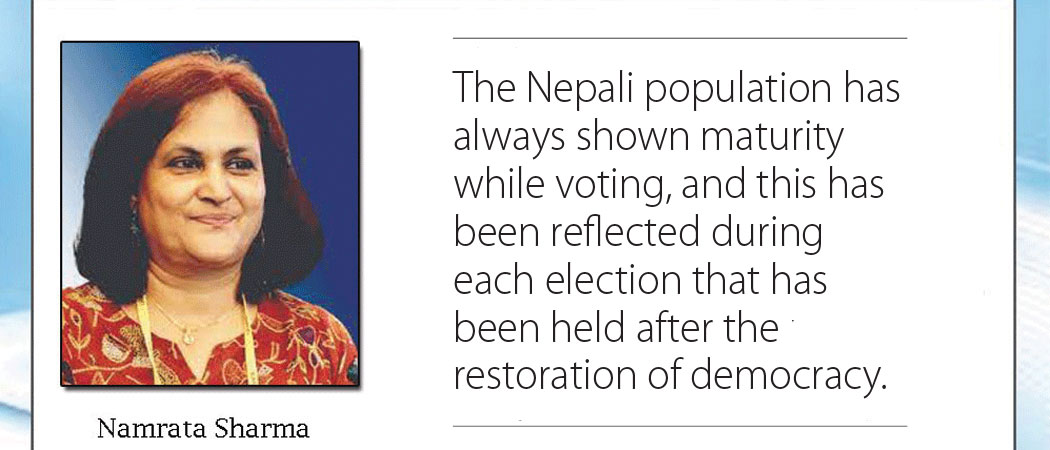
In fact, the Nepali population has always shown maturity while voting, and this has been reflected during each election that has been held after the restoration of democracy. Now is the time for people to reflect and decide how we should ensure that a full five-year term is completed by the next government that comes to power on 5th March 2026.
(Sharma is a senior journalist and women's rights advocate. namrata1964@yahoo.com X handle: @NamrataSharmaP)
-square-thumb.jpg)