- Sunday, 7 June 2026

AI-driven Deepfakes
 Aaisha Dhungana
Aaisha Dhungana
Aaisha Dhungana
What first began as a simple face-swapping experiment has now transformed into the terrifying deepfakes age we live in today. The evolution of deepfakes quietly began around 2017, when hobbyists and researchers showcased celebrity face swaps online. During its early phase, the technology was crude and recognisable.
But with each new step and the rapid advancement in Artificial Intelligence (AI), it has made them alarmingly realistic. Today, with a smartphone, anyone can easily generate fake videos and audio that are difficult to distinguish from reality. So what powers this technology? Well, deepfakes rely on powerful AI architectures that include Generative Adversarial Networks (GAN), which help machines create new, realistic data by learning from existing examples.
Unlike the traditional models that only classify data, they generate entirely new content. It closely resembles real-world data, which makes it difficult to differentiate from reality. GANs consist of 2 main models that work simultaneously: the generator model and the discriminator.
They are pitted against each other. While one generates a fake image, the other detects it, refining realism over multiple iterations. Diffusion models now allow high-quality image and video generation by repeatedly transforming random noise into coherent visuals. Transformer-based models maintain consistency across frames, while voice cloning networks replicate speech with startling accuracy. Real-time deepfakes even transform live video calls, making them instantly manipulative.
The uses are widespread, from social media impersonations to war zones. In wartime, deepfakes have been weaponised. In Ukraine, fabricated videos falsely showing President Zelenskyy urging troops to surrender have circulated, demonstrating their power to spread misinformation. AI- generated videos of celebrities and media personalities spread so quickly and can mislead a million. Deepfakes are even used in content creation and studio scenarios.
These creative uses thrill the audiences, and they take it as an entertainment source, but it also raises questions about consent and authenticity. Criminals are already exploiting deepfakes for financial fraud, mimicking the voices of high-level executives to trick victims into transferring money.
Society is most vulnerable to deepfake content because it exploits emotions rather than facts. Confirmation bias further increases this vulnerability. Individuals tend to believe such content that aligns with their existing narrative. Deepfakes can control elections or damage the reputation of public figures. Older or less tech-savvy individuals are more likely to fall for it. Some other harmful consequences of deepfakes include inciting violence or being weaponised in geopolitical conflicts.
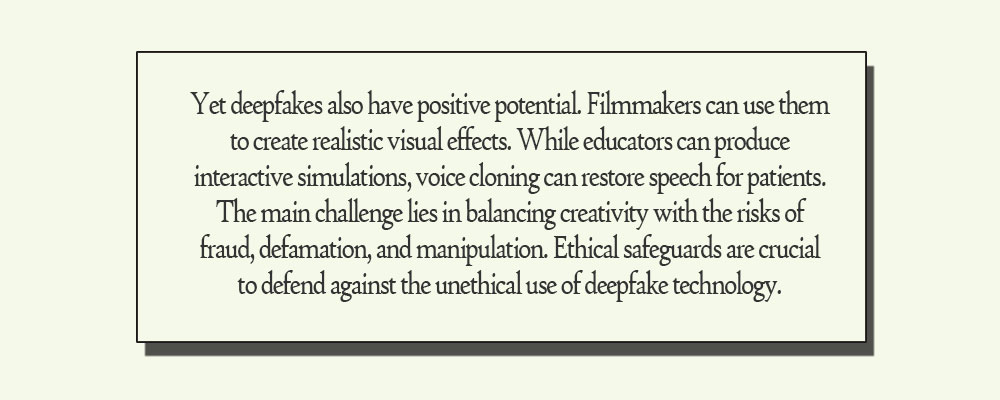
Yet deepfakes also have positive potential. Filmmakers can use them to create realistic visual effects. While educators can produce interactive simulations, voice cloning can restore speech for patients. The main challenge lies in balancing creativity with the risks of fraud, defamation, and manipulation. Ethical safeguards are crucial to defend against the unethical use of deepfake technology.
Deepfake content must be transparent with the use of watermarks or metadata. Detection tools should be widely used. Legal frameworks should penalise malicious use. AI-driven deepfakes are no longer science fiction, but a present reality. The concept of seeing is believing no longer applies. Without responsible action, deepfakes could change reality. The deepfake era relies solely upon us. With vigilance and ethical guardrails, we can truly create a society that can mitigate its worst harms and still enjoy its innovations.


-original-thumb.jpg)