- Saturday, 2 May 2026

Sale of blossomed mango trees underway in Saptari
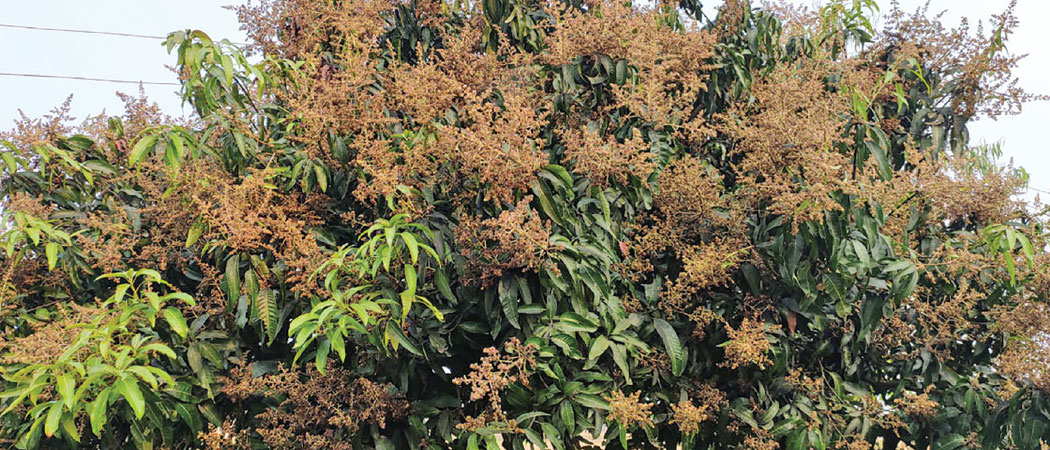

By Dhirendra Prasad Sah,Rajbiraj, Mar. 8: Although mango—the king of fruits—has not yet borne fruit, the buying and selling of mango blossoms has already increased in Saptari.
In Saptari and other districts of the Tarai, traders have started visiting mango orchards to purchase the blossoms.
In Saptari, which is well known for mango production, traders currently visit orchards, inspect the blossoms on the trees, and negotiate prices accordingly.
Instead of buying just one or two trees, many traders purchase entire orchards containing numerous trees.
Farmers said that the deals are usually made through verbal agreements, based on the amount of blossoms on the trees and the estimated potential production.
Mohammad Hanif, a resident of Rajbiraj Municipality–9 in Saptari, said that he purchased the blossoms of 20–25 mango trees in a large mango orchard near his house for about Rs. 90,000.
According to him, the trees currently have abundant blossoms, and if pesticides are applied on time and proper care is taken, a good harvest is likely.
According to traders, the price increases once the fruit begins to form (when the small mango buds appear).
Therefore, buying the orchard at the blossom stage is cheaper.
After purchasing the blossoms, the trader becomes responsible for taking care of the fruit—spraying pesticides and protecting the trees. If the fruit does not develop well, the trader bears the loss.
On the other hand, orchard owners said that they are forced to sell them in advance because they are unable to take proper care of them on time and there is a risk of the mango blooms falling or being damaged by insects and hailstorm.
Bhola Chaudhary, a farmer from Shambhunath Municipality, said that they sell the trees with blossoms because there is a shortage of manpower to maintain a large orchard.
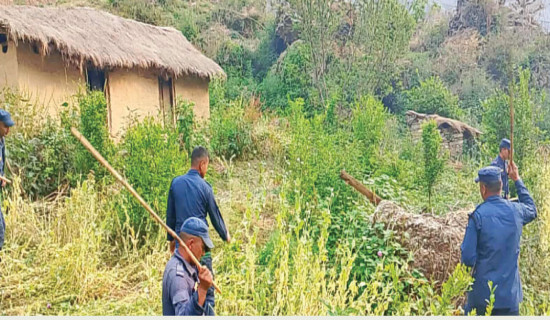
He said that after purchasing the mango trees, the traders build a thatched hut in the orchard and live there. "They take care of the orchard until the fruit ripens. They stay in the orchard day and night to keep the fruit safe and get a good yield. We cannot do that work, so we are selling the orchard," he said.
According to Kisundev Raut, chief of the Agriculture Knowledge Centre in Saptari, about 75 per cent of mango trees in the district are of the Maldaha variety, around 10 per cent are Bombay, Kalkatiya, Dashari, and Mallika varieties, and the remaining 15 per cent consist of other varieties.
He said that mango farming is mainly practiced in the northern region of the district, including Dharampur, Rupnagar, Ghoghanpur, Jagatpur, Kanchanpur, Terahauta, Prasabani, Bakdhuwa, Kushaha, Kalyanpur, Kadarbona, and Kathauna, among other areas.
Mangoes produced in Saptari are supplied to various cities of the country, including Kathmandu, Biratnagar, Hetauda, Birgunj, and Pokhara. Around 40 to 50 per cent of the mangoes consumed in the capital go through Saptari.
Mangoes of Maldaha and Dashahari varieties produced here are exported to Kolkata and Siliguri in India and are also sent to Gulf countries, including Qatar and Saudi Arabia.
Statistics show that about 25 per cent of the mangoes produced in the district are exported abroad, said retired Senior Agricultural Development Officer Anupalal Sah.
This year, farmers are enthusiastic because mango trees have produced abundant blossoms. Compared to last year, a significant increase in production is expected.
According to Raut, if the weather remains favourable and the storms that usually occur in the month of Chaitra do not damage the blossoms and fruits, production could be up to double that of last year
He said that there are mango trees in an area of about 9,000 hectares of land in the district.
-square-thumb.jpg)