- Sunday, 3 May 2026

Temperature rise leaves mountains devoid of snow

By Harikrishna Sharma,Muktinath (Mustang), Jan. 17: A decade ago, snowfall in the pasturelands of Chhoser, Lomanthang Rural Municipality-1 in Upper Mustang, used to force herders to move their livestock sheds closer to settlements.
Angyal Gurung, a local mountain goat herder, recalls that snow would pile up to four feet deep and remain for nearly four months, making it difficult to manage fodder and water in the villages.
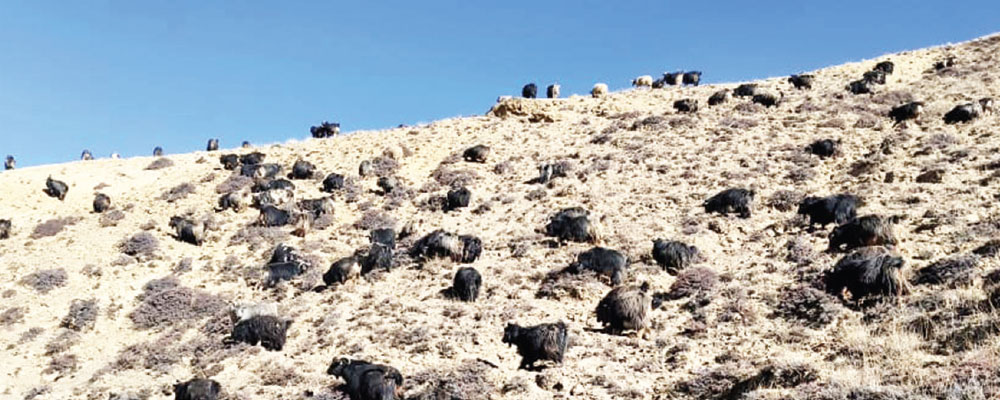
Due to the absence of regular snowfall, Gurung has been grazing his goats for the past five years at an altitude of about 4,700 metres above sea level, even when temperatures fall below zero. Like him, around 10 goat herders still keep their sheds in the high pasturelands rather than moving down to settlements.
In areas around Korala Pass, near the border with China’s Tibet Autonomous Region, mountains that should be covered in white snow are now dotted with herds of goats.
“It is already the second week of February, but there has been no snowfall so far,” Gurung said. “Climate change is gradually shrinking grasslands. Regular snowfall would prevent the scarcity of grass,” he added.
The lack of snowfall is creating serious problems for farmers. In the past, snowfall would begin around November, but this year, even in January, the mountains of Upper Mustang appear dark and bare instead of being clad with snow.
Pema Chhiring Gurung, a young trader from Chhoser who runs a business at Korala Pass, said the absence of snowfall is affecting agriculture, livestock rearing and tourism. The lack of snow has made locals increasingly worried.
According to Karma Namgyal Gurung, ward chairperson of Lomanthang Rural Municipality-2 and coordinator of the economic committee, extreme cold has caused small streams, wells, drinking water taps, irrigation canals and even household water tanks to freeze in Lomanthang and Loghekar Damodarkunda rural municipalities.
He said that even though the minimum temperatures drop below zero degrees Celsius in the mornings and evenings, the absence of snowfall has led to insufficient grass in pasturelands, raising concerns among farmers about agricultural produce and livestock.
The impacts of irregular snowfall are becoming increasingly visible across Mustang. Dr. Lalmani Aryal, chief of the Agriculture and Livestock Development Office, Mustang, said early flowering of apple trees, shortages of grass in pasturelands and increased risks of disease are among the emerging problems.
“Lack of snowfall is a major crisis for agriculture and livestock,” Dr Aryal said. “In the absence of regular snow, alternative plans must be developed.” He stressed the need for programmes to reduce insect infestation in apples, livestock such as sheep, goats and yaks and other agricultural products in the high-altitude pasture areas.
Local governments in Thasang, Gharapjhong, Baragung Muktikshetra, Lo Ghekhar Damodarkunda and Lomanthang rural municipalities have also been demanding compensation for losses caused by climate change.
In the long term, there is a risk that the number of livestock could decline due to shrinking pasturelands. Crop yields are also expected to fall if snowfall continues to be delayed.
Although efforts have been made to raise these climate change issues at federal, provincial and even international levels, the response has yet to be effective.