- Thursday, 4 June 2026

Health System Needs Precision Medicine

The discovery of the DNA double helix structure by Watson and Crick in 1953 laid the foundational concept for how genetic information is stored and replicated. Subsequently, DNA sequencing developed by Frederick Sanger in the late 1970s and further technological advancements in the following decades enabled large-scale sequencing, which led to the identification of genes of key diseases such as Huntington’s disease, Alzheimer's disease, cystic fibrosis, and breast cancer.
The medical field has undergone a paradigm shift to the genomic era. The completion of the Human Genome Project in 2003 has revolutionised genome-directed medicine, improving disease diagnosis, prevention, and targeted therapy. Today, we should adopt genome medicine to transform Sir William Osler’s century-old, patient-focused wisdom into a data-driven reality. His dictum, "It is more important to understand what sort of patient has a disease than what sort of disease a patient has," is no longer philosophical. The 21st century bioinformatics heralds the individual's unique interplay of gene-environment-lifestyle, enabling personalised care, not generic one.
Human diversity
Humans worldwide are approximately 99.9 per cent genetically identical. However, this tiny 0.1 per cent variation can result in massive nucleotide changes accounting for vast human diversity, as the human genome consists of about 3 billion DNA base pairs within 23 pairs of nucleus-packed chromosomes. Due to the huge diversity in traits and disease risks, as well as an individual's unique genetics, epigenetics, lifestyle, and microbiome, there is a need for personalised, proactive medicine for 'multi-omics' data for better disease prognosis.
In the early 1960s, physicians were puzzled over why different patients respond differently to the same treatment, but pioneer pharmacologist Werner Kalow's 1962 work in pharmacogenetics introduced therapeutic approaches for monogenic diseases, laying the groundwork for precision medicine. Precision medicine customises healthcare by integrating an individual's genomic, epigenetic, lifestyle, microbiome, and multi-omics data, facilitated by powerful computational bioinformatics for precise disease management. Despite the global advancement, its application in Nepal remains confined to academic teaching. Nepal must strategically transform bioinformatics from a research tool into a cornerstone of clinical applications for precision medicine.
Nepal's diagnostic landscape is far from sophisticated laboratory systems and relies solely on traditional techniques. A 2021 scientific survey of 23 clinical laboratories revealed the dire reliance on outdated practices and reported that 78 per cent were not equipped with automated systems, and 87 percent relied on a 1960s-era antibiotic susceptibility testing technique. A 2017 study reported clinical laboratories struggle amid systemic issues related to quality, staffing, and affordability, all of which were compounded by gaps in health policy and management.
Biochemical and immunological tests, which are indispensable for laboratory diagnosis, often lack precision, leading to misdiagnosis or delayed treatment. Polymerase Chain Reaction (PCR) has high detection capability but is confined to known pathogens or genetic markers, and struggles to detect antibiotic-resistant infections or genetic disorders. The multidrug-resistant tuberculosis diagnosis, for example, still relies on slow microbial culture-based methods, hindering prompt care.
Nepal's cancer care is said to be obstructed by a lack of trained pathologists, inadequate lab facilities, a dearth of high-tech diagnostics access, and the absence of standardised national guidelines, all of which impede precise diagnosis and treatment. Traditional diagnostics lack personalisation, fail to account for individual disease variations, are slow due to multi-test processes, and have a limited scope that fails to resolve genetic or epigenetic complexity.
Bioinformatics enables precision medicine by computationally analysing genomic/clinical data to identify disease-specific biomarkers, such as BRCA (BRCA1, BRCA2) for hereditary breast and ovarian cancers, EGFR for lung adenocarcinoma, and F5 mutation for thrombophilia. Test accuracy is amplified to detect early with high precision, as well as guides personalised treatment planning by matching therapies with individuals' genetic, epigenetic, and microbiome profiles for more targeted and efficient care.
NGS (Next-Generation Sequencing), a high-throughput tool, could be Nepal's diagnostic landscape game-changer, as it can analyse whole genomes, detect mutations, pathogens, and drug resistance with high accuracy, unlike targeted PCR. In oncology, NGS-based OncotypeDX leads to personalised chemotherapy globally. With rising cancer and hereditary disease cases, Nepal is in urgent need of precision care. NGS is pivotal for the surveillance of emerging infectious diseases caused by diverse pathogens and efficient real-time variant tracking for outbreak investigation.
Precision medicine relies on data-optimised therapy resulting from computational modelling to predict drug-gene interactions. This is key for drug repurposing, where existing drugs may be useful for new indications, i.e., several antimalarial drugs repurposed to treat autoimmune diseases such as Lupus, Rheumatoid arthritis, and Sjögren’s syndrome, saving time and costs while minimising trial-and-error-based prescribing. In resource-limited settings like Nepal, pharmacogenomics enhances treatment efficacy and cost-effectiveness.
Barriers
Despite its promise, integrating precision medicine is stalled by two critical barriers: genomic infrastructure such as high-throughput platforms scarcity and a severe shortage of trained bioinformatician. To convert these barriers into breakthroughs, a strategic national initiative is vital.
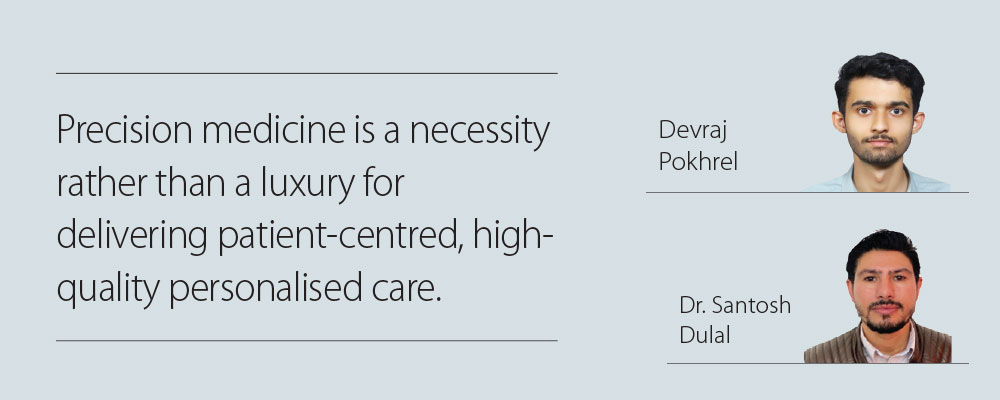
This needs to be built on three pillars: first, strategic investment in specialised bioinformatics centres and national genomic platforms; second, capacity building through partnerships with global biotech companies and reformed academic curricula including clinical bioinformatics; and third, strong governance with public private partnerships (PPPs) based on successful initiatives like Genome India and robust data-security policies from organisations like the Nepal Health Research Council. The medical field in Nepal still relies primarily on conventional systems, which frequently fail to address a wide range of patients' demands. Precision medicine is a necessity rather than a luxury for delivering patient-centred, high-quality personalised care. With this paradigm shift, nations can create a high-tech, equitable and modern precision health system outpacing current antiquated systems.
(Dr. Dulal is a scientist at the Nexus Institute of Research & Innovation (NIRI) and Pokhrel is a biotech researcher at the NIRI.)