- Sunday, 7 June 2026

Stakeholders Seek Policy Remedies For Prosperity
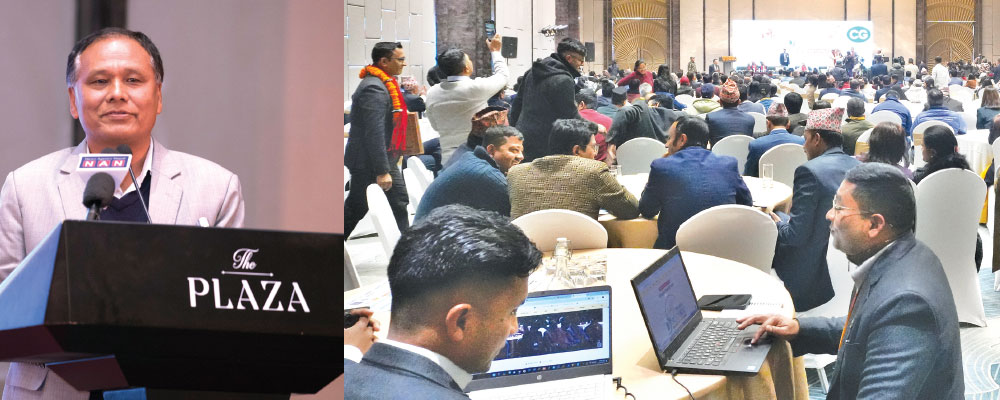

Public and private sector stakeholders of the economy have unanimously voiced that while there is immense potential for business and development in Nepal, immediate remedies are required to address policy instability and remove procedural constraints.
Deliberating at the first-ever 'Gorkhapatra Discourse on Recovery and Resilience, the government, Nepal Rastra Bank (NRB) and the private sector concluded that there is a need to address the structural constraints that are impeding the economic growth, business development and entrepreneurship promotion.
The discourse was organised on the occasion of the 125 years of the publication of Gorkhapatra daily and the completion of six decades of The Rising Nepal in publication. This is the first time that the state-owned Gorkhapatra Corporation has created a platform where the public and private sector openly debated about facilitating business and development amidst the sluggish economic growth and low morale in investors and businesspeople.
According to the speakers, the government should immediately work on reforming laws related to forest and mining, business exit, taxation and profit expatriation of the businesses and industries established with Foreign Direct Investment (FDI).
Operating an enterprise means creating jobs for youth, utilising domestic raw materials and supporting the creation of a value chain of products, as well as contributing to national revenue and economic growth.
Participating businesspeople said that they felt a lack of respect for the private sector from the other sections of society. According to a study conducted by the Federation of Nepalese Chambers of Commerce and Industry (FNCCI) and the International Finance Corporation a couple of years ago, the private sector contributes 81 per cent to the GDP and more than 85 per cent to the overall job creation.
The private sector mobilises Rs. 5,562 billion in credit from the banks and financial institutions (BFIs).
"A politician might leave his profession, but an entrepreneur can't just leave the business since it entails employment, back-forward agents and financial management," said Chandra Prasad Dhakal, President the FNCCI.
He pointed to a harsh reality that, despite having better investment opportunities compared to its South Asian peers and countries elsewhere, Nepal has failed to attract both domestic and foreign investments.
Demand to address policy instability
President of Nepal Chamber of Commerce (NCC) Kamlesh Kumar Agrawal urged the government and the central bank to review the monetary and fiscal policies from the COVID-19 pandemic era and rectify every policy miscalculation that acted as speed-breakers to investment and economic growth.
"Lack of far-sightedness on the part of the policymakers and NRB resulted in multifaceted problems and challenges in the financial sector, business and trade. But while the government has to promote the private sector during the time of crisis, it has curtailed the facilities and incentives for the manufacturers and exporters," he said.
Likewise, Dilli Ram Shrestha, Director of Ncell, said that FDI has largely been a topic of lip service rather than problem-solving. He particularly pointed to the provision of Article 57 of the Income Tax Act 2002, which needs an immediate amendment.
According to Article 57, if an entity’s ownership changes by 50 per cent or more within the previous three years, it is treated as having disposed of its assets and liabilities. Following such a change, the entity is barred from claiming or carrying forward prior interest, losses, adjustments, insurance credits and foreign tax credits. The income year is divided into separate periods before and after the ownership change.
Business people said that tax issues shouldn't reach the court as it directly impacts the business confidence. They maintained that it is untoward that sometimes the tax issues begin after three years of the completion of the audit report.
Promotion of technology is key
While Nikita Acharya of Urban Girl suggested finding strategies to promote startups, Subash Sharma of F1Soft said that promoting digital technology in the public and private sector could speed up the progress.
According to Sharma, entrepreneurs do not wait for policy but initiate their enterprise in the sectors of competitive and comparative advantages. e-Sewa, a venture of F1Soft, was launched in 2009, while the regulatory framework was enacted in 2016. “The government's job is to facilitate and promote the development of digital technology and its adoption. It must promote innovations introduced by the private sector,” he said.
Keshav Kumar Sharma, Secretary at the Ministry of Physical Infrastructure and Transport, said the government’s future focus is on ‘connectivity expansion, smart technology and integrated planning’.
Reviewing Nepal’s 75-year infrastructure journey, he noted that road length has grown from just 360 kilometres in 1951 to nearly 100,000 kilometres today. Calling nationwide road access a major achievement, he said, “Out of 753 local bodies, only 18 lack road connectivity.” He also highlighted that 95 per cent of households now have piped drinking water, while admitting that road quality and safety still need improvement.
Hydropower expert Suman Joshi stressed the urgency of modernising energy infrastructure, warning that reliance on “mechanical technology that is more than 50 years old” has reduced productivity. She criticised fragmented planning and the absence of an Integrated Energy Plan.
Mayor of Lalitpur Metropolis Chiribabu Maharjan pointed to governance challenges, calling the Public Procurement Act 2007 a ‘barrier to development’. “We should have the authority to reward good performers and penalise poor ones,” he said and urged stronger coordination and empowerment of local governments.
Utilising excess liquidity in large energy projects
Executive Director of the NRB Guru Prasad Paudel argued for fiscal stimulus to absorb excess liquidity. “Despite abundant liquidity and lower borrowing costs, the private sector remains reluctant to invest. In such a scenario, increased government spending could catalyse private sector expenditure and revive economic momentum,” he said.
Chief Executive Officer of Nabil Bank, Manoj Gyawali, said the decline in credit demand is the cumulative outcome of past policy and sectoral weaknesses.
Excessive lending to unproductive sectors such as real estate and the share market, inadequate portfolio reviews, implementation of working capital guidelines, and problems in the cooperative sector have collectively weakened business confidence, he said.
However, Gyawali suggested utilising excess banking sector liquidity—available at low cost—for developing a reservoir-based hydropower project.
Participants of the discourse expressed concerns over the accumulating foreign exchange and excessive liquidity. The financial system of the country has above Rs. 1100 billion liquidity and forex equivalent to Rs. 3,851 billion – sufficient to cover the goods and services import for 17.4 months.
Meanwhile, loan defaulters have increased, so the number of blacklisted individuals.
Need of ‘Development Decade’
Ministers who spoke at the national-level discourse accepted that there are problems with taxation, processing investment applications, forest management and resource mobilisation.
Minister for Physical Infrastructure and Transport Kul Man Ghising said that the government is working to address the policy challenges in forest management and mining.
"We need to implement a 'Development Decade' and create ease in policies on forests and the use of natural resources," he said.
Minister for Industry, Commerce and Supplies Anil Kumar Sinha said the government is committed to boosting private sector morale and creating a positive investment environment. He assured that organised crimes during the Gen-Z movement would not be tolerated and that the government would ensure private sector security, clarifying that no agreement permits such acts.
Minister Sinha said that beyond holding elections, the government’s core responsibilities include good governance, peace and security, zero tolerance for corruption, improved service delivery, and an enabling industrial environment.
Likewise, Minister for Labour, Employment and Social Security Rajendra Sing Bhandari stressed that development rhetoric should be changed to have the youth in Nepal and attract investment from the private sector. “We are living with the notion that there are no jobs, so we go for foreign employment, and there is no investment climate, so we refrain from investing in Nepal. We must act proactively to change this rhetoric,” he said.
Reassessing roles of stakeholders
Finance Secretary Dr. Ghanashyam Upadhyay said that innovative and strategic planning is needed to bring the country out of the vicious cycle of under-development and poor economic growth.
He said that the main challenge is converting accumulated cash into productive capital.
“Restoring private sector confidence is essential, as political instability, policy shifts, natural disasters, and disruptions have weakened business confidence,” he said. "The time has come for politicians, bureaucrats, the private sector, and experts to reassess their roles in restoring business confidence and mobilising idle liquidity."
He also underscored the need for the government to improve its spending capacity to stimulate private investment, noting that political interference in budget formulation and delays in project preparation have hindered economic progress.
Economist Dr. Paras Kharel identified declining gross capital formation and low development spending as major contributors to the economic slowdown. He emphasised the need for effective implementation of the Mid-Term Expenditure Framework and called for a thorough review of the private sector credit portfolio.
Director General of the Department of Industry Rajeshwor Gyawali assured that the government is committed to protecting investment. Stating that data indicate a favourable environment for private investment, he agreed that attracting foreign investment requires political stability and strong legal provisions.
The discourse featured three sessions on three of the most pertinent issues of the day – development of smart infrastructure, building private sector confidence, and capital mobilisation and policy facilitation.
General Manager of the Gorkhapatra Corporation Lal Bahadur Airi said that the summary of the debates would be submitted to the relevant government agencies.
The event was inaugurated by Vice-President Ramsahay Prasad Yadav while Finance Minister Rameshore Prasad Khanal and Communication Minister Jagdish Kharel expressed their commitment to policy reform and facilitation to promote the private sector and investment.
(Dhakal is a journalist at this daily.)
-original-thumb.jpg)

-original-thumb.jpg)