- Sunday, 3 May 2026

Maternal health access transforms Mumbra
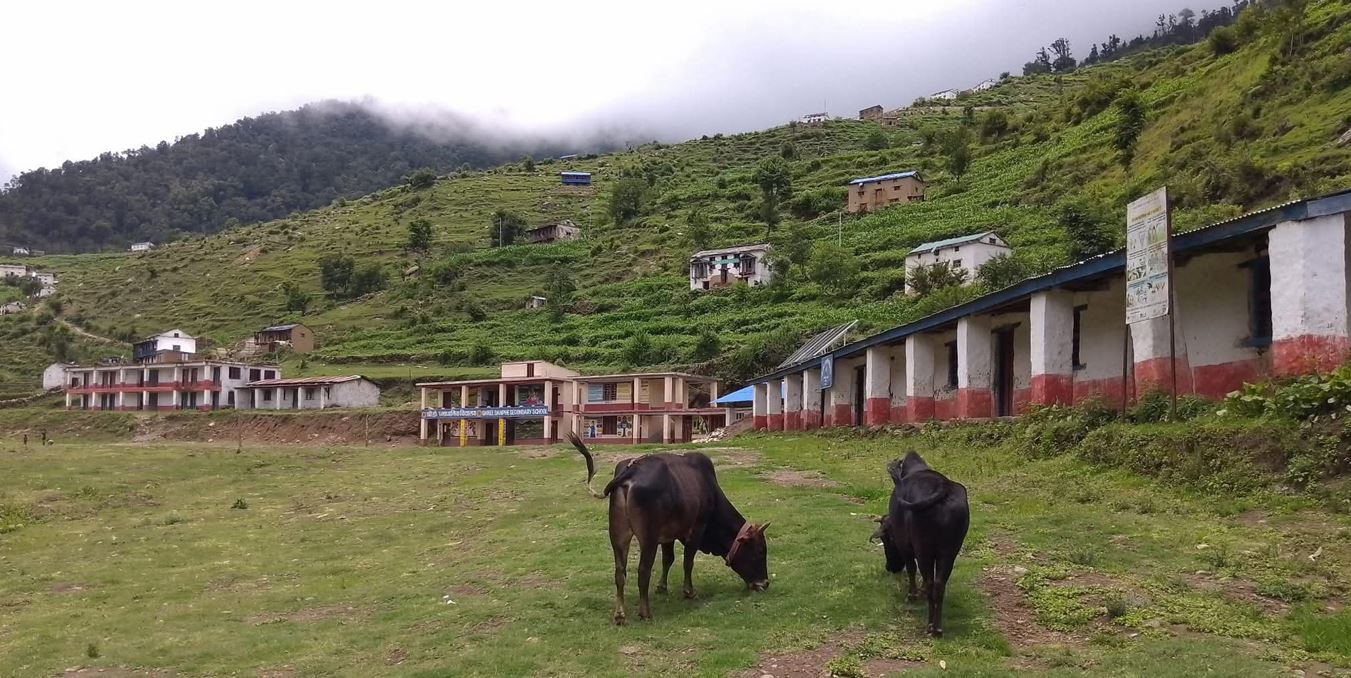
Photo:TRN The transformed school in Mumbra village of Sanni-Triveni Rural Municipality, Kalikot, after fencing off the open area.

By Premraj Simkhada,Kalikot, Dec. 15: Mumbra village of Sanni-Triveni Rural Municipality has witnessed notable progress in infrastructure development and has become a model for accessible maternal health services.
Located within Ward Nos. 8 and 9 of Sanni-Triveni Rural Municipality, Mumbra village has set a commendable example by ensuring accessible maternal health services to all residents.
Women in this village no longer face difficulties in accessing maternal health services. Likewise, there have been no maternal or neonatal deaths in the past five years, and there has been no requirement for airlifts during emergencies in the last two years.
Despite being connected via a challenging, unpaved road from Sannighat, the village continues to prosper. The journey from Sannighat to Mumbra typically takes approximately two to three hours by vehicle. According to Dhirendra KC, the head of Mumbra Health Post, eleven women have given birth in the first four months of this fiscal year alone, including an 18-year-old girl.
Last year, 44 deliveries were conducted at the health post. He emphasised that the number of home deliveries in the village has dropped to zero, and with the availability of essential equipment for the birthing centre, the situation has improved significantly.
The Nepal Red Cross Society’s Kalikot district branch has been actively supporting local health institutions. With financial and technical assistance from the Swiss and British Red Cross, the ‘Integrated Initiative for Community Health’ programme has helped provide essential materials for the birthing centre and constructed toilets.
Bhojraj Ojha, the district coordinator for the programme, informed that the project also supported the construction of ‘green schools’ and ‘one-house-one-tap’ water systems in the municipality.
Durga Bahadur Budha, the principal of Dhampe Secondary School, expressed his happiness after the school’s open courtyard was fenced off with support from the programme.
He explained that before the fencing, livestock would enter the classroom, creating chaos. It was a time-consuming task to keep the children’s belongings safe. “Now, we are at ease,” said Budha.
The programme also provided sanitary pads for female students, which has led to increased attendance of girls at school. However, the school is facing challenges in managing the proper disposal of sanitary pads.
The municipality has also implemented the ‘one-house-one-tap’ water system, benefiting approximately 17,000 locals. Over 200 water sources have been preserved, and the municipality claims that this has significantly improved the water supply system.
According to the chairman of Sanni-Triveni Rural Municipality, Mohan Bahadur KC, more than 2,000 taps have been installed so far.
Projects like the Mudpani Mumbra Bichgaun Khopani and the sanitation programme have been completed with the support of the ‘Integrated Initiative for Community Health’ programme. Preparations are now underway to declare the village as a ‘completely clean’ municipality.