- Monday, 25 May 2026

Mustang voters demand land ownership certificates, not promises
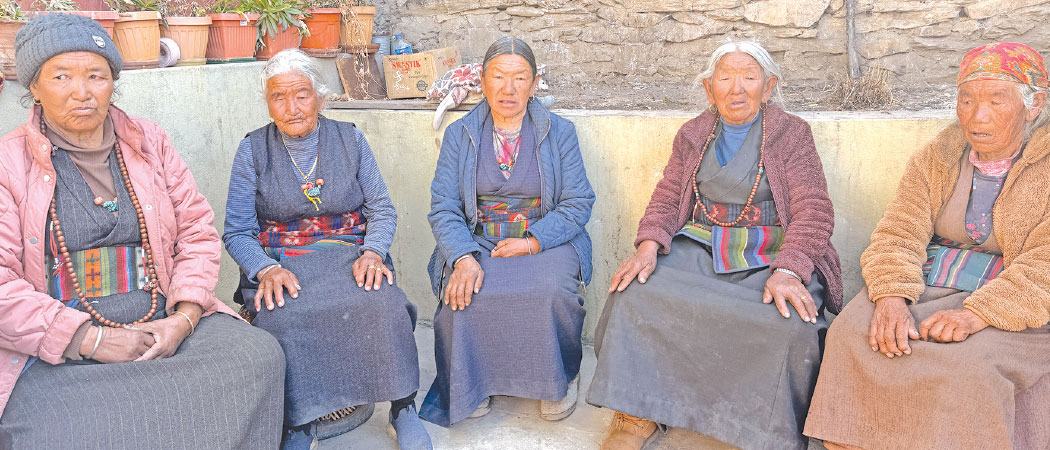
Photo: Harikrishna Sharma Elderly residents of Jharkot, Baragung Muktikshetra Rural Municipality-1, Mustang.

By Harikrishna Sharma,Muktinath, Mar. 3: As election candidates go door to door, Dholka Gurung, 69, repeats a story she has told for decades, the land her family has occupied for generations is not theirs legally.
Although she has lived on and used the land for decades, Gurung has no formal government documents to prove ownership. This time, too, she did not only share her suffering with candidates seeking votes, but also expressed anger that past promises have been forgotten.
Like Gurung, Chhin Angmo Thakuri, 91, of Jharkot, also raises the land issue whenever candidates arrive. Having crossed nine decades of life, she said her wish is to die holding the lalpurja (land ownership certificate) of her land.
Gurung and Thakuri represent a common problem in Mustang. “Leaders are only worried about votes; our problems remain unresolved,” Gurung said.
As candidates go door to door ahead of the House of Representatives election scheduled for March 5, voters are demanding solutions to land measurement issues rather than just promises of development.
Although the Ranipauwa market at the entrance to the famous pilgrimage site Muktinath Temple has expanded, many houses inside the market stand on land without legal ownership documents, despite generations of use.
Across all five local levels in Mustang, physical infrastructure, apple orchards and other farmland are located on public land. Even where towns and markets have grown on ancestral land, people have lived in fear and hardship because proper land surveys were missed in the past.
Local people have traditionally marked boundaries and used land at the community level, but the lack of legal recognition has left their problems unresolved.
Chairperson of Baragung Muktikshetra Rural Municipality, Rinzing Namgyal Gurung, said this is a shared pain for all residents of Mustang. “I am also affected by this problem. Despite many efforts, it has not been resolved. We need a re-survey that grants ownership rights to those who have long used the land,” he said.
He warned that Mustang residents are anxious about possible future action by the state, as apple farms and structures on public land are divided and used within families without any legal basis.
According to him, careless work by survey officials in the past continues to cause suffering today.
Chief of the Survey Office in Mustang, Rabiraj Bhandari, said less than two per cent of Mustang’s total area of 355.73 square kilometres has been surveyed. “This is an old issue. Errors and omissions during surveys require policy-level solutions,” he said, adding that problems persist since surveys were missed in 1975.
While some individuals resolved their cases through later registration, many rural residents were left out due to a lack of information.
Experts said that Mustang’s situation differs from other districts, as public land encroachment is also increasing. Government agencies are compelled to provide subsidies even for agriculture and fruit production carried out on public land. The District Administration Office in Mustang has shown concern about protecting public land.
Meanwhile, candidates for the House of Representatives from Mustang have pledged to prioritise solving the land issue. Yogesh Gauchan Thakali (Nepali Congress), Indradhara Dadhu Bista (CPN-UML) and Ngutuk Gurung have all committed to addressing land measurement problems.
Thakali, a former lawmaker, said, “Despite many efforts, the problem remained unresolved. This is my unfinished task and I will see it through.”
Bista said a law should ensure ownership rights for those who have long used the land, while Gurung pledged to bring a re-survey team directly to voters’ doorsteps.
According to data collected by the Land Problem Resolution Commission in Mustang, 1,468 households out of 1,653 people across Thasang, Gharapjhong, Baragung Muktikshetra, Lo-Ghekar Damodarkunda and Lomanthang were found to be living in an unplanned and irregular land tenure situation.