- Monday, 8 June 2026

Rising Road Accidents
A Political Blindspot That Kills Voters

Nearly five years ago, an emerging actress, Mahima Silwal, along with her sister, Sharmila, was killed in a head-on collision with a truck in Gajuri, Dhading. It has been a year since the death of Hikmat Singh Mahara, a comedian from the Sudurpaschim province, who was killed in a road crash on the Bhimdatta Highway near Godawari. Some eight months ago, a local politician, Ramkrishna Pathak (Ward member, Tilottama-2), was killed in a motorcycle crash in Butwal. Earlier this year, in August, a Chitwan-based doctor, Biplav Bhatta, was killed while driving his car and was involved in a crash in Bharatapur-10.
This series of road crashes continues across the country on all types of roads, killing thousands of people before they reach their destinations. Fatal outcomes of road crashes are 'the tip of the iceberg,' as for every single death, there are at least 50 people who survive with injuries, ranging from minor to life-changing ones. Police records also confirm the increase in the number of casualties each year. Most recently, on November 29, 2025, a journalist, Birendra Acharya, station manager of Tila Awaj Kalikot, was killed in a head-on collision that occurred in Surkhet. Acharya was a pillion rider; it is unknown whether he was wearing a helmet.
Huge death toll
According to the World Health Organisation, road traffic injuries claim about 8,500 lives in Nepal each year. The Ministry of Health and Population records about 100,000 road traffic injury treatments in hospitals. Although it's not a blame game, the main reason for this ongoing carnage is the poor road transport management on the part of the state agencies. There is no agency that has the authority to look after and regulate road safety in Nepal.
Slightly over three months remain until the general elections in Nepal, slated for early March 2026. Political dynamics have changed as a result of the September Gen Z protests and continued calls for paradigm shifts. These shifts were mandated by the youths who took control of the streets. A large number of new political parties are being formed and registered. Simultaneously, existing parties are merging and planning to reform their structures, or at least they have started a debate towards this.
Meanwhile, the government has been applying innovative approaches to register eligible voters for the upcoming election. According to the latest figures, 837,094 new voters are registered, making a total of 18,168,000 eligible voters. Sadly, at least 3,000 aspirant voters will miss casting their votes, as they are projected to be either killed or severely injured while traveling on Nepal's dangerous roads.
Ironically, Nepal has not acceded to any of the UN Road Safety Conventions https://unece.org/transport/publications/united-nations-road-safety-conventions, despite being a member of the United Nations. Accession to these conventions would demonstrate that Nepal upholds international laws, supports the creation of national policies guided by global standards, and improves accountability. This would also show that the country is fostering cooperation to address a pressing global problem that directly contributes to achieving at least two SDG targets.
The latest Regional Road Safety Status Report 2024, published by the WHO South-East Asia Regional Office (New Delhi) https://www.who.int/publications/i/item/9789290211730, repeatedly makes similar recommendations made in 2004, given the worst road safety scenario among the SEARO member states. In the advent of the campaigns for the November 2022 federal and provincial elections, major political parties included issues related to road safety and safer mobility in their manifestos, following several requests from road safety advocates, including the authors of this article. This was the first time in Nepal’s history that clear electoral promises were made regarding the improvement of both public transport and road safety.
The four major parties of the previous parliament — Nepali Congress, CPN -UML, CPN -Maoist Centre and Rastriya Swatantra Party (RSP)—included a number of promises in their manifestos that account for measures to enhance road safety, manage urban public transportation, build better roads, develop alternative transportation infrastructure, strengthen fines and compensation, and improve the health and capacity of transportation workers – especially drivers.
In their manifestos, the parties committed to integrating pedestrian safety into the design of future road infrastructure, thereby ensuring the safety of all road users. Furthermore, they pledged to strengthen the driver licensing system, conduct regular mechanical inspections of automobiles, and establish a special court to handle cases involving accident victims. Had these measures been implemented seriously, several thousand lives could have been spared from death or permanent disability.
Low priority
In contrast, over the past 3 years of the parliament in Nepal, only a few motions of urgent public importance regarding road safety improvement were registered by the lawmakers -- including one in Lumbini Province Assembly. These motions were led by enthusiastic Members of Parliament (MPs) from three major parties: UML, RSP, and Nepali Congress. Sadly, the leaders did not deem the issue urgent enough to take urgent action. Consequently, as per WHO data, over 20,000 eligible voters have been killed in those three years. The promises scripted in their manifestos for making the country's roads and transportation safe proved to be untrue.
Nepali politicians and parties, already infamous for making false promises to voters, proved this once again by forgetting what they had promised. Hopes are resting on the sitting Prime Minister, Sushila Karki, who was among the judges who, nine years ago, issued a mandamus order to the government to ensure the safety of road transport users. A lot has already been researched and discussed about the country's poor road safety management and conveyed to most stakeholders -- sans concrete actions. This failure leads to unacceptable bloodshed on our roads. Furthermore, unregulated motorized transportation is a factor that aggravates accelerated air and noise pollution, which, coupled with corruption, ultimately pushes citizens into poverty.
Revisiting promises
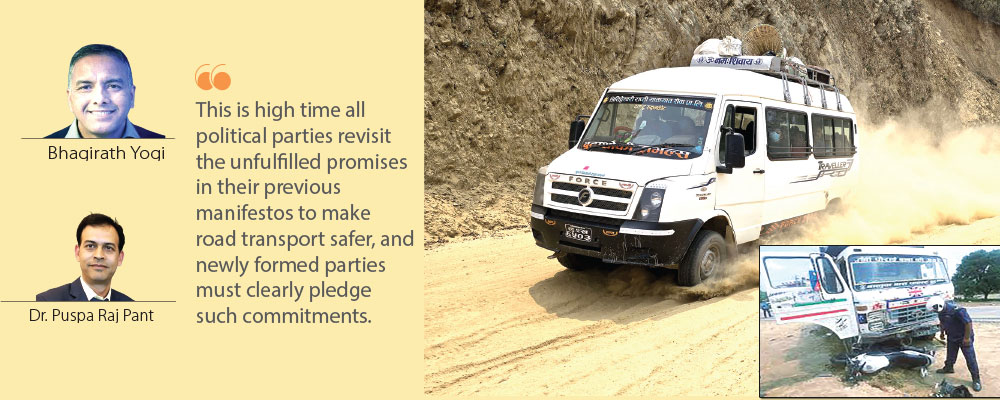
This is high time all political parties revisit the unfulfilled promises in their previous manifestos to make road transport safer, and newly formed parties must clearly pledge such commitments. This is not a new appeal. Almost a quarter of a century ago, the first World Report on Road Traffic Injury Prevention (2004) was published collectively by the World Bank and the World Health Organiation, and clearly mentioned six priority recommendations to governments: identify a lead agency in government to guide the national road traffic safety effort; assess the problem, policies and institutional settings related to road traffic injury and capacity for prevention and prepare a national road safety strategy and plan of action.
The report has also suggested allocating financial and human resources to address the problems; implementing specific actions to prevent road traffic crashes, minimise injuries and their consequences and evaluate their effectiveness; and support the development of national capacity and international cooperation. Sadly, none have been achieved by Nepal. Should these pledges be ignored again, politicians will be knowingly driving their voters into a dangerous blind spot, where thousands are likely to be killed or injured before the polling day next year.
(Dr. Pant is an injury prevention and road safety researcher affiliated with the University of the West of England (UWE), Bristol and NIRI Nepal. Yogi, a former BBC Nepali correspondent, is the chief editor of www.southasiatime.com.)
-square-thumb.jpg)