- Sunday, 3 May 2026

Understanding China Through Great Wall Lens

The Ming Dynasty's full face is clearly visible on the wide streets of Beijing. After hanging his camera around his girlfriend’s neck, Chao took my picture with my mobile phone. The dense traffic of millennials, born under the one-child policy, makes the 600-year-old markets near Tiananmen Square crowded. Whether on a plane in the sky, on a train racing across the ground at 300 km/h, or in an airport waiting room, China looks modern and open.
Our relationship with China dates back hundreds of years. The exchange of love and greetings between kings and emperors at that time made diplomatic relations closer and historic. The trade with Tibet, the marital relation through Bhrikuti, and the transfer of art and technology by Araniko provided ample grounds for us as a technology-transferring country at that time. Araniko, who stands in the Miaoying Temple in Beijing, traveled to China during the Yuan Dynasty. At that time, Nepal was a country capable of transferring technology to a giant country like China.
Protecting nationhood
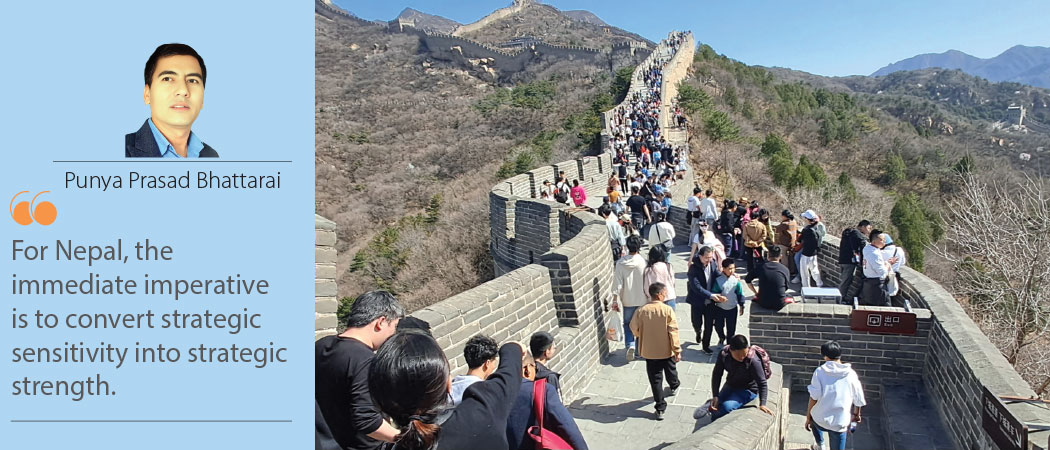
Climbing the Great Wall near Beijing, I entered into international relations theories, and the theory of realism was implemented very deeply back then. Ancestors of man dared to build giant walls, no matter how large, to protect their nationhood. These high walls must have been constructed to prevent the passage of nomadic people from other regions during the nomadic era, extending from Mongolia to Europe.
The modern foundations for building 'state nations' from 'nation states' were evident in the patriotic sentiment shared by the tour guide during the journey. The tour guide’s sense of national pride showed how a country creates its modern identity by focusing on the whole state, rather than just the specific culture or ethnicity of its people. The claim that the key to current global economic power is entirely in its hands may hold if China's per capita income increases and the volume of income inequality decreases.
According to the tour guide, the sound of small children crying is rarely heard these days. The declining number of small children is one challenge for China. Even after the one-child policy was abolished, young people do not seem to get married and raise children. The dream of making life as colorful and enjoyable as possible is visible everywhere. Modern freedom is spreading, and the market is leading society.
Confidence was audible in the voice of the guide. A Chinese miracle in the form of a long bridge over the sea brought brightness to her face. But, she was sharing something important: "The new generation may not have the courage to preserve history." The forty-five-year-old guide remembered her childhood, which was somewhat sentimental. She was able to eat meat only once a week. That statement reminded me of my own vegetarian childhood; it was easy to connect with her pain or childhood aspirations.
She said, "I had to wait a long time to wear the new clothes I wanted." But today, the market has reached inside the home and even to the kitchen; desired food can be consumed in an instant. Some research articles online state that commerce is one of the prominent technologies that has rapidly eradicated poverty in China. The picture of the production chain shows how rural products are delivered to urban kitchens. The success story Jack Ma promised—connecting everyone—is perfectly illustrated by a simple orange going from a remote farm all the way to a luxury hotel in Shanghai.

The Chinese people place a high priority on food, ensuring meals are eaten on time and that the quality of the cuisine is high. A Chinese tunnel engineer asked me, "What is your reason for not eating crab?" I replied, "Because for me, the first tunnel engineer is the crab. My childhood was spent trying to find the tunnels it made in my paddy fields." The joke made him laugh uncontrollably. The Chinese build complex, dense transport networks (like tunnels and subways) beneath the city, which reminds me of the simple holes the crabs made in my childhood rice fields.
Power deriving from imaginary objects
Along the way, we can see evidence of cultures that grew up along the riverbanks. The Chinese show their deep respect for the Yellow, Yangtze, and Pearl Rivers by calling them their mother. They frequently remember the mythical dragon. This must be the proof that power can be derived even from an imaginary object or thought. Of course, river worshiping is not unique to our Nepali culture. King Mahendra's photo displayed on the 70-year-old bridge over the Yellow River (on the Henan-Shanxi border) confirms he was interested in global development and learning. However, the regret is that Nepal's past governments failed to achieve truly durable, sustainable infrastructure in high mountains and hills like in China.
About six years ago, my history professor Prosello had asked in class, "Why do Chinese people speak loudly?" I gave one answer: "To communicate from one hillside to another in mountain villages." This time, I asked the same question to the guide, and she gave the same answer. I, too, was born in the mountains, and I knew that reality. A person's lifestyle is derived from how their life has been lived.
It is said that the land area of Shanghai is about 6,000 square kilometers. About 26.5 million people live here. That is close to the population of Nepal. There are wide open areas as park in the city. Skyscrapers have swallowed many people. People here live paying a very high price per square meter for apartments. There are global market stores like Starbucks, McDonald's, and KFC within short distances. Seeing stores of world-renowned brands everywhere, one realizes that China has truly lifted the people from the poverty line, as if by a crane, all at once.
The right to choose
China now only needs to focus on uplifting the low-income groups. Looking at the lifestyle of the market-centric people in these large cities, they seem to have reached the income level of developed economies. The customers at stores like Adidas and Nike show that their preference (choice) has also become different and higher. Indian scholar Amartya Sen has said, 'the right to choose and access to it is a symbol of development and complete freedom.'
The connectivity (transportation network) appears to be extremely well pre-planned, much like the tunnels our crabs made to store away rice. In a rural area, an elevated road was being built for the metro. Very rural and old houses are visible on the ground there. According to our guide, after the metro highway is completed, layers upon layers of roads will be built there.
Not just roads, but a network or web of roads, and then tall buildings with parks alongside, residential homes and commercial complexes are common sights. Seeing the supported trees along the roads, it feels as if these trees were transplanted in their mature /adult state. Now, similar trees will be planted in the park being built, and within a year, that remote settlement will have a dense, forested park and open fields.
Cherishing historical sounds
A gramophone was playing in a corner of a restaurant in Zhengzhou, the capital of Henan Province. It was a modern, digital gramophone in an old form. Chinese music culture often cherishes historical sounds—like the gramophone's nostalgic melodies—even as it adopts modern digital formats, reflecting a deep respect for both tradition and innovation.
My journey, which began from the Great Wall of Beijing, was flowing at the height of Shanghai's Oriental Pearl Tower. This tower, situated amongst the skyscrapers that face the sky, is an old TV tower. Moreover, a TV tower would naturally be taller than the tall buildings. Looking down from the top of the tower, I thought, what does it signify when all these skyscrapers are competing to reach the sky? Is it a sign that the city or country intends to compete in the global economy?
As people without wings, seeing those houses reach for the heavens gives us a unique feeling. We have the desire to fly in our hearts, but our bodies keep us on the ground. Standing on the thick glass floor at the top of Guangzhou's Canton Tower gave me the same feeling.
From that height, the people below looked just like tiny ants. Cars looked like matchboxes, and trees looked like shrubs.
When someone achieves great height, it's just natural for them to see the people beneath them as small. People and nations are still acting based on self-interest and power (the core of the realism theory). Different nations continue to compete aggressively against one another. Conflicts are ongoing. We, however, are still walking the fundamental path of 'Sarve Bhavantu Sukhinah' (May all be happy).
As I flew home, I tried to take one last look at the Great Wall. I realised that this huge stone barrier is not just history; it is a permanent reminder of basic human nature. The Wall stands strong, constantly teaching us lessons about humans and nations that will be relevant for millions of generations to come.
(An MBA from International University of Japan, the author is Director of the Centre for Education and Human Resource Development based in Kathmandu.)