- Saturday, 30 May 2026

Pay Heed To History Or Perish

History never really says goodbye.
History says, 'See you later!'
-Eduardo Galeano
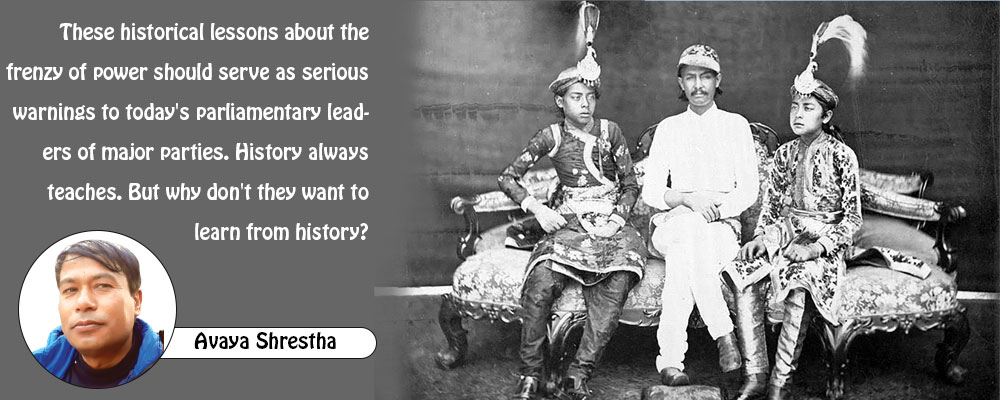
The frenzy of power is often reckless. The arrogance of Jung Bahadur Rana's daughters and the downfall of his sons exemplify this vividly. Baal Narsingh Kunwar carved out a significant place for himself in the royal court by killing Sher Bahadur Shah, the man who had assassinated King Rana Bahadur Shah, grandson of King Prithvi Narayan Shah. Kunwar was the father of seven sons. The most ambitious of them, Jung Bahadur, shot and killed his own maternal uncle, Prime Minister Mathabar Singh Thapa, to become the confidant of Queen Rajyalakshmi.
To destabilise the balance of power between King Rajendra Bikram Shah and his junior queen Rajyalakshmi, Jung Bahadur used a goon named Lal Jha to assassinate Kaji Gagan Singh Khawas. Then, using his brothers and military force, General Jung Bahadur massacred his 31 foes gathered at the Kot (the notorious Kot Massacre) under the pretext of finding Gagan Singh's murderer. By enticing Queen Rajyalakshmi with the promise of enthroning her son Ranendra instead of the crown prince Surendra Bikram Shah, Jung Bahadur became prime minister in 1846 (1903 BS). Later, he placed both King Rajendra and Queen Rajyalakshmi under house arrest and installed Surendra as king. He was rewarded with the states of Kaski and Lamjung and was declared the all-powerful Shree 3 Maharaj.
Jung Bahadur strengthened his blood ties with the royal family by getting his eldest son Jagat Jung married to Surendra's eldest daughter. He arranged for his daughters Tara and Lalita Kumari, to marry Surendra's eldest son, Crown Prince Trailokya, and another daughter to marry Surendra's younger son, Narendra. The pattern continued: his brother Dhir Shumsher's eldest son Bir Shumsher married Surendra's niece Munindra Rajyalakshmi, and Jung Bahadur married his other daughters Kanchi Maiya and Chirbire Maiya to Surendra's nephew Dhirendra. As a result, the sons born from these unions were fated from birth to become generals and colonels.
A Krishna of Kali Yuga
According to Pramod Shumsher Rana's book Rana Shasan Ko Brittanta (The Chronicle of the Rana Regime), Jung Bahadur was the Krishna of the Kali Yug, a man who had a large number of wives. Even after becoming prime minister, he would bring women of all kinds —nannies, widows, married or unmarried — into his household as wives. He had over forty officially recognised wives, and many more unofficial ones.
When he was young, Jung Bahadur had wanted to marry Siddhigajendra Laxmi, the daughter of Prasad Singh, but her father refused due to Jung Bahadur's poverty. Years later, after becoming the prime minister, he remembered her. One early morning, before dawn, he rode an elephant to her house, smashed the glass window from the courtyard, dragged Siddhi out of bed, who was sleeping beside her husband, and brought her to his home. He decorated her with vermilion and sacred pote, declaring her his wife. Their son Ranbir Jung rose to the rank of Jangi Lath (a high-ranking officer), while their daughter Chirbire Maiya army married Dhirendra Bikram, son of Upendra Bikram.
Later, Jung Bahadur desired to marry into the royal household, but no suitable princesses remained. He then turned his attention to the Chautariyas, another powerful noble family. He asked for the hand of Hiranyagarbha Kumari, the unmarried sister of Chautariya Fateh Jung Shah, who had been killed in the Kot massacre. At King Surendra's request, Hiranya's mother agreed to give her daughter to the man who had killed her own son and grandson. Not stopping there, Jung Bahadur went on to marry Hiranyagarbha Kumari's three nieces one by one.
After Jung Bahadur's death, his sons and grandsons were not only removed from succession but also brutally murdered. His eldest son and King Surendra's son-in-law, Jagat Jung, and his grandson, Yuddha Pratap Jung, were cruelly murdered. Their severed heads were presented to Bir Shumsher on a tray. Other sons and grandsons, as well as Jung Bahadur's daughter Tara Kumari, who had married Crown Prince Trailokya, had to flee and hide in British India to save their lives.
Power over blood
Jung Bahadur's brothers had risked their lives to help him rise to power. For this reason, he did not establish the office of prime minister as a hereditary position passing from father to eldest son, as kingship did. Instead, he decreed that power would pass first to his brothers, then to his sons and grandsons. When he placed his grandson Yuddha Pratap Jung ahead of his brothers' sons in the line of succession, the ambitious Dhir Shumsher began plotting to sideline Jung Bahadur's sons and grandsons and place his own sons in power. He often incited his 17 sons by saying, “Jasko tarbar, usko durbar” (Whoever holds a sword owns the palace).
After Jung Bahadur died in 1877 (1933 BS), Ranodip Singh Kunwar became the prime minister, but the de facto ruler was the hot-tempered commander-in-chief Dhir Shumsher. This marked the beginning of a silent enmity between the Jung and Shumsher factions. The Shumsher family was poor but bold and aggressive, while Jung Bahadur's sons, raised in luxury, preferred fun over intrigue. Dhir Shumsher accused Jagat Jung of conspiring against the Rana regime, stripped him of succession rights, and exiled him. His brother Jit Jung was placed in his stead. After Dhir died of a pheasant bone lodged in his throat, Ranodip pardoned Jagat and recalled him to Nepal.
When Jit Jung traveled to India for ear treatment, a rumour spread that Maharaj Ranodip planned to appoint Jagat as commander-in-chief and his successor. Alarmed by the potential threat, the Shumsher brothers became alert. General Bir Shumsher, who had to go to India with four battalions for a military parade and exercises, along with weapons and treasury funds from the Maharaj, used the opportunity to stage a coup. That very night, Bir and his brothers Dambar, Khadga, Rana, Chandra, and Bhim assassinated Ranodip Singh and seized power.
It is worth remembering that Bir Shumsher conspired to assassinate Ranodip with the help of Jung Bahadur's own daughters, Rajmata Lalita Kumari, Kanchi Maiya, and Chirbire Maiya. Lalita Kumari spread the false claim that 'the Gore General' (her own brother, Ranbir Jung) had killed Ranoddip, and then rode in a carriage with Bir Shumsher and her son Prithvi Bikram to Kanchi Maiya's Bagh Durbar to plan the next move. Meanwhile, Kanchi Maiya herself arrived at Bagh Durbar with Khadga Shumsher, her uncle Ranodip's murderer, to discuss plans.
A tragic night
That same night, a squad led by Colonel Lalit Man Basnyat, the Shumsher brothers' maternal uncle, brutally shot Jagat Jung and his son Yuddha Pratap Jung, beheaded them, and presented their severed heads to Bir Shumsher. Ranoddip's wife, Haripriya, Rajmata Lalita Kumari's co-wife and her own sister Tara, and Jung Bahadur's brothers sought refuge in the British Residency to save their lives.
For secretly informing the Shumsher brothers about their own uncle, brother, and nephew's movements, Jung Bahadur's daughters Kanchi Maiya and Chirbire Maiya were rewarded by Bir Shumsher. Thus, the hereditary regime built by Jung Bahadur's sword passed not to his sons but into the hands of the Shumsher clan. Later, Khadga Shumsher was exiled to Palpa on charges of plotting a coup, and Kanchi Maiya was banished for aiding him. Chirbire Maiya, too, was expelled from Kathmandu, accused of entering Bir Shumsher's Lal Durbar with a revolver hidden in her bag.
The misdeeds of Jung Bahadur's daughters, Lalita Kumari and Chirbire Maiya, are almost unbelievable; they sided with the murderers of their own uncle, brother, and nephew. Yet they reveal how low evil beings can stoop under the obsession of power. And their fates make it equally clear that such frenzy inevitably leads to utter ruin. These historical lessons about the frenzy of power should serve as serious warnings to today's parliamentary leaders of major parties. History always teaches. But why don't they want to learn from history?
(Shrestha is a litterateur.)



-square-thumb.jpg)
-square-thumb.jpg)


-original-thumb.jpg)