- Thursday, 7 May 2026

Economic indicators positive: DPM Paudel
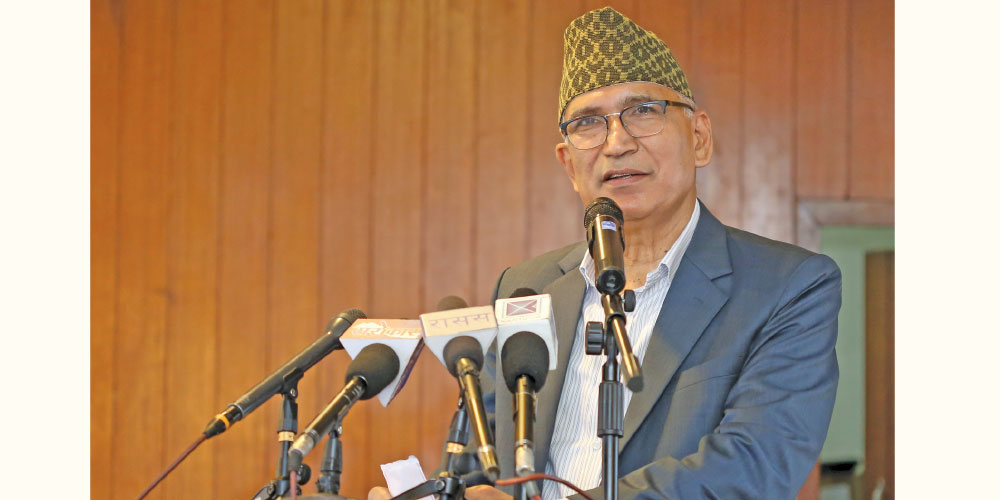

By A Staff Reporter,Kathmandu, Sept. 2: Deputy Prime Minister and Finance Minister Bishnu Prasad Paudel has said that the government is ready to make necessary and positive intervention to bring the economy out of contraction.
“The economy has gone on the path of improvement through the policy and operational intervention of the government. The government is ready if the intervention is not enough to make the economy vibrant. I want to request everyone to give suggestions to make the economy more viable,” he said while addressing the 26th annual general meeting of Society of Economic Journalists, Nepal (SEJON) on Sunday.
He said that the government was committed to accelerate the economy by adopting any policies as the present government was formed to provide policy and political stability in the country.
He said that although there has been significant improvement in the external sector of the economy, the internal sector, which was sluggish for the past few years, has not improved comparatively. He, however, said that the economic indicators were becoming positive.
"The monetary policy is relatively flexible. The interest rate is low. There is sufficient liquidity in the banking sector. However, there is no demand in the market and investment has not increased. Therefore, if necessary, the government is ready to bring the economy out of the recession with a positive intervention."
DPM Paudel said that the private sector should grow out of complaints. He said that there was no need to complain as the present government was ready to listen and solve the problems of the private sector.
“The present government is not only ready to listen; it is ready to solve it. Our recent practice has also proved that the government is ready to listen to the problems of the private sector and solve them. Therefore, we should not complain, but find a solution,” he said.
The private sector should be encouraged to come out of the level of complaints and contribute in the fields of investment, production and employment, he said.
"As far as the law under consideration in Parliament is concerned, representatives of the private sector want to participate in the discussion. I will also put a message to the Chairman of the Finance Committee that we listen to their suggestions and accept them and complete the pending law," he said.
Governor of Nepal Rastra Bank Maha Prasad Adhikari said that the country's economy was improving. He said that the economy was improving and a clear foundation for further reforms had been seen in the economy.
He said that sufficient investable funds in banks, low interest rates, below average inflation, and high reserves of foreign exchange were clear indications of economic reform.
“The external sector economy is in a strong position. But, the internal economy of the country could not accelerate as expected. As the NRB has adopted flexible provision in the monetary policy, it is expected to accelerate the domestic economy and increase the private sector’s confidence,” he said.
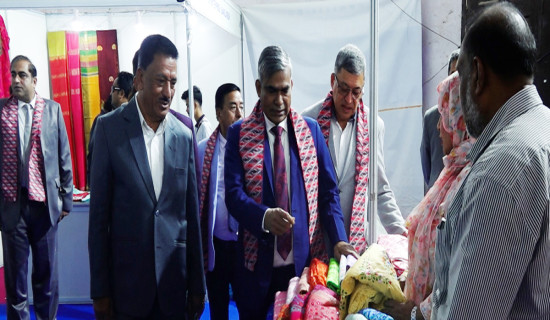
He said that the improvement seen in the capital market and the enthusiasm seen in the ongoing NADA Auto Show also indicate that the economy was improving. He said that the increase in capital expenditure in the first month of the current fiscal year was also a positive development.
President of the Federation of Nepalese Chambers of Commerce and Industry (FNCCI) Chandra Dhakal said that if the issue of allowing the Commission for the Investigation of Abuse of Authority and the National Vigilance Centre to investigate the private sector was passed, the role of the central bank would shrink.
He claimed that it would be a problem if CIAA and National Vigilance Center entered the private sector while other agencies were regulating and watching over. He demanded that the payments to be received from the government by the contractors be released quickly.
President of Confederation of Nepalese Industries (CNI) Rajesh Kumar Agrawal stressed on the need of increasing the overall market to make the country’s internal economy strong and vibrant.
“There is low market demand. Private sector is not interested to augment investment. Due to this, there is no increase in investment even though the interest rate is low. So, it is urgent to pay attention to increase consumption,” he said.
He said that the government should work hard to implement the budget effectively and increase capital expenditure.