- Friday, 8 May 2026

Revamp Nepal's Health System
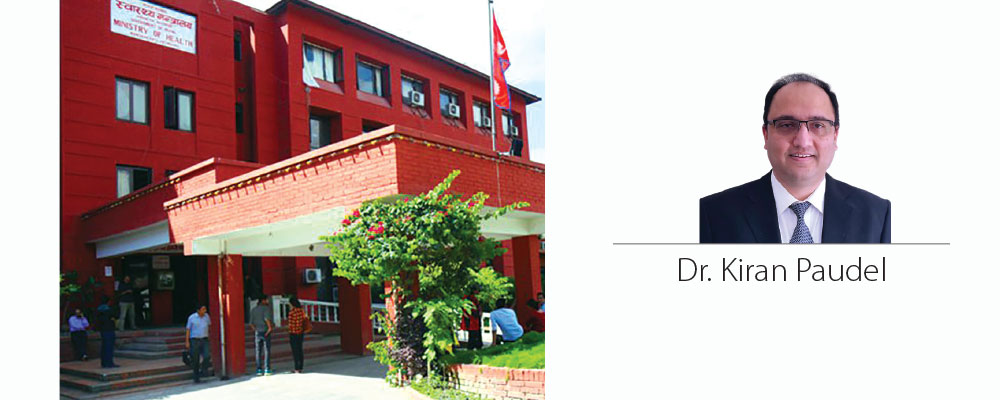

The healthcare system in Nepal urgently needs an overhaul. Chaos, mismanagement, corruption, and policy failures have been business as usual for decades now, leading to significant disparities and systemic inefficiencies in the healthcare sector. The crisis-like ongoing situation is evident in news reports of gross failure of service delivery in public hospitals, controversies related to medicine and medical equipment procurement, frequent reports of violations in medical education regulations, and a mass exodus of nurses and doctors aggravating resource constraints in the health sector. These issues demand immediate attention and innovative, forward-thinking solutions, as traditional approaches have proven grossly ineffective.
With the change of government, the newly appointed health minister, Pradeep Paudel, carries the burden of public hope to clean the mesh in the health ministry. However, he also holds a unique opportunity to distinguish himself by fixing or eliminating failed initiatives, introducing new evidence-based policies and programme, and capitalising on successful policies that have yielded results in the past. This article aims to spotlight the key ongoing policy issues and corresponding potential solutions, the current priorities, and the innovative policy ideas to implement in the coming days, instilling a strong sense of hope, optimism, and motivation in the new minister.
Enhance quality accountability
Quality control and accountability in government-run hospitals are the most significant concerns that must be fixed immediately. A government assessment revealed that less than one-third (30 per cent) of government hospitals met the minimum quality standards set by the health ministry.
This alarming statistic emphasises the need for strong quality assurance and a culture of accountability in public healthcare institutions.
One effective alternative could be for the new minister to consider establishing an independent Healthcare Quality Commission, similar to the Care Quality Commission in the UK, which has significantly improved healthcare standards through regular inspections and public monitoring and reporting (CQC Annual Report, 2020).
Establishing a comprehensive quality improvement programme for all public health facilities could be a cornerstone of Paudel's tenure. This kind of health quality excellence programme should set clear benchmarks with a defined threshold of acceptable criteria for various aspects of healthcare delivery, implement a performance-linked incentive system for healthcare facilities and staff, and conduct monthly, quarterly, and annual third-party audits with publicly available results.
Revamp health insurance
Another primary concern is the dysfunctional NHIP programme. NHIP was introduced in 2016 to provide universal health coverage. However, as of 2023, only about 23 per cent of the population was enrolled in the programme. This slightly increased from 21.35 per cent the previous year as of July 2022. The striking fact is that even out of those low enrollment, the dropout rate is 25 per cent. To address this issue, the government should aim to increase NHIP coverage to at least 50 per cent of the population within a year, develop innovative incentive ideas for new enrollment, and stop dropouts once they are enrolled.
To achieve this goal, it is essential to overhaul the NHIP comprehensively. Nepal could learn from other developing countries' experiences to achieve higher coverage rates. For example, Thailand's universal coverage scheme achieved 98 per cent coverage and could provide key policy ideas to learn. Likewise, Ghana’s universal coverage model, one of Africa's most successful health initiatives in Africa, could provide further insights on how to implement the program to get the desired results effectively.
In a country with a poor population like ours, the government should consider formulating a targeted income-driven subsidy programme for premiums for low- or no-income families and explore the possibility of directing remittance contributions to lower premium coverage costs. Likewise, improving the program's IT infrastructure for seamless claim processing and fraud monitoring would be beneficial to reducing high dropout rates.
Unequal resource distribution
Similarly, the third concern is the disproportionate resource allocation in Nepal's healthcare system. Although the healthcare budget increased to about 5 per cent of GDP in 2021, resource distribution remains uneven. The doctors are busy serving multiple shifts in the urban areas, while over two-thirds of the population resides in rural areas, which are vastly underserved. According to a 2019 study by the Nick Simons Institute, only 20 per cent of doctors posted to rural areas stayed beyond their mandatory service period.
The new minister should consider launching a rural health mission program to address the chronic shortage of healthcare professionals in rural areas. This initiative requires offering attractive packages and career advancement opportunities for healthcare professionals committed to serving in rural areas for a specified period. A study found that doctors born and raised in rural areas are more likely to serve in rural health facilities. Another study finds compulsory service scholarships, improved living quarters, personal counselling, and moderately higher salaries, including performance-based incentives, could help retain healthcare professionals in rural areas. Thailand's rural retention program, which combines financial incentives with professional development opportunities, can also be leveraged to devise the appropriate solution.
Healthcare worker exodus
The fourth concern is the departure of healthcare professionals from the country. Nepal loses hundreds of doctors and healthcare professionals annually to foreign countries. This continuous loss of skilled professionals worsens the shortage of healthcare workers, especially in rural and remote areas. Despite various incentive schemes, efforts to retain healthcare professionals in the country have yet to show much success. Addressing this issue will require a comprehensive approach, including improving working conditions, depoliticising the professional work environment, implementing a merit-based appointment system run by an independent board, offering competitive salaries, and creating opportunities for professional development within Nepal, which could improve the overall quality of healthcare governance.
Digital shortcomings, corruption
Similarly, the fifth concern is procuring medical supplies and equipment tainted by corruption and mismanagement. A 2018 Commission for the Investigation of Abuse of Authority (CIAA) report highlighted irregularities in medical equipment purchases, estimating losses of over NPR 4 billion due to these malpractices.
The Health Minister must implement transparent and technology-driven procurement systems to tackle corruption and ensure cost-effective healthcare spending. Nepal can learn from Estonia's e-health system, one of the most successful such schemes in the world. Their system covers 95 per cent of health data generated by hospitals and doctors (e-Estonia Briefing Centre, 2021) and offers a compelling model for such digital health initiatives. Likewise, South Korea's KONEPS e-procurement system has saved the government billions of dollars and significantly reduced corruption (Public Procurement Service, South Korea, 2019). Nepal should take advantage of such time-tested ideas. The ministry should think of implementing e-procurement systems with built-in checks and balances, establishing an independent oversight committee for large-scale medical equipment purchases, and introducing a whistleblower protection program for healthcare staff reporting corruption.
A nationwide digital health platform integrating electronic health records, telemedicine, and health education could improve healthcare access and quality. Equally important alternatives are launching mobile hospitals and digitally managed remote clinics, which are other innovative ideas that have been successfully implemented in other developing countries that Nepal can also leverage.
Way forward
This article does not cover many other important policy issues in the health ministry. However, the aforementioned are the most critical ones. To ensure the success of these initiatives, the new minister should adopt a holistic, fact-based, data-driven approach to policymaking. Establishing a robust Health Policy Research Unit within the ministry, conducting regular health system performance assessments, and collaborating with academic institutions for ongoing health policy research and evaluation would provide further out-of-the box ideas for effective policymaking.
Finally, while strengthening partnerships with WHO and UNICEF, the new minister should also seek ways to request assistance from global philanthropic powerhouses such as the Bill & Melinda Gates Foundation (focus areas: infectious diseases, maternal and child health, etc.), the Rockefeller Foundation (public health focus), the Carter Centre (mental health focus), and the Conrad N. Hilton Foundation (safe water access focus), among others.
Thus, to conclude, the challenges are significant, but so are the opportunities for transformative change. By addressing systemic issues and implementing innovative programs, the new minister, Paudel, can lead Nepal towards achieving universal health coverage.
(The author is a financial economist.)