- Friday, 8 May 2026

Maldivians Re-endorse Muizzu

A day before the Maldives’ new president, Mohamed Muizzu’s deadline for India to withdraw its military personnel was to end, foreign ministers of India and the Maldives met in New Delhi. Indian External Affairs Minister Subrahmanyam Jaishankar reminded his Maldivian counterpart, Moosa Zameer, that India has been a key provider of development assistance. Regional powers India and China are competing for influence in the Maldives, which has a strategic location in the Indian Ocean. Muizzu, 45, wanted the 90 foreign troops to leave. The foreign hands helped operate two aircraft donated by India and assisted in the rescue of people stranded or faced with calamities at sea. Under a revised agreement, the deputation of competent civilian technical personnel has taken place.
Muizzu ran for president in September on a campaign theme of “India out”, accusing his predecessor of compromising national sovereignty by giving India undue influence. After taking office in November, Muizzu visited China ahead of India and said the Maldives’ small size is not a license for anyone to bully it. On his return, he spelled out plans to rid his nation of dependence on India for health facilities, education and medicines. Last year, New Delhi started construction of the Indian-funded Greater Male connectivity project, named as the largest infrastructure initiative in the island nation, a 6.7-kilometer-long bridge and causeway connecting the capital city. In 2013, the Maldives joined China’s Belt and Road initiative to build ports and other infrastructures for expanding trade in Asia, Africa and Europe.
Move for clout
Influence-wielders and influence-losers clash for space — all in the familiar and expedient name of vital national interests. Security interests are surely not the sole concern of the big and the mighty. Are others to submit to the wishes of the big bosses? In practice, big powers tacitly agree to spheres of influence. How much this goes ahead depends upon other individual states assertive power to reject such hegemony. Blockades, military coups, street unrests and civil wars are at times the works of big neighbours and powers.
Maldivian general election in April dramatically reversed the parliament’s composition. Muizzu’s People’s National Congress (PNC) secured a landslide majority in the 93-member majlis, or parliament. It contrasts sharply with the eight seats the PNC and its partners had in the previous house. Clearly, New Delhi’s sanctions on the island state did not have adverse effects on popular support for the president who took office only less than seven months earlier. Meanwhile, New Delhi’s advisory to potential Indian tourists not to visit the Maldives that had installed a “pro-China” government failed to deliver the intended electoral damage that some political commentators had speculated.
Muizzu’s confidence is boosted by the parliamentary polls that reversed party equations. The main opposition, pro-India Maldivian Democratic Party, and its allies suffered a humiliating defeat. The combination that previously commanded a super majority is now shrunk to a smaller presence just as yesterday’s small opposition has its leader as president and a highly comfortable control in the popular house. A low-lying nation of some 1,200 coral islands, the Maldives is the smallest South Asian nation in terms of territory and population. It is enlisted as one of the most vulnerable to sea level rise caused by global warming.
Dotted with holiday destinations and pristine white beaches, the Maldives’ is basically a tourism-based economy. Indian and Chinese tourists contributed to substantial share of the foreign paying guests until 2023.Things have changed sharply after arrivals of Indian tourists dried up in the wake of the Indian military personnel being asked to leave the islands before June. New Delhi’s reaction was grim. A campaign of sorts to boycott the archipelago resulted in a drastic drop in Indian tourists landing on the island. Prior to the COVID-19 pandemic, Chinese tourists were the single-largest number in the Maldives. Indian tourists were second. In the post-pandemic period, this has changed. In 2023, Indian tourists and Russian tourists were almost the same in number while those from China were less by 10 per cent.
The island chain recorded 1.7 million foreign tourists in 2023, and India’s contribution was 209,000 tourists. This year, Chinese arrivals have been the single largest as against Indian tourists placed sixth in numerical strength. An undeclared sanction undoubtedly hurts the tourism destination. But overstretching the tool could boomerang in terms of political capital, compelling the desperate target to seek alternatives. Muizzu asked Beijing to promote more Chinese tourists to his country even as latest statistics indicated the duration an average tourist spending in the Maldives has increased to nearly eight days.
Road to normalcy
All along, the Maldivian president did not leave any opportunity to emphasise on development aid from India. His government wanted to purchase sugar, garlic and onions. Delhi did not drag its feet in responding positively. Both Male and New Delhi have taken into account their mutual differences and the need for pragmatic approach to bilateral ties. In order to send a message to the international community, the two sides agreed to a provision whereby Indian technicians would help the Maldives to operate military aircraft until the latter developed its required technical manpower. This signalled that their bilateral relations are normalised.
In the past few years, Sino-Indian rivalry has impacted the Maldives. Rivals called Muizzu pro-China, but he won the presidential poll in September against the incumbent “pro-India” Mohamad Nasheed. Even as the parliamentary elections were on, Muizzu awarded major infrastructure contracts to Chinese companies. The outgoing parliament had been dithering over bills the government tried to push forth. But fresh parliamentary election greatly strengthened the president’s position. The super majority in the house was a clear message.
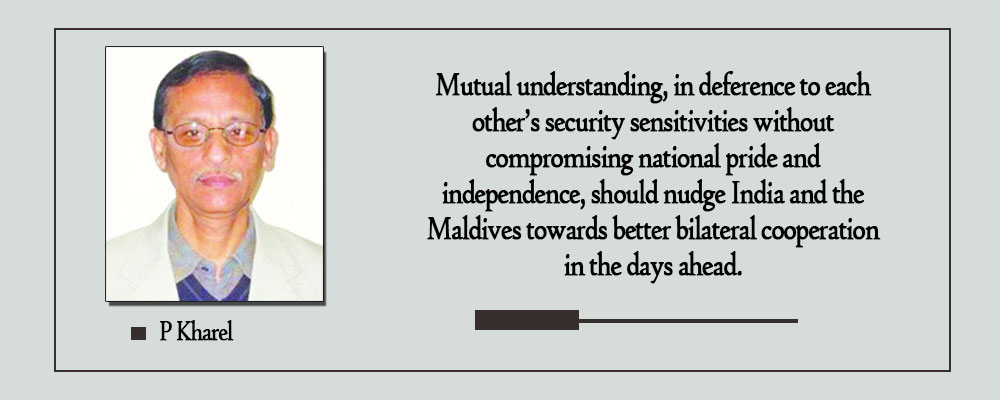
It firmly showed that he retained his popularity. His policies had a strong backing from voters who were willing to bear difficulties resulting from the executive head’s decisions and actions. The voter turnout of more than 75 per cent added to the strength and meaning of the electoral exercise. Mutual understanding, in deference to each other’s security sensitivities without compromising national pride and independence, should nudge India and the Maldives towards better bilateral cooperation in the days ahead.
(Professor Kharel specialises in political communication.)