- Saturday, 9 May 2026

A Canvass Of Life’s Suffocations

The beat story in literature is an artistic avenue to read the ups and downs of life. In fact, life is a complex living existence, which many believe can’t be explained. But litterateurs are effortful to weave and decorate such human emotions, and they choose the beat story to write about life in the art of words.
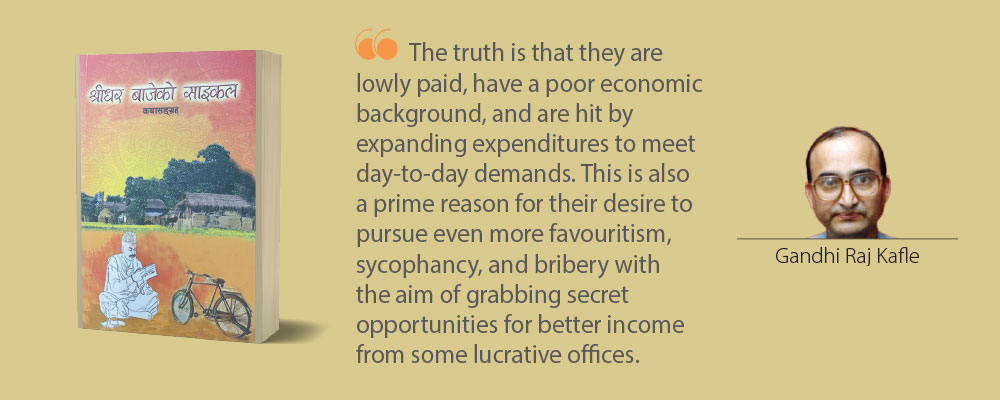
The collection of stories entitled “Sridhar Bajeko Cycle," which is under review here too, is here with the same aim in the domain of Nepali readership. But the question is: What kind of life has been portrayed in this collection?
The concerns of the author, Tej Binod Pokhrel, solely go to ordinary characters and their needs and aspirations. So, the common man is his theme, and he has written stories on it after retiring from government services.
This is a 241-page book, and there are 25 stories in it. Many of the imaginary characters in it are employees of the government, and they represent common posts like Mukhiya, Khardar, Subba, and Adhikrit (most of them are assistant-level staff) in this collection.
While describing the stories of such characters, the author’s focus is on the portrayal of the socio-economic ethos of all regions, hills, valleys, and terai of the country. Characters move from one place to another because they are government staff, and they must move from place to place in the course of their transfer for government services, and the author has weaved stories imaginatively to add sentiments of different regions for readers.
The desire for progress is in the deep psyche of the characters in Pokhrel’s stories in this book. But what is important is that he describes it not to narrow the vision of attaching due importance to the values of life, which is the much-loved means of the author to draw the attention of readers in each story of this collection.
Here, we can even raise a few questions in light of the themes of this collection. What is the true message of ‘progress’ achieved by the characters in these stories? Here what we get is that one trouble eliminated in the lives of characters does not mean life’s other aberrations are checked or solved.
Happiness, ultimately, is shaken, or we can even say it has been more complicated, and at the end, what is seen is that no character is happy.
The author of this book has churned themes from the domain of the country’s administrative staff to present this example. What kind of staff do we have in our government? The characters in Pokhrel’s stories speak the truth.
The truth is that they are lowly paid, have a poor economic background, and are hit by expanding expenditures to meet day-to-day demands.
This is also a prime reason for their desire to pursue even more favouritism, sycophancy, and bribery with the aim of grabbing secret opportunities for better income from some lucrative offices.
In other words, this is the path of bribery, and characters often do it because the story author has tried to attach his writings to the ground reality of the socio-economic conditions of the country.
But what is the main message of these stories? The author has themes to explain it from different points of view. He has visited different places in the country while working for the administrative services. He has spent time abroad and seen how Nepalis are struggling to earn and study for the future of themselves and their families.
In this broad canvass, the message the author offers through the medium of stories in this book is that amassing property alone can’t ensure happiness in the long run. Only a broad outlook can be valued, and it is moral insight that becomes a cause of happiness.
One more thing here is the title of the book itself. Why did he choose “Sridhar Bajeko Cycle," which is the first story of the collection, for the title? In the context of the dominant number of stories on themes of small government employees, this seems to have grabbed the special preference of the author. But this preference is not without cause.
The author has full sympathy for the causes and conditions of the common man in society. In this vein, what we find is that the imaginary small staff of the government in this collection are also common men, and there is similarity in the themes and desires of “Sridhar Baje” with his dominant number of characters from the government sector. The choice of the book title, thus, is reasonable.
In conclusion, the author Pokhrel deserves all the good wishes for his passion to write in diverse beats of Nepali literature like essays, poems, stories, and novels.
(The author is a former Deputy Executive Editor of The Rising Nepal.)
-original-thumb.jpg)