- Sunday, 10 May 2026

Unexpected Challenges For Israel

In a classic case of not forgetting the hardships and indignities the black people in South Africa suffered during the apartheid rule by a white minority, South Africa in the other week moved the International Court of Justice to call for a cease fire to the ongoing “genocide” in Gaza. Later, Uganda supported the South African initiative. In its verdict on Friday, the Hague-based ICC directed Israel to prevent acts of genocide. The ruling is a big setback for Tel Aviv and also an indirect rap against foreign supporters of the Benjamin Netanyahu government.
While more than 25,000 Palestinians have lost their lives, no less than two million others have been forced out of their homes in the territory in 2023. International agencies report that more than 8,000 children have been killed since October, which presents a highly grim picture amidst anger also against Israel’s key allies and donors. As the single-largest recipient of the US annual aid, Israel receives $3.5 billion in military aid. The Jewish state with a population of about 9.2 million receives another $1 billion in philanthropic assistance.
The colour of skin demarcated an individual’s social station, economic opportunities and justice during apartheid in South Africa. Segregation was the order of the regime, to which the ruling class’s cousins in the West were complicit. In fact, Ireland’s parliament in May 2021 condemned the “de facto annexation” of Palestinian land with a population of 5.4 million. Its Foreign Minister Jean-Yves Le Drian proudly pointed out that his country was the first among the European Union’s 27 member nations to employ the phrase on Israel.
That Israeli government has settled 450,000 Israelis in Palestinian territories occupied for 55 years carries significant demographic implications and, with it, political consequences —something Tel Aviv cannot be unaware of. The future can no longer assure Israel that Palestine’s probable prospects of attracting greater proactive substantive support from not only Muslim but also non-Muslim world. Bahrain, Bangladesh, Bolivia, Bulgaria, Chad, Chile, Jordan, Honduras, South Africa and Turkey recalled their ambassadors accredited to Israel, with some of them cutting off all diplomatic ties. This was in protest against the collective punishment after the Hamas’s deadly attacks in October.
Table can turn
In “Africa United: How Football Unites”, Steve Bloomfield themes a popular sporting discipline to portray and analyse a continent that for long remained colonised, economically exploited and ruthlessly suppressed. Issues can indeed unite communities and countries. It does not bode well for Israel that latest research surveys indicate anti-semitism to have hiked by 388 per cent in the United States and 689 per cent in the United Kingdom.
Sections of the American press have called for their government to be consistent in responding to conflicts in various parts of the world. They pointed out that, if Washington supports illegal annexation of Palestinian territories by Israel, it became the only state to recognise Morocco’s sovereignty of Western Sahara. Former US Secretary of State James Baker III described the move as an “astounding retreat from the principles of international law”. Weeks before Russian troops entered Ukraine, the US and its allies warned Russia’s President Vladimir Putin: “Any use of force to change borders is strictly prohibited under international law.” When Russian parliament recognised the independence of two self-declared republics, American Secretary of State Antony Blinken termed the action a “gross violation of international law”.
Whereas what the US leaders said were indeed correct, they carried little weight simply because of Washington’s previous stand on similar issues elsewhere. The US and its allies invaded Iraq in 2003 on charges that were a big suspect from the very beginning and could not obtain confirmation from the United Nations. Remaking borders by force violates a core principle of international law. Which is why the Biden administration must do more than resist Russia’s aggression in Ukraine. It must stop flouting of that principle anywhere. In 2019, the US was conspicuous by being the only foreign country to recognise Israel’s sovereignty of the Golan Heights, which was taken over from Syria by Israel in the 1967 War.
Palestinian Prime Minister Mohammed Ishtaye recently made an appeal for an international pressure group to compel Israel to pull out from Palestinian territories and give vitality to the two-state solution. There is mounting support for Palestinian rights. Annoyed over British backing for Israel in sustaining the “unbearable status quo”, The Guardian news outlet attributes Britain’s complicit in the oppression of Palestinians to diplomatic and military support together with a thriving arms trade. Although the US and the UK governments are among Israel’s staunchest supporters, their publics have witnessed divisions over official policies. Some prominent British organisations demand that military exports to the Jewish state be stopped.
Review in order
A Joint Arab-Islamic Extraordinary Summit held in the Saudi Arabian city of Riyadh in November condemned the Israeli “aggression against the Palestinian people”. But a powerful leader of the Muslim world, Saudi Arabia asserted its weight in scuttling a proposal that all diplomatic ties with Israel be snapped off and sanctions be applied against the Jewish state. However, that does not conceal growing mass anger in Muslim countries as well as other countries. Houthis, the Yemen-based Islamist political and military outfit, has been attacking targets within Israel and those of the latter’s allies. Originating in Yemen, the Houthis have been launching attacks on Israeli and Western installations after Israeli troops stepped up attacks on Gaza. Various groups want them to ignore the United Nations “just as the Israelis do”.
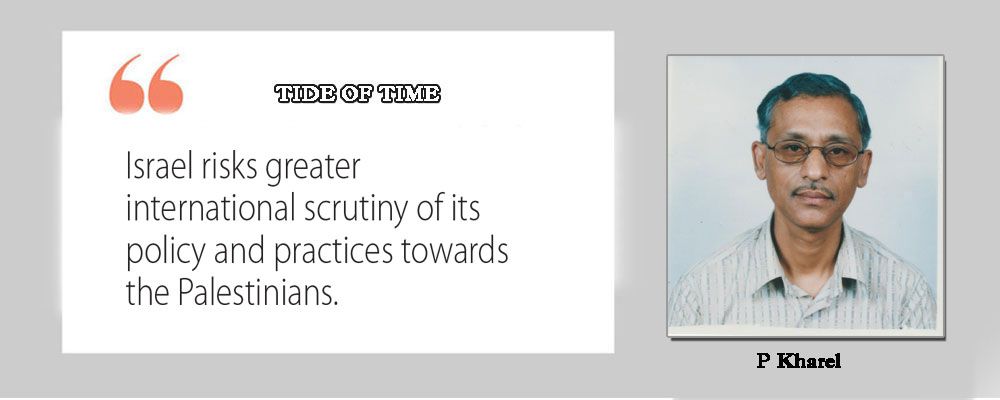
Too much reliance on its traditional allies since so long does not guarantee that things will remain the same forever for Israel. New power equations in the international political landscape cannot guarantee status quo in existing bilateral ties and traditional backing. Israel risks greater international scrutiny of its policy and practices towards the Palestinians. Nation-first policy precedes everything else. Israel, which has maintained its independence for 75 years, is a force to reckon with in West Asia. It has defended itself against heavy odds, as underscored by several major wars. The Holocaust, in which six million Jews were exterminated by Nazi Germany, draws much sympathy for the horrific trauma inflicted on the community during World War II.
Jews carry a history of having, for centuries, been persistently persecuted mostly in West Asia and Europe. They deserve their right to independence. But it is also time that Israel reviewed its policy on Palestine for prospects of greater peace. In a dramatic development carrying considerable meaning is the offer made on Saturday to Israel by five Arab nations to commit themselves to complete normalisation of relations with the Jewish state in exchange for agreement to an independent Palestinian state.
(Professor Kharel specialises in political communication.)