- Sunday, 10 May 2026

Take Steps To Save Lives On Roads

In deficiency of collective and thoughtful interventions aimed at reducing road accidents, Nepal witnesses a considerable number of road crash deaths every year. It is saddening to mention here that the country has one of the highest road fatality rates in South Asia as a whole. Nearly 3,000 people lose their lives in road mishaps annually while thousands of others get maimed. This figure accounts only for those who die on the spot. Several from among those injured also pass away in the course of treatment. With an increase in investment in the expansion of road networks nationwide, there has been a significant rise in the number of vehicles over the years. This poses an additional challenge to the nation’s poor transport management system.
Records of the Nepal Police show an awful scenario of road crashes and resulting fatalities. In fiscal year 2078-79 B.S., almost 2,900 people died in road accidents across the country. The police recorded as many as 24,000 vehicular mishaps during that period. However, the number slightly dropped to 2,368 in fiscal year 2079-80 B.S. The nation logged more than 900 road fatalities in the first five months of the current fiscal year. But many road mishaps and fatalities go unreported.
Rising fatalities
The densely-populated Kathmandu Valley also sees a lot of road accidents and deaths annually. The valley alone recorded a total of 88 casualties on the road in the first six months of the current fiscal year (2080-81 B.S.). Almost 50 per cent of about four million vehicles, including motorcycles, ply the roads within this valley. On average, eight persons lose their lives in road accidents daily. This speaks volumes about the gravity of the problem. Pedestrians, motorcyclists and cyclists are at higher risk of road mishaps.
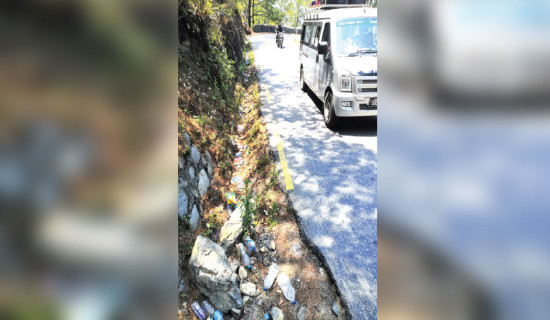
It is needless to mention that overspeed, violation of traffic rules, recklessness on the part of drivers, mechanical problems, and bad condition of roads are major factors leading to road disasters. Traffic police officials often point out overspeed and non-compliance with traffic rules as the leading causes of road accidents. The tendency among pedestrians to cross roads haphazardly is also responsible for vehicular mishaps. Many roads even in urban areas do not have footpaths. Because of this, many pedestrians seem to have fallen into road accidents time and again. Traffic police offices are found taking initiatives frequently to raise public awareness of road accidents.
But such efforts do not appear to have been so effective in reducing the number of road disasters. Neither drivers nor pedestrians seem to be following traffic rules rigorously. So, it is necessary to enhance the capacity of the traffic police so as to increase their surveillance. What is more worrying is that drivers are sometimes found driving vehicles after having consumed alcohol or narcotics. However, traffic police units have given continuity to checking drunk driving. This step is said to have contributed considerably towards preventing many accidents. The authorities must enhance surveillance with the use of digital technology to improve road safety situation.
It is obvious that road safety also has a substantial economic impact. Experts say that the financial cost of road traffic injuries has an important impact on the gross national product (GNP). As per a study, which was conducted by the World Bank indicated that the financial cost of road crash injuries has risen substantially for the past one and a half decades or so. The study shows that it is now equivalent to 1.5 per cent of the GNP. This is because a considerable number of road fatality victims in the country are susceptible people such as pedestrians and those riding motorcycles and cycles. Those injured are unable to earn money and their medical expenses are very high. This situation forces them into profound poverty. Thus, road safety is a key transportation and development challenge as it impacts health, human capital and economic growth.
Although the Nepal government seems to have done something to improve road safety over the past couple of years, much remains to be done in this connection. Considering a distressing situation of road accidents, the then government had formed the National Road Safety Council (NRSC) as an inter-departmental body to ensure safer roads. This agency is led by the Ministry of Physical Infrastructure and Transport. But NRSC has not come into operation owing to a lack of laws and necessary budget. Because the proposed National Road Safety Bill could not move ahead as anticipated, the ministry some months ago drafted another bill to guide the NRSC. But the government has not tabled it in parliament. As road safety is a critical issue, the government must prioritise this and act accordingly to save lives on roads.
Rescue services
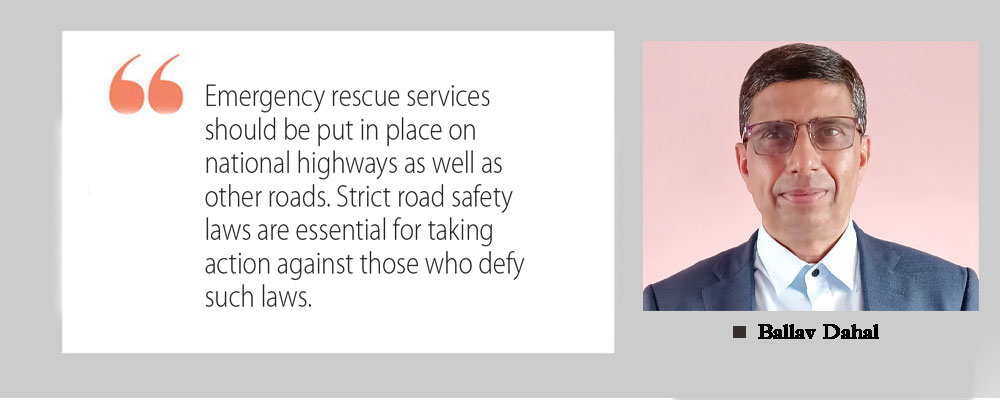
To reduce the number of road accidents, the three-tier governments need to make collaborative efforts. Emergency rescue services should be put in place on national highways as well as other roads. Strict road safety laws are essential for taking action against those who defy such laws. It is a matter of shame that there have been irregularities in the issuance of driving licenses. Chances of road accidents are very high when fake driving license holders drive vehicles. The authorities concerned must consider this issue seriously and take action against those involved in this crime.
There has been a practice of forming an investigation team immediately after any major road mishap takes place. Such panels seem to have given suggestions to the responsible government bodies to take necessary steps for ensuring road safety. But those recommendations are rarely found being implemented. The relevant authorities must pay attention towards this matter in order to prevent additional road disasters.
(The author is a former deputy executive editor of this daily.)