- Sunday, 10 May 2026

Insights Of A Civil Servant On Corruption

Corruption is possibly one area in Nepal that everybody, from politician to administrator, lawyer to judge, and even civil society to the ordinary person, professes to focus on and reduce, if not totally eradicate. It is also accepted that the phenomenon of corruption exists in some form or manifestation, from family to public life. This may range from outright bribery to policy-level corruption and even aspects of social life not taken that seriously in the ordinary sense of the term.
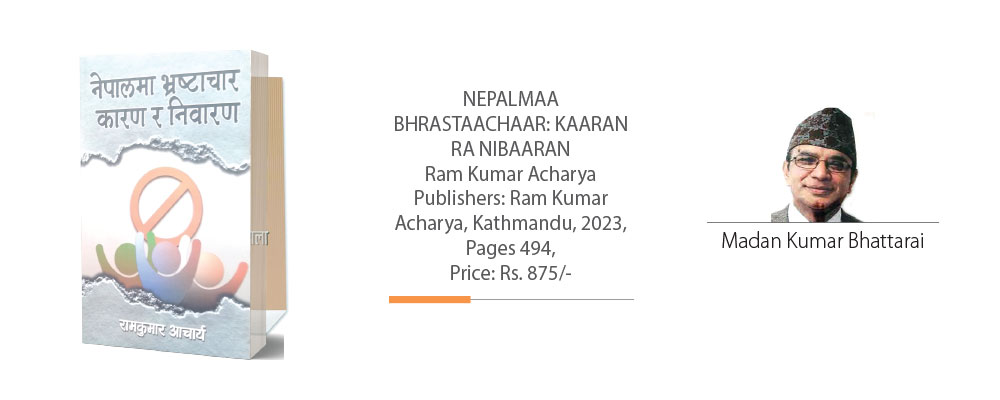
Ram Kumar Acharya, a retired special class officer of the Nepal Judicial Service with a Master of Laws from Bond University, Australia, has made a solid effort to highlight different aspects and manifestations of corruption in the global context in general and its special impact on Nepal with deadly consequences in particular. The book with an impressive cover, entitled NEPALMAA BHRASTAACHAAR: KAARAN RA NIBAARAN, can roughly be translated as Corruption in Nepal: Causes and Prevention.
Seen as a logical output of serious research, study, and interest in the area, the voluminous book is divided into eight major chapters along with appendices, a picture gallery, and quite a comprehensive 36-page bibliography, mostly in English. One basic attribute of the book is the telltale details of the corrupt behaviours of various people. Those who read the book thoroughly can't remain unimpressed with the last two pages dealing with what is called a resume of corruption, tracing its tentative birth dating back to almost 300 BC.
Chapter one categorises five types, forms, and levels of corruption, including policy-level corruption normally practiced as a protective shield to save people from indulging in such acts, along with normative criteria and definitions. The second chapter deals with the corruption index vis-à-vis Nepal's status. Chapter three deals at length with the theoretical and practical aspects of corruption as a social, economic, and political malaise.
The biggest chapter of the book is the fourth, which seeks to specifically portray the causes and reasons of corruption, even citing major cases of sheer anomalies involved. Linked to this are chapters seven and eight that depict endeavours against the evil and suggestions and recommendations to control visibly rampant corruption in the country, respectively. Chapter five seeks to deal with what can be called the ill-effects of corruption. The remaining chapter six essentially seeks to highlight global efforts to control corruption.
One disturbing aspect of corruption in Nepal is the visibly perceived impression by people both inside and outside the country that the menace has constantly mushroomed with a tinge of impunity after the political change supposed to foster democratic culture and promote socio-economic transformation through efficient and judicious utilisation of internal and external resources.
As a reflection of his 32-year-long experience in legal service and close observations of the working modality of organisations and bodies expressly dedicated to controlling corruption, including the judiciary and the Commission for Investigation of Abuse of Authority, Nepal's Ombudsman type of constitutional organ, Acharya finds a state of dilemma and even a double standard pervading Nepali society as everyone talks of controlling the vice but takes little interest in going through its cause and effect, not to mention the quite distant issue of controlling it.
The well-researched book is possibly the second such attempt by a senior bureaucrat after former Secretary Sharad Chandra Paudel's similar but still bigger work entitled BHRASTAACHAAR: KAARAN, PARINAAM RA NIYANTRANKAA UPAAYA (Corruption: Causes, Effects, and Measures towards its Eradication) that hit bookstalls more than two years ago.
Acharya has used a methodology to deal with the vexed issue of corruption with both historical insight and the real-time status of corruption in Nepal, with some leading examples, with a view to presenting a cogent approach as far as the theoretical and practical aspects of corruption in our context are concerned.
Besides, the new book has incorporated commentaries by popular figures spread over a wider compass, like actively practicing politician Gagan Kumar Thapa, senior economist Dr. Swarnim Wagle, who caught international limelight after his resounding success in the Tanahun by-election, then Chief Secretary Dr. Somlal Subedi, and a senior journalist writing on corruption, Hari Bahadur Thapa.
Acharya has also tried to convey his message to readers in the form of various dos and don'ts and taken care to cover a wide range of stakeholders and the erosion that has taken place in our social value system and normative behaviour over several decades. His field, which can be called the command area, is wider to include all aspects of corruption, including historical legacy, the preponderance of corruption-friendly legal rules and regulations, and the politicisation of constitutional and judicial councils supposed to become vanguards of anti-corruption activities.
Acharya tries to depict and expose varied areas and tools of corruption that have now been discussed in public with satirical derision. These include an advance payment system for contractors, a loss of quality in bureaucracy, overpoliticization, a corrupt and costly election system, political parties and their leadership, proportional representation, weak norms for good conduct and behaviour, corrupt leadership, an unequal and discriminatory educational system in practice, etc.
One discerningly notable aspect is that Acharya has used a comprehensive quantum of references and source materials in his quite detailed presentation, with emphasis on a vast range of foreign publications and topical reports, to highlight his concerns about the rather thriving phenomenon of corruption in Nepal. He has also made use of a number of our own sources, including articles available in both print and web media.
However, it is quite difficult to understand why he has not thought it prudent to make reference to a large volume on the same subject written by Secretary Sharad Chandra Paudel, as already mentioned above.
Another lacuna of the otherwise comprehensive book is the plethora of proofreading mistakes. Likewise, there are some instances relating to the Nepali context that seem to have been directly culled from newspapers. The sheer volume of the work might have prevented the author from processing and refining it properly.
Despite such seemingly unavoidable and minor pitfalls, I congratulate Acharya on his wonderful contributions, despite lingering apathy on the part of readers on the very subject of corruption. This is in the context of a lack of seriousness among stakeholders to squarely deal with the subject that has significantly eroded our credibility in the community of nations, including among our development partners and international organisations that have shown interest in assisting us in improving the quality of life.
(Dr. Bhattarai is a former Foreign Secretary, ambassador, and author; kutniti@gmail.com.)
-square-thumb.jpg)