- Sunday, 10 May 2026

Chobhar Blues: A Good Reading
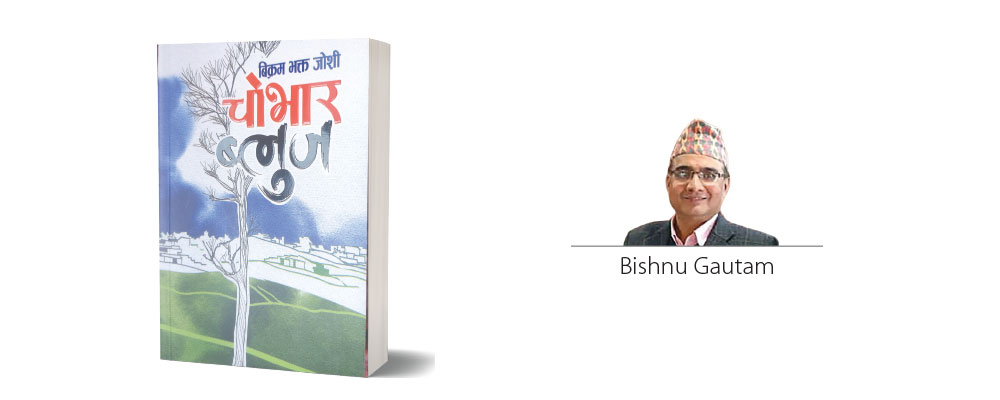

Chobhar Blues, a collection of stories by Bikram Bhakta Joshi, is a good read. Published by Sahitya Post, the book gives an unconventional test to its readers. No reader can rightly guess the ending of each story even after reading half of it. And if one tries to do so, he is sure to be wrong. Of course, an unexpected ending is the main feature of all the stories included in the collection.
Interestingly, it is the debut literary work of a banker by profession and an engineer by study, but it can captivate the readers. Bikram Bhakta studied engineering. But later, he became a banker. A man with a deep passion for literature, he also quit the job of a banker and jumped into the literary world as a learner.
The book under review, published last year, is his first work. However, he has succeeded in winning the hearts of readers with his debut work. Like his life, the 19 short stories included in this collection do not move in a straight line. So, the readers cannot rightly guess the ending of the stories. They swirl like the flooded streams of summer.
Most of his stories tell the tale of the pains of the people. The first story, Utsarga, has a tale of poor, lonely Lady Goma, who has nothing other than a few goats to live with in a hut at Pharsidol. She is alone because she was unable to tie the nuptial knot because she had a small brother to bring up when she was of marriageable age. But her brother went overseas to stay with his son, leaving his old sister Goma alone. Similarly, there is a story of an old goat herder in Bosandanad. Likewise, in Sunko Poko, there is a character named Sante, a poor man who dared to jump into floods in the hope of getting some gold by saving a bundle of gold from the sinking house in Pune. But neither he came up with gold nor his life; we went missing in the flood. In other stories, there are Harke, Bange, and Bisancha, who have been living through the pains of poverty and other problems in the hope of overcoming them one day, which never comes in their lives. There is also a story named Morokwal (more equal), which deals with the animal world similar to the Animal Farm of George Orwell.
Of course, story writer Joshi has presented not only the story of poverty and loneliness but also the betrayal of love. Chobhar Blues and Anichchhit Samabandh are the stories of such a betrayal. As his stories are full of pain, they end in tragedies.
However, as said above, most of the stories do not move ahead in a straight line. They take unexpected twists and turns, confusing the readers, as the plots of the stories change unexpectedly. In Anichchhit Sambandh, two men who have married their ex-girlfriends happened to share the same table while drinking in the evening. Likewise, in Planner Fantasy, the story writer all of a sudden turns into a wise sage and starts roaming in the sky of Kathmandu.
While telling the stories of men and women, the author has beautifully presented the life and culture of the people of the Kathmandu Valley. The settings and characters of almost all stories are from the Kathmandu Valley. While telling the stories of people, Joshi has beautifully explored the cultural and geographical beauties of the valley. His story, Khyak, Manchhe Ra Kukur, tells many things about the cultural aspects of the valley people.
As the stories are focused more on the Kathmandu Valley, its people, lifestyles, and culture, the writer has given insights into many of the cultural practices as well as the impacts of modernity. Joshi has also used Newari words in abundance. He has also used English words, which are commonly used by the learned men and women of today. Hence, his stories are about both the people of the older and younger generations and are relevant to all readers.

-square-thumb.jpg)