- Sunday, 10 May 2026

A Rare Literary Ride

In the list of Nepal’s prominent broadsheet daily editors — past and present — Kamal Rijal stands out as the indisputable champion of writing prolifically quality prose on Hindu philosophy, Eastern culture and related literature for no less than three decades. Immersed in re-reading, interpreting and explaining topics emanating from his field of special devotion, he contributes to various media — print, broadcast and online portals.
The former chief editor of Gorkhaptra, Nepal’s first newspaper, whose history stretches from 1901, his literary work can now be read also in the English language, brought out by Sahitya Post. Unlike his earlier books, Deep Past — entitled Sukarma in its Nepali and Hindi versions — is a novel whose theme and characters belong to many millennia ago but brought to the present by the novelist who emerges with distinction. Set in the deep yore, it wades in a fountain of captivating flow of imagination with relevant references that people especially in South Asia and of its descent spread across the world are familiar with.
Absorbing cast
With a cast of characters filing out with relevance and presented eloquently for timeless message, the narrative is lucidly simple and powerfully effective in sustaining interest in the core theme, which is shorn of ambiguity. A cut above the many, it stands a class in itself. The characters enable the reader to delve into the conditions the narrative dwells upon, including beliefs and practices bound in firm conviction. The narrative weaves the long suspense-spawning journey through the times and territories of the various continents on Planet Earth and beyond. The peg knitting all this is the Vedic times represented by the characters.
Readers travel to an immensely long voyage traversing different planets and various parts in the space, including water, clouds and thunder. Mentioned are the black hole and talks about the mysteries of the universe, particularly the planets in the solar system. “Where there is poverty, there is more honesty,” represents the philosophy of the then times and numerous more to follow. The teachings of the Vedic period down the several millennia are against dushkarma (sinful acts), as they probe into the past, review the contemporary times and give an idea of the future.
Sukarma, the proven righteous deed, enables sustenance of the Earth. Subadhra, accompanied by an array of brave souls, including some from the space, is counselled retention of patience in the course of their mighty mission pursued with intense passion for Earthly welfare. Encounters with superheroes are endowed with valued wisdom springing from interesting interactions recorded during the epic search. The background is one of eternity, punctuated by cycles of evolution and dissolution, and profusely prosed in a dialogic pattern strewn with philosophical discourses. Passionate pursuits combine to contributing to the welfare of all living creatures and promoting the ultimate cause of liberation from the cycle of birth and death.
Deep Quest represents a finely sculpted fiction embracing a literary genre rarely dwelled upon. The well-crafted story has settings not entirely unfamiliar as far as their environs and episodes are concerned. This is particularly so to the denizens of those parts of the world whose legacy evolves from the origin and evolution of the cultures of the Himwatkhanda that stretches from the Himalayas to much of the present-day South Asia and beyond.
Emotionally engaging, the story is marked by inquisitive interest and valued responses to profound queries and interactions between the characters who are dignified and disciplined in their stupendous mission pursued with unflagging determination. Simple and clear diction ensure that words are hardly wasted. There is no one specific villain but the pollutants and pollution that begin to be unveiled on Earth once the Kali Yuga commences. The journey is an outcome of pure passion for finding the reliable and revered one for stemming the chaotic, traumatic slide the Earth started suffering with the advent of the foreboding period.
A voyage into hoary past, driven by yogic energy and Vedic norms at their exacting best, the story transports readers through planetary missions to places inspiring awe and actions familiar to even neophytes with rudimentary acquaintance with the Ramayana, the Mahabharata and the purana episodes eulogising a galaxy of deities. Gautam Buddha, Jesus and Mohammad also figure.
Massive contents in bins of sins well up — a matter of grave consternation for those bent on moral integrity and welfare of all as the primary purpose of human life. The successful sighting of Sukarma marks the dawn of a realisation that problems are not to overwhelm anyone but to be addressed to the very end.
Celebratory course
One of the most prolific authors, who already has 14 books to his credit on various aspects of Vedic culture and Hindu religion, Rijal, the erudite interpreter of the Mahabharata, is also a regular columnist for different publications and online news portal. He contributes to, among others, Yuva Manch, Madhupark and Gorkhapatra, his professional alma mater.
Rijal gives his year of “birth” as 2048 BS (1992) in reference to the time he debuted as a full-time journalist and regular scribe. After working for the country’s most popular youth magazine, Yuva Manch, he edited the largest circulating and widely respected literary magazine, Madhupark. In addition to his regular working hours as a journalist, Rijal wrote for the Gorkhapatra a fortnightly column on life and spirituality for a decade and a half until 2002. His first published work was a poem for Barta weekly (Kanchanpur) in 1981.
First published by Dikura in 2012, Sukarma was taken up by Shangri-La publications for the second edition. The novel caught the searching eyes of Nepal Academy that quickly had it translated for Hindi readership. The translated version in English seeks a wider audience. When Sukarma first appeared, it was awarded the newly founded Kumar-Saraswati Utkrishtha Sahitya Purashkar.
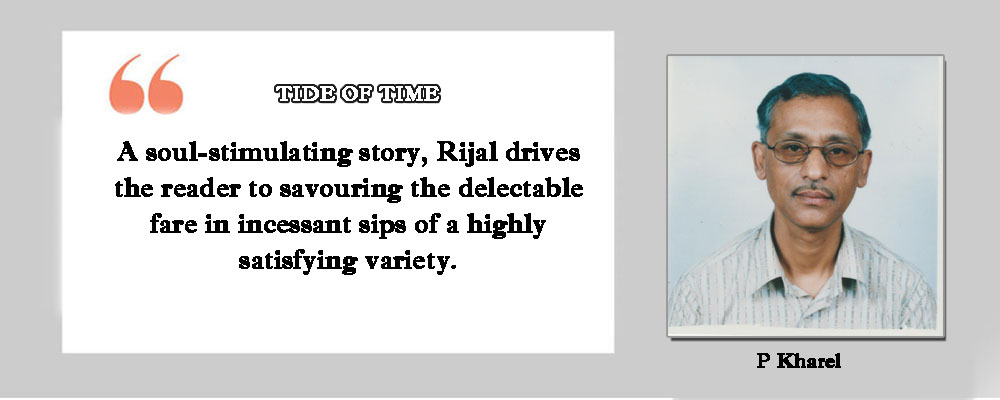
And now in English, so painstakingly and creditably translated by Mahesh Paudel, a regular faculty member at Tribhuvan University’s Central Department of English, Deep Quest should make an absorbing read of a genre very rarely offered in the catalogue ¬of Nepali literary menu. The undertaking deserves celebration as a pride of literary read. A soul-stimulating story, Rijal drives the reader to savouring the delectable fare in incessant sips of a highly satisfying variety.
(Professor Kharel specialises in political communication.)