- Monday, 11 May 2026

KU and NAFA agree for craft and design course
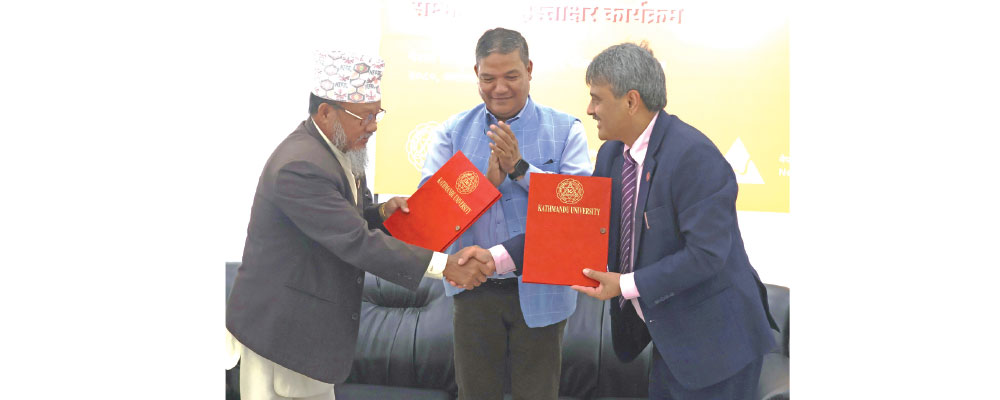

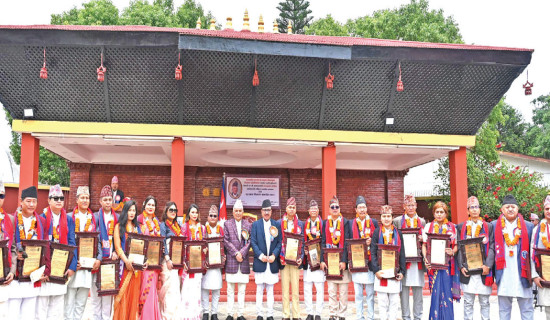
By A Staff Reporter,Kathmandu, Oct. 13: An agreement was signed between the Nepal Academy of Fine Arts (NAFA) and Kathmandu University (KU) on Thursday to foster cooperation in various fields of fine arts.
Through this programme, the university also formally introduced the course on 'Crafts and Design' at the undergraduate level.
The memorandum of understanding was signed by Chancellor of the Academy Narad Mani Hartamchhali and Vice Chancellor of the University Prof. Dr. Bhola Thapa.
Ekku Maya Pun, Associate Professor of KU School of Arts, highlighted the significance of the new course and expressed optimism about the increased support from the Nepal Academy of Fine Arts in the future.
Likewise, Prof. Dr. Manish Pokharel of KU School of Engineering claimed that reaching the agreement was a historic moment, as the KU School of Engineering and the KU School of Arts have jointly introduced the course for the first time in Nepal.
He opined that the agreement between the Nepal Academy of Fine Arts and Kathmandu University marked a milestone in the educational history of Nepal.
Prof. Dr. Bal Chandra Luitel, the Dean of Kathmandu University, School of Education, emphasised the cultural importance of the traditional local craft and its impact on societal progression.
Ramakrishna Chitrakar, the Minister of Bagmati Province, who graced the event as the chief guest, saw this agreement as an opportunity for Nepal to gain a unique identity and added responsibilities.
He said that the provincial government has prioritised such initiatives, citing the introduction of the Handicrafts Bill in the provincial assembly. Chancellor Narad Mani Hartamchhali envisioned the partnership as a transformative step for education in Nepal, particularly highlighting the importance of local craftsmanship.
Closing the event, Vice-Chancellor Bhola Thapa emphasised that while they were not creating something entirely new, they were enhancing and promoting the art forms inherited from their ancestors.
He expressed hope for a brighter future enriched by the amalgamation of local art, traditional skills, and knowledge
-square-thumb.jpg)