- Monday, 11 May 2026

Stunning Sights Of Giant Planets

The night skies of this month would pleasantly present the stunning sights of the giant planets Jupiter, Saturn, Uranus, and Neptune and their mesmerising moons. The elusive planet Mercury would not be easily picked out this month since it would be too close to the Sun. It would be sliding through the sprawling constellation of Virgo (the maiden). The red planet Mars would go unnoticed because of its proximity to the Sun. It would be marching across constellations Virgo and towards faint Libra (scales). Planet Venus could be seen in the eastern sky before dawn. It would fade in the sun's glare at sunrise. It would be venturing across the southern section of the charming constellation Leo (lion). Venus would reach its biggest western elongation from the sun on October 23. It would be placed highest above the horizon in the eastern morning sky before dawn. The resplendent star Regulus (Magha) would be coruscating above Venus.
It would be fascinatingly 79 light-years away. Planet Jupiter could be observed in the evening in the eastern sky after sundown. It would be ascending in the southern sky during the wee hours of the night. It would be lost in the southwestern sky at sunup. It would be mingling with the stars that abound in the sparse southern sector belonging to the cute constellation Aries (ram). The greenish distant planet Uranus would be a luminous speck of light northeast of Jupiter.
It would be spotted late at night in the eastern sky. Later, it would hover high in the southern sky. It would be lost in the heavens above the western horizon at dawn. The ringed planet Saturn could be perceived in the southeastern sky after sundown. It could be glimpsed in the southern sky until late in the night.
It would be evanescent in the fulgent western sky as day would begin at sunrise. It would be discerned by the background stars that would be shimmering on the southwestern side of the commanding constellation Aquarius (the water bearer). Bluish planet Neptune could be affirmed to the east of Saturn as a shiny spot of light. Neptune would be accessible in the eastern sky after sunset. It would be climbing in the western sky until late in the night. It would then sink towards the western horizon after midnight. It would be recognisable below the circlet asterism of the comfortably conspicuous V-resembling charismatic constellation Pisces (fishes).
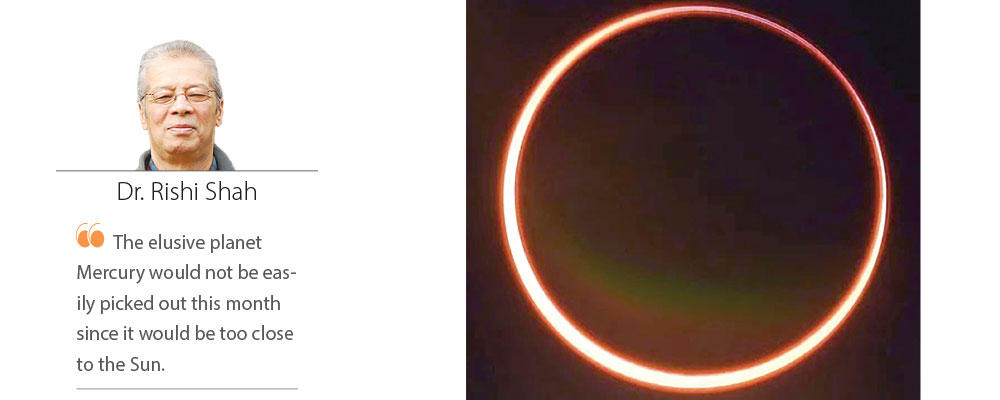
The new moon would be on October 14. An arcane annular solar eclipse would occur on this day. The eclipse would appear in the Pacific Ocean off the coast of southern Canada and move across the southwestern United States, Central America, Columbia, and Brazil.
A partial eclipse would be visible throughout much of North and South America. We would sadly be unable to savour this eclipse. Such eclipses would manifest when the moon was too far away from the earth to completely cover the sun. Consequently, a ring of light around the darkened moon would be witnessed.
The Revered Bijaya Dashami festival would be cheerfully celebrated on October 24, 2023. The full moon would befall on October 28. It has been popularly known as the hunter’s full moon because, at this time of year, the leaves would be shed, and the game would be fat and ready for hunting. A partial lunar eclipse would happen on this day.
The eclipse would be relished by avid eclipse enthusiasts from almost all of Europe, Asia, Africa, and Western Australia. We could chase this eclipse happily from 01:21 AM to 02:38 AM the next day. Partial lunar eclipses would transpire when the moon would slip through the earth's partial shadow, alias penumbra, and only a tiny portion of the moon would be immersed in the darkest shadow, dubbed umbra.
During this type of eclipse, only a particular part of the moon would be dingily unlit as it would pass through the earth's shadow.
An average Orionid meteor shower would display up to twenty meteors per hour at its maximum, which would be experienced this year from the night of October 21 until the morning of October 22 in the northeastern sky. Orionids have been puzzlingly produced by debris left behind by the iconic comet 1P/Halley with an orbital period of 75 years, which has been known and has enthralled exuberant onlookers since ancient times. The shower would run annually from October 2 to November 7. The first quarter waxing crescent moon may outshine some dim meteors, but it would set shortly after midnight, leaving inky skies for enjoying an exclusively good morning show.
The radiant for the Orionids would lie north of the baffling bright ruddy star Betelgeuse (Ardra), glistening gorgeously in the region of the constellation depicting the so-called sword of Orion the hunter. Orionid meteors would zip through the sky extremely fast as they plummet through the earth’s atmosphere at whooping 66 kilometres per second and burn up fairly 96 kilometres above the earth's surface.
The Draconid meteor shower would exhibit merely ten meteors per hour during its peak on the night of October 7 this year. The shower would generally be evident from October 6 to 10. The second quarter waning crescent moon with tenebrous skies would be ostensibly offering opportunities for seeing spellbinding scintillating shooting stars right from dusk.
Meteors would emanate from the confounding circumpolar constellation Draco (dragon). Draconids has been an uncannily unusual shower for watching during the evening instead of the early morning hours. This minor meteor shower has originated from the dusty dregs left behind by comet 21P/Giacobini-Zinner with an orbital period of basically 6.6 years, which was first acknowledged in 1900 by French astronomer Michel Giacobini and then recovered by German astronomer Ernst Zinner in 1913.
The radiants of the Draconids would lie near two eccentric stars, Eltanin and Rastaban, that resemble the imaginary eyes gleaming graciously in the head of the fiery dragon in the northern sky. The orange giant star Eltanin would be purely 148 light-years away, while the yellow giant star Rastaban would be 362 light-years away.
NASA's USD one billion the OSIRIS-REx-RExsion has boldly brought back a peculiar, pristine bounty comprising roughly 250 grammes of rare rock samples from the alluring asteroid Bennu. The loosely bound rocky Bennu has become involved with the third touch-and-go landing venture in history and the first one for the United States, following two Japanese spacecraft that had flown back to earth with a frugal quantity of asteroid specimens in 2010 and 2020.
OSIRIS-REx had collected the material samples from Bennu, and at the end of its over four-billion-kilometre celestial journey, the OSIRIS-REx mothership released an 81-centimetre return capsule, which was parachuted to settle down at the US Air Force's Utah Test and Training Range southwest of Salt Lake City. Officials from the military test range and Lockheed Martin, which had built the OSIRIS-REx spacecraft for NASA, approached and recovered the blackened container.
The package was wrapped and tucked in a safety net under a helicopter, which carried it cautiously away to a nearby clean room facility at the US Army's Dugway Proving Ground. Technicians then transported the cargo in a special aeroplane to NASA's Johnson Space Centre in Houston for a detailed investigation. Bennu has been awash with carbon-based minerals, which are considered building blocks for existence.
In the chaotic early history of the solar system, after the sun allegedly ignited putatively 4.5 billion years ago, discs of gas and detritus around the newborn star started aggregating together into grains of dust and thereafter into snowflake-like particles that gradually coalesced together to form asteroids and planets. Bennu could presumably be that queer leftover relic from that era.
The seeds of life had probably been delivered by these asteroids at the beginning of the earth, which led to this bewildering biosphere and biological evolution as needed for our creation. OSIRIS-REx is an abbreviation for Origins, Spectral Interpretation, Resource Identification, and Security-Regolith Explorer.
OSIRIS-REx was launched from Cape Canaveral aboard an Atlas V rocket in 2016. It attentively approached Bennu in 2018, setting it up for the touch-and-go landing after two years. After rejecting the canister, the OSIRIS-REX mothership has steered away from Earth. The craft would continue with an extended errand to analyse the next target asteroid, designated Apophis. OSIRIS-Apophis Explorer (OSIRIS-APEX) would arrive at Apophis in 2029.
(Dr. Shah is an academician at NAST and patron of NASO)

-square-thumb.jpg)