- Wednesday, 3 June 2026

Sweden sees opportunity to grow its young wine industry
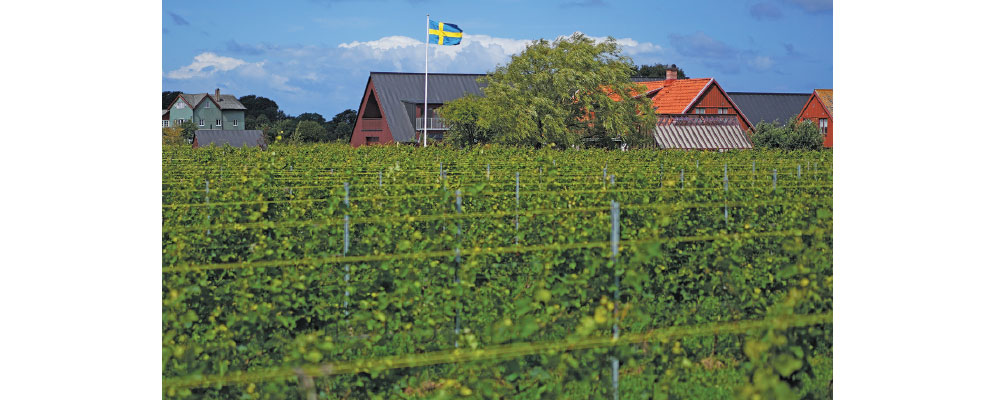

Nyhamnsläge, Sweden, Aug. 21: It’s mid-afternoon in late summer and a fresh North Sea breeze blows through the vines at Kullabergs Vingård, a vineyard and winery at the vanguard of producers seeking to redefine what Swedish wine can be.
Scandinavia isn't exactly what connoisseurs would define as prime wine country and commercial vineyards are still tiny compared to France, Italy or Spain. But with climate change making for warmer and longer growing seasons, and new varieties of grapes adapted to this landscape, the bouquet of Swedish wines is maturing nicely.
As drought, rising heat and other extreme weather events are forcing traditional wine-growing regions to reassess their methods, Swedish winemaking is shifting from mostly small-scale amateurs to an industry with growing ambition.
Kullabergs Vingård stretches over 14 hectares (about 34 acres) and most of the vines were planted less than a decade ago. By 2022, the winery had reached an annual output of over 30,000 bottles — mostly whites that can be found in high-end restaurants from Europe to Japan to Hong Kong and that have won multiple international prizes.
“Where vineyards in more traditional countries are suffering, we are gaining momentum,” said Felix Åhrberg, a 34-year-old oenologist and winemaker who returned to Sweden in 2017 to lead Kullabergs Vingård after working in vineyards around the world.
Grapevines can tolerate heat and drought, and farming without irrigation is traditionally practiced in parts of Europe. But the past decade has seen the planet's hottest years on record, and more warming is expected. That can hit wine, where even minor weather variations can change grapes’ sugar, acid and tannin content.
Climate change can make areas once ideal for certain grapes more challenging. Extreme heat ripens grapes faster, leading either to earlier harvests that can diminish quality, or to stronger, less balanced wines if left to ripen too long.
In recent years, grapevines have been planted farther and farther north, with commercial vineyards appearing in Norway and Denmark and others, including in the American West, expanding into cooler zones. The United Kingdom, famous for its ales and bitter beers, expects the area under vines to double in the next 10 years fuelled by demand for its sparkling wines.
“This is the new frontier of winemaking and grapes grow best on their coolest frontier,” Åhrberg said as he walked through Kullabergs Vingård’s newly built winery, an Instagram-friendly gem worthy of design magazines that was built with sustainability in mind and capacity of three times the current volume.
Temperatures in southern Sweden have increased by about 2 degrees Celsius over the past 30 years compared to the 30 years before that, according to data from the Swedish Meteorological and Hydrological Institute. And the growing season has lengthened by about 20 days.
The widespread adoption of new varieties of disease-resistant grapes is also credited with Swedish wine's growth. Most vineyards have planted a grape called Solaris, developed in Germany in 1975, that is adapted to the cooler climate and more resistant to diseases. That enables most vineyards to avoid using pesticides.
“Solaris is like the national grape variety here in Sweden,” said Emma Berto, a young French oenologist and winemaker at Thora Vingård on the Bjäre peninsula, about 20 kilometers north of Kullabergs Vingård. (AP)