- Tuesday, 2 June 2026

Focus On Agro Research

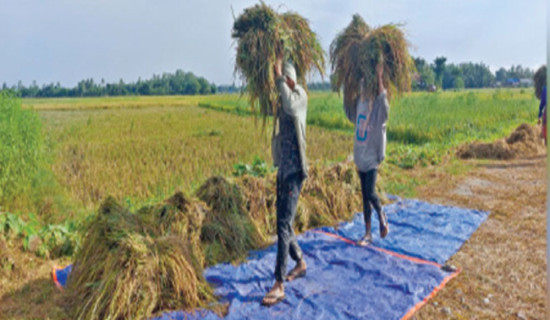
Agriculture is still a main occupation for over 60 per cent of the total population in Nepal although the industrial and service sectors’ share in national economy has grown over the years. The agro sector contributes around 24 per cent to the gross domestic product. These statistics justify the necessity to prioritise agriculture for attaining self-reliance and revitalising the rural areas. A good deal of investment and research in agriculture is vital for ending extreme poverty, hunger, and malnutrition and food insecurity. The country is unlikely to achieve the Sustainable Development Goals (SDGs) until the agriculture sector is modernised and commercialised. It is imperative to attract youths towards agriculture. For this, the sector must be lucrative and reliable occupation for them. The adoption of advanced agriculture technology is necessary to reduce the country's dependency on imported food stuffs.
In order to increase agro products and productivity, the focus must be on research and development (R&D) on it. The developed countries, which have made strides in the scientific discoveries and technology, invested in the R&D to boost agro products and husbandry to feed the ever increasing population and increase national wealth. It is the research and development that provides innovative edge to the countries in increasing overall economic sector. Despite the policy support for the agro sector, its growth has been less than 3.0 per cent owing to inadequate access to the cross-cutting technologies, innovation, inputs, capital, incentives and the market. This shortcoming can be overcome by promoting and investing in R&D that enables to improve quality of soil and develop drought-resistant seeds, improved varieties of crops, effective pesticides and yield-sensing technologies, among others.
In this context, Prime Minister Pushpa Kamal Dahal Prachanda has called upon universities to direct their attention to scientific research and incorporation of new technology in agricultural production. Prime Minister Prachanda made this remark while addressing the eleventh general meeting of the University of Agriculture and Forestry in Kathmandu on Tuesday. The PM also put emphasis on generating skilled professionals for the development of agro and forestry sectors. Being the nation's first technical university, the University of Agriculture and Forestry (UAF) is expected to play a significant role in making a holistic progress of agriculture, animal husbandry and forests through research, technological breakthroughs and their expansion to the nook and corner of the country. The university has established eight colleges under the faculty of agriculture, one college under the faculty of forestry and two centres of agricultural science in different provinces.
The UAF has unveiled the second ten-year strategic plan (2023-2033) to achieve its stated goals and objectives. Since the university enjoys full support of the government, it may not face difficulty in implementing the strategy. It has the onus not only to pay attention to the research and development but also the quality programmes that are effectively implemented to gain impressive outcomes. As a premier institution to impart education on agriculture, the university needs to join hands with other domestic oganisations as well as the foreign universities to excel in innovation and technology so as to bring about agriculture transformation. For example, collaboration with the Nepal Agricultural Research Council (NARC) can be instrumental to spur research and innovation and apply it for the enhanced productivity. It is also equally important to foster public-private partnership to build coordination and linkage mechanisms to this end.