- Tuesday, 2 June 2026

Guru Purnima
Day To Celebrate Knowledge, Wisdom

Teachers have a major role in the production of skilled human resources to work in various sectors. Teachers, like the sun giving light to the universe; provide light to students to help them overcome ignorance.
They lead society from darkness to light. Everyone born on this earth is indebted to three things: God, parents and teachers. Parents give birth to us; the teachers teach us about life, religion, philosophy, culture, habits, behaviours, dresses, dignity, nation and its glory.
They are revered everywhere. We have a special festival dedicated to teachers or Gurus, which has fallen on Monday this year. As teachers always inspire everyone to walk on the right path and to pursue truth, they are called ‘gurus’ or “guiding light” to our journey to enlightenment.
Meanings
According to Joel D. Mlecko, the Sanskrit word ‘Guru’ has a cluster of meanings beyond that of English translation ‘teacher’. ‘Gu’ means ‘ignorance’ and ‘Ru’ means ‘dispeller’. The ‘Guru’ is thus, a dispeller of all sorts of ignorance.
The gurukul is the oldest form of education. In the Rig Veda (IV, 5, 6), ‘guru’ is described as a source, an inspirer of knowledge of the self and the essence of reality.
The Yajur Veda (VII, 27) defines ‘guru’ as one who blesses and enhances the spiritual life of the disciple. From these opinions, it can be said that a teacher always has a higher position in society. The Chhandogya Upanishad (VII-XII) says that one can attain ‘truth’ only by the knowledge received directly from the ‘guru’.
There are legends about how and when people started celebrating “Guru Purnima”.
According to Hindu legend, Vyas, the author of the Mahabharat, was born to a sage named Parashar and a fisherman's daughter Satyavati. So, this day is celebrated as “Vyas Purnima” or “Guru Purnima”.
Likewise, the Buddhist legend states that the Buddha discovered his five former companions whom he enlightened with the Dharma Chakra Prabartan Sutra. This was the full-moon day of Asar. Since then, people have started celebrating this day. In this context, Guru Purnima, which is an occasion in various cultures to honour teachers for their tireless mentorship, is a celebration of learning and wisdom.
It promotes student-teacher relationships and fosters self-reflection about our own horizontal growth on the path of learning. This day encourages everyone to become lifelong learners and strive further for the knowledge that ultimately leads one to wisdom. Over the last few decades, we have seen that teachers have not been given much honour. The bond between the teacher and student has weakened. Students seem to be close with teachers until they complete their studies. But soon after they receive graduation certificates, they start ignoring teachers. The students treat knowledge as goods bought from the market. This trend has reduced the teachers’ positions to mere salespersons.
Political leaders, too, use teachers as their activists. They want them to work for the benefit of their parties rather than letting them engage themselves in research and scholarly activities. Teachers have been a marginalised group in the eyes of the state. They have been treated as second-class citizens in comparison to bureaucrats in terms of providing facilities.
An undersecretary receives residential allowances, vehicle/ fuel, dresses, free electricity and many other facilities from the state. No university professors, except the ones appointed as administrators, enjoy these facilities. Are teachers not the ‘gurus’ of even the bureaucrats?
Social impact
Politicians alone are not responsible for the degrading position of teachers in Nepal. The academics themselves are responsible for this. Their inability to guide society is a major weakness. They need to be able to make everyone aware of the fundamental issues related to nationalism, national security, the economy and many others. They should be dedicated to learning and research. They should be knowledgeable, disciplined and inspirational to their students.
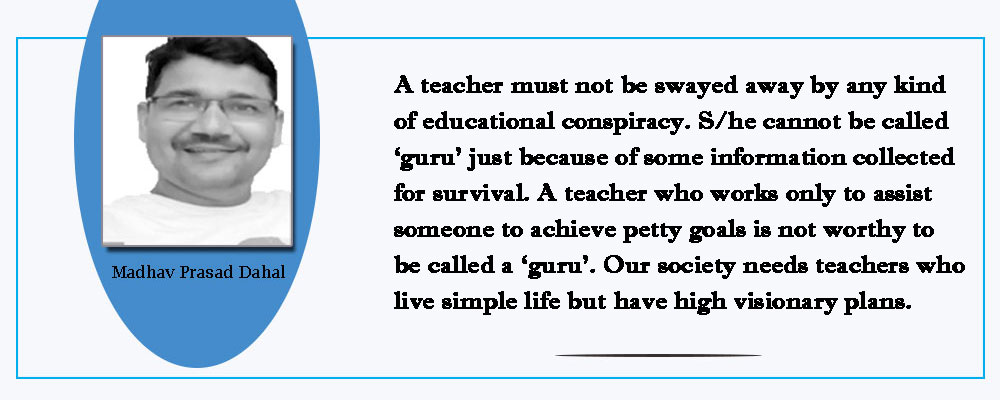
They must guide their students to follow traditional values, maintain high standards and develop critical consciousness. A teacher must not be swayed away by any kind of educational conspiracy. S/he cannot be called ‘guru’ just because of some information collected for survival. A teacher who works only to assist someone to achieve petty goals is not worthy to be called a ‘guru’. Our society needs teachers who live simple life but have high visionary plans.
Some teachers might have defamed the worth of dedicated ‘gurus’. But we must not forget the positive impact that the teachings of devoted ‘gurus’ have left on us. We must pay them our gratitude as we can.
The political leaders who are offered heavy garlands weighing 20 or 30 kg from the general public should also make their teachers smile with the same level of respect.
The President, the Prime Minister, former prime ministers and ministers and all other high-ranking officials should start paying respect to their ‘gurus’. That will certainly have a positive impact on instilling good culture among youths.
(The author is an Assistant Professor at the Institute of Engineering (IoE), Pulchowk Campus, Tribhuvan University.)