- Tuesday, 2 June 2026

Operation of feed factory by cooperative benefits farmers
 Laxman Kafle
Laxman Kafle
Laxman Kafle
Nawalparasi, July 2: Farmers and members of Mukundasen Dairy Producers’ Cooperative of Gaindakot Municipality-11, Nawalparasi East are happy to feed quality grains produced by their own cooperative to their cattle.
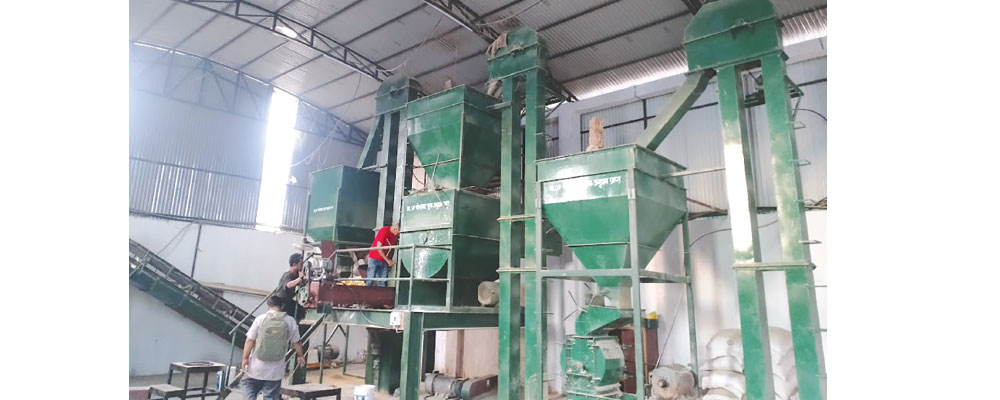
With the aim to produce quality feed and provide to farmers, Mukundasen Feed Factory run by the Mukundasen Dairy Producer’s Cooperative is producing animal feed using modern technology.
The cooperative started the industry after being selected for the Nepal Livestock Sector Innovation Project (NLSIP) for the purpose of feeding quality feed to animals.
The NLSIP is a project conducted by the Ministry of Agriculture and Livestock Development with the support of concessional loans from the World Bank with the aim of increasing productivity in selected livestock value chains, increasing the value of livestock products and strengthening the animal service sector of Nepal.
Gopal Shrestha, chairman of Mukundasen Dairy Producer’s Cooperative, said that the cooperative was able to establish a feed factory with the support of the NLSIP.
After starting the construction of the industry in September, 2021 and ending in mid-December, 2022 with a total investment of more than Rs. 19.4 million, the Cooperative has received a grant of around Rs. 9.7 million from the NLSIP as per the agreement.
In this project, there is a provision that the project should invest 50 per cent, banks and financial institutions should invest 30 per cent while 20 per cent should be self-invested by the sub-projects.
Daily 12 tonnes feed production
The industry is currently producing around 12 tonnes of grains daily, said Shrestha.
The industry which came into operation from mid-December 2022 is producing two types of feed -- pellets and powder.
Chairman Shrestha said that the industry, which has a production capacity of 24 tonnes of feed daily, is producing only 12 tonnes.
The production is lower than the capacity due to the irregularity of electricity supply as well as the lack of raw materials required for feed production, he said.
“Mustard residue is considered very nutritious for grains. But it should be imported from India. Among the 11 items required for feed production, maize should also be imported from India. Because of this, it has not been possible to produce according to the capacity,” he said during the media monitoring at the cooperative.
Chairman Shrestha informed that currently 360 tonnes of grains are being produced monthly by the industry. Out of this, 90 tonnes of grains per month are being consumed by the cooperative farmers, while the rest is sold in Biratnagar, Bhairahawa and Narayangadh.
Increased milk production, reduced costs
The cooperative is selling pellets at Rs. 50 per kg and powder at Rs. 48 per kg to its members.
According to Sagar Kadariya, a young farmer who is a member of the cooperative, he had to buy it in the market at Rs. 55 per kg. But after the cooperative started grain production, farmers are buying pellets at Rs. 50 per kg and powder at Rs. 48 per kg, including transportation cost.
In this way, the farmers are able to buy grains at a cheaper price of at least Rs. 5 per kilo. He claimed that the grain is not only cheaper but also better in terms of quality than the grain available in the market.
He said that due to quality feed, milk production has also increased and animal diseases have also reduced.
“I am very happy to use the feed produced by our cooperative. In almost 20 years of being in this occupation, I have never been able to use such quality feed for my cattle. After using this feed, the milk production of the cows has increased and the diseases of the cattle have also decreased,” Kadariya said.
Currently, there are 45 cows in his shed. According to him, he sold around 200 litres of milk daily and earned around Rs. 100,000 monthly from the sale of milk.
Chairman Shrestha said that they never compromise in quality as the quality feed was a must to increase production of milk and increase income of farmers.
According to him, he is also using the same feed for his cattle. “I have 60-70 cows in my shed. I am selling 500-600 litres of milk daily.”
Due to quality, the consumption of grains used by our members for their cattle has reduced, he said. This has supported farmers to reduce cost and increase income.
He said that earlier, 5 kgs of grains bought from the market had to be given to a cow, but now if we use our own production, 3 kgs will suffice.
Collecting 14,000 liters of milk per day, turnover of Rs. 400 million yearly
There are 925 members in the cooperative. It is collecting around 14,000 litres of milk daily.
Chairman Shrestha informed that the cooperative which used to collect 9,000 litres of milk daily is currently collecting 14,000 litres.
He claimed that milk collection had increased after farmers were encouraged increasing number of cattle and increased milk productivity of animals.
According to him, the cooperative had an annual milk turnover of Rs. 400 million.
After collecting the milk, the cooperative is also making sweets and selling them.
This cooperative, which has been providing feed to its own members, has also been providing technical assistance to farmers in milk production and animal care.
The cooperative is selling milk with a low margin with the aim of ensuring that the farmers get a fair price for the product.
“Our aim is that farmers get the maximum price. We have reduced the cost of grain, while the price of milk has been fixed by making general operation cost only of Rs. 1 per litre,” said Chairman Shrestha. According to him, the cooperative is buying milk from farmers at Rs. 76 per litre.
He said that the cooperative which is providing some amount as bonus to the farmers who are producing milk annually, is giving a separate bonus as festival expenses.
Sushil Khadka, an agricultural economist of the NLSIP, said that the project was supporting farmers through the subsidiary project by cooperating with the farmers in a cooperative/group and individual manner with the aim of making the country self-sufficient in the production of milk, goat meat and pashmina.
The NLSIP is conducting sub-projects in 289 municipalities in 28 districts across five provinces of the country.
He said that the project was supporting farmers in increasing the production and marketing of dairy products under the dairy production chain of the project and is conducting 537 sub-projects across the country.