- Tuesday, 9 June 2026

A Tale of Bhutanese Refugees
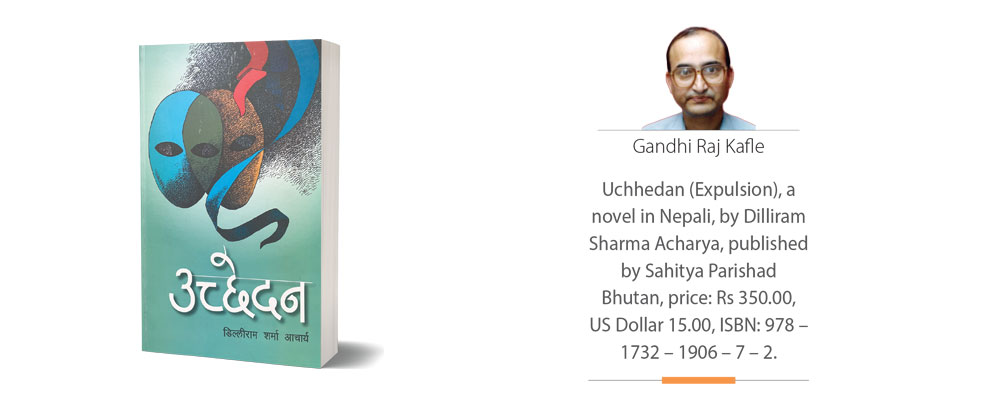

Some pains are stubborn because they build a secret hole in the heart to pinch permanently. There can be many contexts to this, but a more painful theme has been portrayed as a novel in the under-review book entitled Uchhedan, written by Dilliram Sharma Acharya.
In a broad sense, we can call it a social novel. But the portrayal of stories in it is extremely harsh because of mala fide action taken by one community or nation against a few minorities there. Is this treatment not unsocial? But some societies or nations exist in the world that act in such a way that expulsion from the dear soil becomes an inescapable compulsion for many, and they, thus, live a life of refugee.
Nepali readers know well what happened in Bhutan, our neighbour. If we see it now in the political spectrum, many things have been said and many impacts and implications explained already, and today Bhutan’s refugee issue is no longer a burning issue for power centres.
But who stops her heart from telling? Litterateurs’ sovereign tools do find some arts in words to bring out true stories felt by hearts incessantly. Here Dilliram Sharma Acharya, the author of the under-review Uchhedan, has expressed himself to spread the message before Nepali readers clearly that the status of 'refugees’ for them can’t be as sacred as their pure desire of heart to live and grow as sovereign citizens. So, the author Acharya, who now is a refugee living in Norway, is presenting a proof to show how sacred Bhutan soil, his birthplace, and his nation is living in remembrance and sentiments lovingly, writing the novel entitled "Uchhedan".
This is a 284-page book where the story is complete with descriptions of thirty-four themes of the novel. The sufferers of eviction and expulsion are many if we recall the then-peak-time stories of the Bhutanese refugee issue. But this novel has quite a few characters, which means the stories of Dechchen (the lead female character) and Ramesh (the lead male character) are the representative stories of the issue.
Like all the girls and boys, Dechchhen and Ramesh, too, had a beautiful, innocent life in Bhutan. They even did not care about how or from where they came there. Nepal, in fact, was not their country; only Bhutan, in whose respective birthplaces they were spending their golden childhood, were places of all love.
Character Dechchhen suffers premature cheating in times of innocent love from a fraudulent lad named Dipak, but this part of the story disappears because of the arrival of the other horrific troubles in her life. According to the stories described in the novel, she finds love and peace with the arrival of Ramesh. But the path ahead for them is unpredictably painful because of the divisive politics played by the Bhutanese authority with the intention to expel many of the people who have the identity of Nepali origin.
The novel "Uchchhedan" describes all levels of torture faced by Bhutanese Nepalis in the southern belt of Bhutan. But there was no one to listen to it. They openly said, "Go back to your country, Nepal, because this is the country of Drukpa’. Their private properties—lands and houses—were seized or burned down. They began to call themselves "Ngolop’ (anti-national). Even the peaceful protests were crushed brutally. The protesters in custody were compelled to sign authorities drafted documents to forcefully expel them from the country. The Bhutanese Nepali, who later started to be known as refugees after they came to Jhapa district of Nepal, thus have numerous stories of discrimination, torture, and suffering to tell just because they were denied their in-born identity with the ill-intention to expel them from their own land of birthplaces. This is the main theme that has been focused on for readers in this novel.
The story is written in simple Nepali language. The theme of love, which is one of the decorative arts for such stories, is only a momentary thing of description in this novel. This is not illogical because it is neither a love story nor an attempt to weave a literary presentation of happy social change. So, the characters in it go through abnormal times, put up arguments about the injustices they met, and finally speak out about why they accepted to live a life as refugees under the mediation of the UN (United Nations).
But one thing that must be said about the Uchchedan novel by Acharya is that things suppressed in the heart can’t be forgotten forever. They finally come out, and the literary art is there to assist in the release of pain, which is built up in the hearts of Butanese refugees by their expulsion from Bhutan, their sacred birth country. Acharya’s Uchchedan highlights this fact in plain language.
(Kafle is a former deputy executive editor of this daily.)