- Tuesday, 2 June 2026

Some Thoughts On Global Citizenship

One queer question often reverberates in my ears – is there such a thing as global citizenship in our world? The question is as unpalatable today as it would be in the past if someone asked. I ponder this intriguing issue and find only tentative answers, which are not only inconclusive but may be debatable to many and controversial to a few people.
What once was a queer question has become a pertinent issue in less than half a century, owing to the rapid mobility of people between the nations. In the changing context, another question quickly arises – can there ever be such a thing as global citizenship in the future? This write-up hinges on these two pertinent issues – the existing condition of citizenship at present and the possibility of global citizenship in the future.
In primitive ages, people lived in tribes and small communities. Due to their immobility or slow mobility from one place to another, the rest of the earth was unknown to them. If people ever moved, they only did it in search of food and shelter. They needed fertile land to grow grains and vast grassland for their cattle to graze. This was the pattern of their livelihood. In a sense, the whole earth belonged to human beings who could move to any place they liked, provided that they were not threatened by local tribesmen. Today we have only divided it for our convenience, not to mention forcible division in the interest of some rulers.
National citizenship
As time went by, the population grew fast, making the land narrow and financial resources limited. Then the concept of small states originated. Over the years, the powerful states began to invade the powerless, and the latter also tried to protect their territories from the looming danger of the former. Amidst the attacks and counterattacks, the idea of national citizenship evolved.
National citizenship involves a legal status of a person to permanently live and enjoy political, economic, social, and cultural rights and follow duties in accordance with the rules and regulations of the country where she or he is born or is an immigrant who has fulfilled all conditions for being a citizen of the host country. It entails the relationship between an individual and the state, where each has the defined respective rights and responsibilities. In this sense, citizenship is used as a synonym for nationality.
Many civilizations developed and declined in human history. But the previous century was the most turbulent century that underwent the two great wars killing many million innocent people and devastating the civilisation and culture that had developed with the hard efforts of good citizens worldwide. The destruction culminated in the utter ruin of Nagasaki and Hiroshima in Japan caused by the atom bombs named “little boy” and “fat man” hurled mercilessly by the American forces. None could ever imagine the evolution of global citizenship in such a context of horror caused by powerful nations. So, at least for me, the question I mentioned at the outset proves irrelevant.
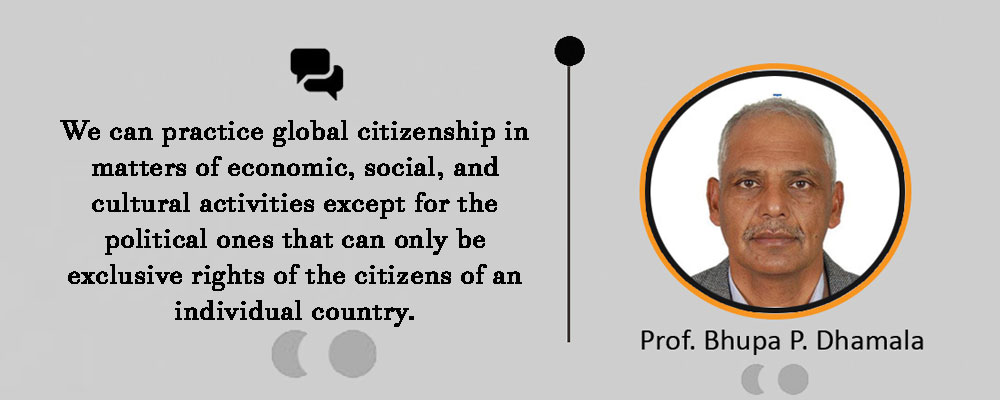
However, time healed the deep wound of the suffering of nations and their people. Moreover, international cooperation and interdependence between the countries became essential for development and prosperity. Therefore, the type of global citizenship we can imagine in the present context is different from what we might imagine as the whole earth in one nation. To assume the global citizenship of the whole earth is not practical owing to the geographical distance and biological as well as cultural diversity between the peoples. What we can best practice is the unrestricted mobility of people to other nations while being permanent residents of a particular nation. This can be a type of dual citizenship in a sense – global citizenship for new things and national citizenship for already defined things. We can practice global citizenship in matters of economic, social, and cultural activities except for the political ones that can only be exclusive rights of the citizens of an individual country.
We can thus tentatively describe global citizenship as a body of economic, social, and cultural activities where communities and individuals are involved and recognise that every human being is a citizen of the world. This type of global citizenship, if it ever exists, nurtures mutual respect among all humans on the earth, irrespective of living in an individual nation. It encourages individual citizens to think critically about what is just and equitable and what can minimise possible harm to other people living in another country but sharing the same planet.
Conspicuous example
The most conspicuous example of global citizenship is perhaps the European Union (EU), where any person in an EU country can freely live, move, work, pay taxes, and sometimes even vote for the leaders they like. Interestingly, these people can be hailed as European citizens while at the same time being bona fide citizens of their respective citizens. The same can be done in the Americas, North Asia, and the Arabic world.
If the EU is a good practice despite some problems, it can also be done in South Asia with good intentions of making this region a beautiful paradise imbued with rich biodiversity despite religious, linguistic, and cultural differences. Much controversial though it might seem to some chauvinists, it can be esteemed as the need of the day. In some sense, it has already come into practice in the form of SAARC, no matter how thinly. If we practice sincerely, we can build cordial relations between the South Asian nations, which can form a substantial unity of people sharing similar issues and possibilities of development.
When national citizenships are joined to form larger regional citizenships in all regions in the least controversial ways, comprehensive global citizenship is very likely to occur while keeping the national integrity of each nation intact. But we need to think creatively and critically discuss the issue with all good intentions and motives to bring about positive changes in our planet.
(The author is the chairman of Molung Foundation. bhupadhamala@gmail.com)