- Sunday, 17 May 2026

What Is Credible Is Definitely Reliable
 Dhruba Hari Adhikary
Dhruba Hari Adhikary
Dhruba Hari Adhikary
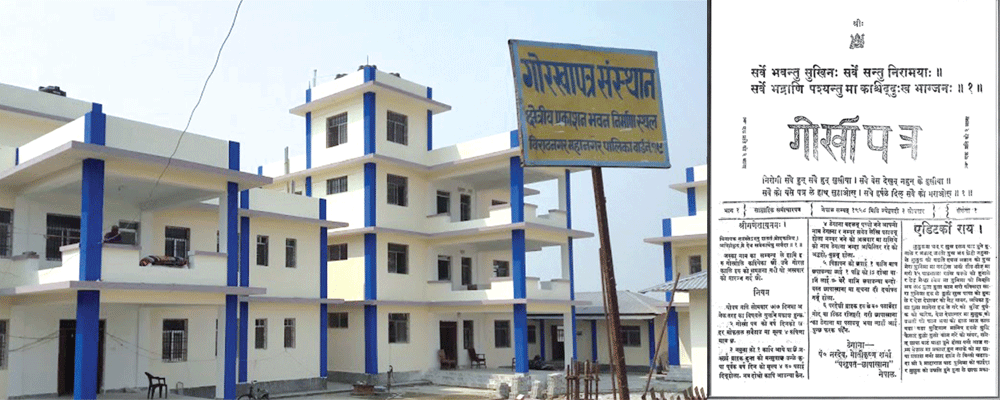
Even a cursory scan of Nepal’s annals of media industry is sufficient to understand how the country’s oldest newspaper, Gorakhapatra, has been able to dominate the national media landscape for well over a century. It indeed is a rare phenomenon, at least in the South Asian context, to see a newspaper launched as a weekly in 1901 continues to be one of the major news outlets in the present era—often dubbed as the digital age.
Today, the Gorakhapatra is not just a Nepali language daily; it has grown up to be an institution which runs one English daily—The Rising Nepal— and three other Nepali publications, catering to the needs of diverse audiences that include the literary community, the burgeoning class of youths as well as the caring groups of parents who want their offspring grow in a competitive educational atmosphere.
All of the Gorakhapatra Corporation’s publications have print editions, with their contents simultaneously available in their digital editions. In other words, the readership is no longer confined to domestic locations; the readers are scattered worldwide embracing the Nepali diaspora abroad.
Understandably, these transformations did not happen overnight. It took several decades of effort and came along with innovative changes in the area of information technology. With concomitant scientific advancements, the number of media platforms have proliferated in recent years, giving consumers the opportunity to select the convenient ones. Besides, social media outlets have visibly helped expand the instant communications between and among communities across the world. All said and done, the prospects of social media replacing and displacing traditional mainstream media outlets remain uncertain. This uncertainty primarily emanates from increasing anxiety over the reliability of information contained in the social media posts—be that in Facebook, Twitter, Instagram, YouTube or other platforms.
This point has been aptly illustrated by Alan Rusbridger, a British editor, in his book BREAKING NEWS: “In 2017 anyone can be a ‘journalist’, and anyone can transmit their work to a global audience.” But how credible —and thereby reliable–would such casually collated information be? Needless to emphasise, absence of verification of facts and figures together with proper editing of contents, such stories cannot provide a basis for informed decisions on issues of serious public concern. Probably it is this reason why the West has so far resisted attempts to sideline traditional mediums. And this perception appears to have been shared globally. Nepal is not an exception.
Distinct synonym
Gorakhapatra, which became a daily newspaper in February 1961, stood as a synonym for newspaper for decades—up until the political change of 1990. Over time, interest to invest in the news industry surged with the emergence of dozens of newspapers. Liberal state policies also attracted investors into radio and television sectors. The process further expanded to include internet-based mediums. These changes effectively ended the monopoly the Gorakhapatra enjoyed till then, and made it face the emerging competition. The ‘official’ tag traditionally attached to this flagship publication also inflicted a slight dent in public perception. Newer publications in the private sector claimed to be ‘free and independent’, as opposed to publications owned by a public undertaking.
If we look at the relevant scenario of the1950s (after the first democratic inning of 1951) the vacuum appears even more striking. While the newly dawned democracy opened the door for a free press, a few individual enthusiasts from the small community of intellectuals of that time showed interest in running newspapers. Nevertheless, their efforts produced some papers of different periodicity—ranging from dailies to weeklies and fortnightlies. But most of them were run on shoestring budgets by activists—seemingly without a definite idea about how newspapering worked. All they had had was a missionary zeal—to institutionalise democracy.
Editors in those days, recall some of the surviving journalists, had the privilege of being their own publisher, reporter and hawker themselves! Most of the papers were tabloid—in both size and contents. Gossips and rumors occupied a fair amount of newspaper space. With an exception of one or two, all ‘national’ newspapers ran speculative— and often slanderous—stories. That situation left a place for credible and authentic news reports. It was this void that the Gorakhapatra filled in, although chattering classes continued to label it as the ‘government mouthpiece’.
Public awareness
Numerical growth of news organisations in the intervening decades is an indicator of enhanced public awareness aimed at making democracy a participatory process. However, quality journalism, based on factual reporting, has been on the decline for a while. And emerging trends do not offer credible basis for optimism. Party propagandists have been found assuming the role of editors and reporters. Likewise, publishers (investors) of prominent media houses have tended to recruit editors and reporters as their pliant clerks.
Oftentimes, facts appear stranger than fiction as some of the committed journalists too have tended to compromise on the journalistic principles and ethical standards in lieu of a quid pro quo. Such unhealthy practices are a disturbing indicator.
Meanwhile, what Gorakhapatra and its allied publications are currently doing can be seen as a beacon of hope. People who look for reliable sources of information prefer to turn to the pages of Gorakhapatra and The Rising Nepal. As can be seen today, these papers have lately augmented the volume of domestic stories produced by their own network of reporters, using fewer reports from the news agency, Rashtriya Samachar Samiti (RSS). Obviously, today’s busy readers do not want to misspend their money in buying three or four newspapers (or visit online news portals) or squander valuable time in sifting stories to figure out what must be the ‘real news.’ Even if the readers choose to go for online editions only, they have to waste their time for a fruitless exercise. Broadcast mediums, particularly privately run radio stations, are equally unreliable. And, amazingly the regulatory authority, Press Council Nepal, is an ineffective entity, to put it mildly.
A close analysis of news reports—and leading articles— published by the Gorkhapatra and The Rising Nepal in the past couple of years offers room for reasonable satisfaction. From time to time, they have run stories that can be called scoops or exclusives. For instance, misuse of properties belonging to Pashupatinath temple, pathetic conditions in government-run hospitals and collapse of bridges due to contractors who earlier won construction contracts by bribing corrupt officials are examples of issues picked up for in-depth reporting. The news reports printed by the Gorkhapatra, in late April, about mysterious losses of electronically stored official data, made the government alert on this front. Topical commentaries found in opinion pages are also making valuable contributions.
The story on losses of data, mainly affecting the Public Service Commission (PSC), reminds me an incident of mid-1990 when copies of Gorkhapatra sold like hotcakes. It ran a detailed story on how some palace courtiers attempted to push through their draft of constitution that visibly diluted the reforms king Birendra had promised through a proclamation he made in early April that year. Resourceful editors at that time had obtained a copy of the controversial draft and took a bold decision to print the story in the larger public interest.
In conclusion, editors and managers at Gorkhapatra deserve appreciation for applying their professional skills to retain, even enhance, the glory they inherited from their illustrious predecessors. They must not remain complacent, though.
(Adhikari is a senior journalist, intellectual and media analyst.)