- Tuesday, 2 June 2026

Big Power Rivalry Sparks Risk

Governments are best known during crises. The growing division among hitherto allies in the West reiterates once again this fact in no uncertain terms. Differences of opinion and approaches to dealing with their existing domestic conditions show an accelerated rift and trust-deficiency. Triangular superpower rivalry is beginning to define and outline the changing shift in global power structure and implications. This will lead to a world witnesses forging of new strategic alliances at regional and perhaps global levels.
The Washington-initiated AUKUS (Australia, the United Kingdom and the United States) has yet to gather momentum. It risks shaking at its foundation. Of late, Australia seems to be reviewing the implications of the grouping’s nature of functioning. Widely seen as an alliance aimed at containing China, the campaign could hurt Canberra’s trade with China, Australia’s largest two-way trade partner, which amounts to nearly one-third of its overseas trade.
The UK, too, is facing domestic problems because of rising costs of living. The US itself is beginning to feel the heat of competition from China, Russia and their allies while Europe remains divided over the American agenda on China. Nation-first agenda is a natural course that leaders and their governments aspire for. Pragmatic approach and necessary adjustments are inevitable but not to the cost of core national interests. Each to its own interest first and foremost is the assertive stance.
Ill imprint
Now in its 14th month, the Ukraine war has had fallout in multiple ways. One of the lessons it offers is how nations in the 21st century react and connive against rivals. It is also a telling narrative on how power blocs interpret global events—sometimes in the name of national independence and sovereignty and, on other occasions, citing security interests. Ukraine might be heading toward the whirlpool of “the next Afghanistan”, what with the US-led West having already spent a staggering $150 billion in the first 12 months of the war. While Kyiv constantly asks for more, the strains borne by European governments begin to show on their economy and the living standards of people in general.
While the still powerful dollar faces the kind of competition it had not confronted in the post-World War II decades with a disconcerting bearing on US and its core allies, the rest of the world gets baffled by the development. Trade, industry and others watch with close interest on what is termed as a steady dedollarisation development. This all began with the manner in which the US roll called Russian “oligarchs” for sanctions, freezing their bank accounts and seizing their property. Individuals in close proximity to Russian President Vladimir Putin found themselves assaulted by the sanctions just because they did not denounce the man who ordered his troops into Ukraine, after the latter pushed for NATO membership.
Occasionally taking light of history might merit a modicum of understanding at normal times but blatantly ignoring the past in crisis does not deserve sympathy, let alone empathy. Ignorance is bad enough; arrogance added to it is an open invitation to unpredictable consequences. In about four decades, communist China lifted 800 million people out of extreme poverty. The sheer size of the people thus rescued from harsh economic conditions is unprecedented. The enormous record is underscored by the fact that the number is significantly higher than the entire population of the whole of Europe, not just the 27-member European Union. It has proved to be the envy and a strong potential model for other nations to borrow a leaf or two from the Chinese success.China’s investment in Africa having consistently been higher than the combined investments from the rest of the world, the continent with the proportionately youngest population could try to borrow some, if not most, development features emanating from the communist superpower. NATO plan to expand military presence to the East is strewn with serious risks. Intrigues, clandestine transactions of militarily strategic nature create intra-alliance and inter-alliance suspicions and mutual distrust, which vitiates regional as well as global relations.
Telling facts
As direct fallout of the on-going struggle for strategic dominance, the breaching of the Nord Stream pipeline in Europe offers an ominous example. The US role in the incident that disrupted the supply of cheap oil to much of Europe is highlighted by America’s top journalism prize winner, Seymour Hersh, known for his investigative journalism over the decades, dropped a bombshell of disclosure in February, when he disclosed a confident finger at Washington’s role in disrupting damaging the pipeline.
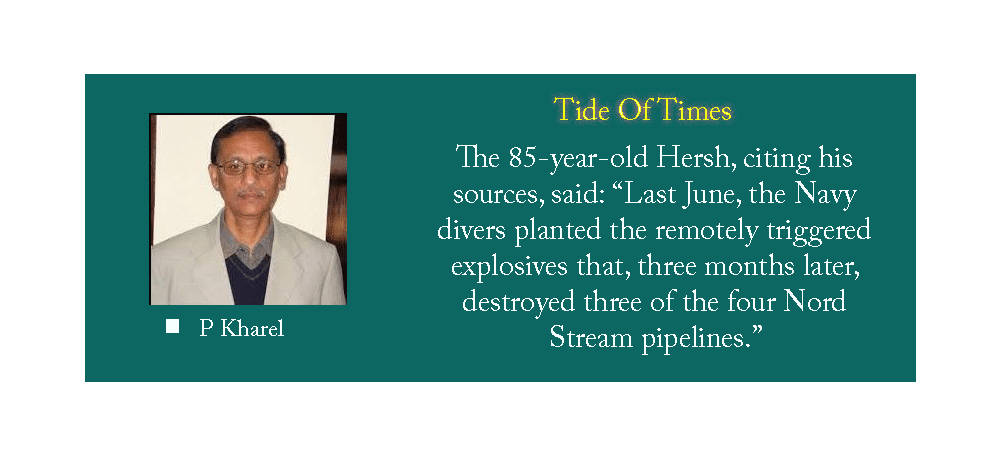
The 85-year-old Hersh, citing his sources, said: “Last June, the Navy divers planted the remotely triggered explosives that, three months later, destroyed three of the four Nord Stream pipelines.” Predictably, White House Spokesperson Adrienne Watson dismissed the report as “false and complete fiction”. He did not elaborate or issue reiterations to this effect. Sanctions against Russian oil/gas soared US oil price to soar, fetching huge billions of extra dollars in profits to those with heavy stockpiles. Norway, too, made $138 billion extra profits, out of which $7 billion was doled out to Ukraine, whose tragic conditions have worsened because of war costs and the hike in gas and oil prices.
George W. Bush wanted to complete his father’s unfinished task of subduing Iraq. He and his loyal supporter British Prime Minister Tony Blair contrived an excuse to invade Saddam Hussein’s Iraq in 2003. The duo’s ruse was the lie that Iraq possessed banned weapons of mass destruction. At least 500,000 civilians met with violent deaths, most of them at the initial stages of the war. Other agencies originating in the West estimate the figure to be more than one million.
Against such background, who will blink first in the prolonged Ukraine war? Putin is mostly unlikely to do so. He cannot afford to lose without risking great damage to his reputation. His high public approval ratings as compared to his counterparts in the US and Europe can be attributed in large measure to Russian people’s admiration of a man who put the sagging image of their country back on the map of superpowers. This only begs for true conflict resolution seekers to work on a viable peace process acceptable to the first rank stakeholders with endorsement of others in the not so deep background.
(Professor Kharel specialises in political communication.)