- Friday, 29 May 2026

An Erudite General's Security Perspective
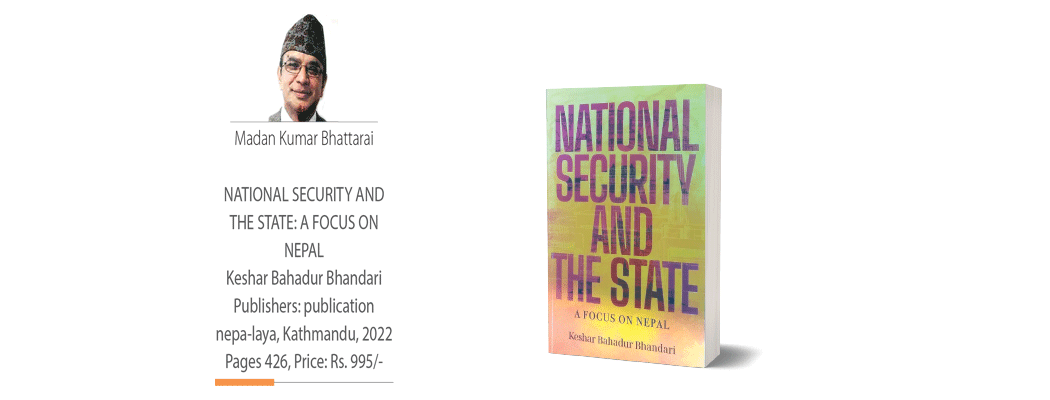

Keshar Bahadur Bhandari, a retired Brigadier General with an academic bent of mind and holder of PhD degree, is taken as a defence and security analyst with considerable experience in the area of security studies and exposure to security-prone countries like Pakistan and Afghanistan as a military adviser under the auspices of the United Nations.
He published a book entitled 'National Security and the State: A Focus on Nepal', as possibly the first attempt to write any book in English on the subject so far from a practising security expert with tenures in various command and field assignments including National Security Council, an important unit of the Nepal Army apparatus.
Divided into eight parts and 23 chapters plus three annexures dealing with the structure, rank and organization of the Nepal Army, the book has taken an unconventional approach to deal with Nepal's national security in the sense that it tries to assimilate various thought processes in terms of Nepal's security paradigm in the context of changing situation in the region with significant repercussions on the country's security. Dedicated to his parents, Pralhad Bahadur Bhandari and Uttar Kumari Bhandari, the book is a product of his long innings in the national army and his persistent research zeal that has put him in good stead.
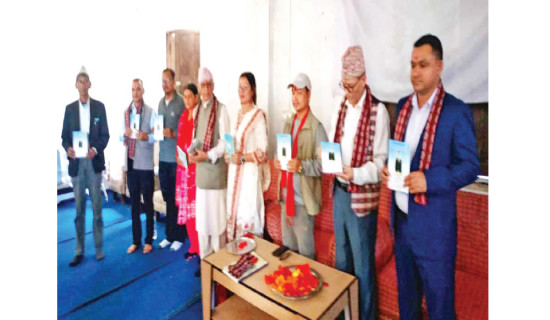
In the preface, the author has a mixed approach to Nepal's security policy, saying that the country drafted its first security policy under the aegis of the National Security Council with him as one of the pivotal figures as early as 2001 as Lt. General Balanand Sharma thought it appropriate to describe the state of affairs during the formal launch of the book. In the prologue, the author tends to describe the peculiar geo-political location of Nepal as a mix of opportunity and challenge to its security and prosperity.
Remaining unimplemented for a long time, Nepal's security policy took the shape of a formal document only in 2015. The first part with two chapters basically deals with Kalapani and the surrounding area of Nepal's westernmost border which has remained a hot topic for border disputes between Nepal and India, and dynamics of small power-big power relations from the perspective of defence including the definition of a small state. It seeks to portray the role of small powers in international relations including security dynamics with case studies of countries with a major focus on Israel, Mongolia, Sweden and, of course, Nepal.
Chapters three to nine under part two incorporate discussions on a variety of issues particularly relating to a cursory glance at national security before unification, the role of three stalwarts, King Prithvi Narayan Shah the Great, Bahadur Shah and Bhimsen Thapa, in the context of the country's unification, a century-old Rana interregnum with focus on Jang Bahadur, and situation during one decade of the advent of democracy. They also try to examine the threadbare Panchayat period with stress on the rules of King Mahendra and King Birendra with the concurrent role of B.P. Koirala, 1990 - 2006 era with the reinstatement of parliamentary democracy, the upsurge of the Maoist movement and critical role vis-à-vis national security and impact of 12-point understanding among Nepali parties.
Part three chapters 10 and 11, dwell on more complicated and even controversial aspects of the nation, nation-state and national security. The author forcefully implies that Nepal does not qualify to be called a nation-state if requirements for such categorization are duly taken into account. He concludes that our country can better be taken as a state-nation rather than a nation-state.
Chapters 12 and 13 in part four pertain to wider dimensions of security challenges of the 21st century with succinctly defined subjects/areas like uranium, petroleum reserves, UN peacekeeping operations, and innate ties between religion and national security on the one hand, with suitable emphasis on some recent aspects like Belt and Road Initiative, connectivity, regional security and security concerns, Indo-Pacific Strategy and Millennium Challenge Corporation, China factor and role of Nepal in such a scenario, on the other.
Part V in chapter 14 deals with Nepal's National Security Council, constitutional provisions and international practises as regards such bodies with a special focus on practises as prevalent in SAARC countries. Chapters 15 and 16 under Part VI are more specific in the sense that they discuss national security thoroughly with a special focus on Nepal's security policy and various contours and dimensions of security threats and challenges from both traditional and non-traditional perspectives.
Part VII with chapters 17-20 is more specific in the sense that it scrutinizes the role of the Nepal Army with a detailed analysis of its history, prevailing situation and future scenario. The last part VIII divided into three chapters 21-23 examines national security from a rather theoretical perspective with a focus on the formulation of national security policy along with its constituent components and challenges.
In the comparatively brief epilogue, the author identifies the Kalapani issue as what he prefers to call a catch-22 poser, and advises its deft handling even suggesting likely modalities to resolve the situation amicably in the larger interest of close and mutually beneficial ties of friendship and cooperation that characterise Nepal-India relations.
All these factors tend to make the book quite a useful treatise to be read by all those who are interested to learn the nexus of national security dynamics of Nepal, with or without uniforms.
On the issue of the unpredictability of the role of the security apparatus in the survival of a nation, Professor Anand Aditya in his quite useful note in the book raises the status of the fall of the mammoth Soviet Union leading it into disintegration despite owning the largest army on the earth. Aditya also seemed apprehensive in his remark that Bhandari's book leaves quite a few queries and curiosities unanswered or even unraised, possibly in a deliberate manner given the complexities of the issues involved. To conclude and be fair to the writer, it is also a daunting task to attempt a fully comprehensive work in one volume on such a cross-cutting issue of national security. With these words, I congratulate the writer and his best half Professor Bidya Bhandari for their concentrated hard labour in bringing out such an important book with great contributions to the country at large.
(Dr. Bhattarai is a former Foreign Secretary and ambassador.)





-original-thumb.jpg)