- Friday, 29 May 2026

Fractured G20 foreign ministers grapple with deepening rifts
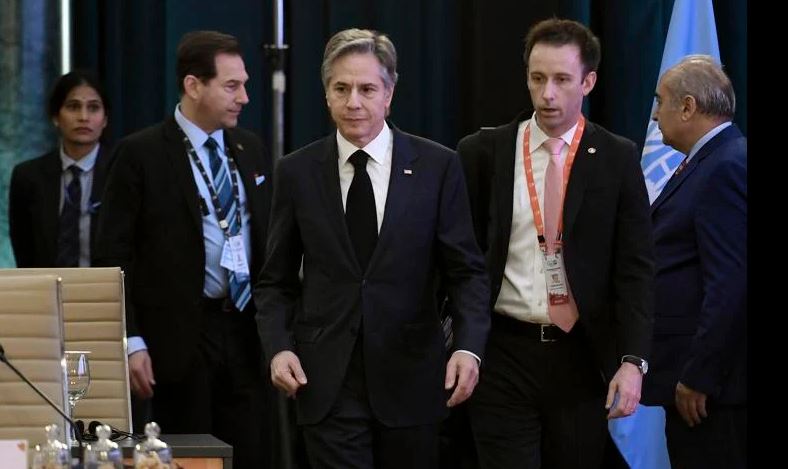

New Delhi, Mar. 3: Top diplomats from the world's major industrialized and developing nations grappled Thursday with deepening rifts in their ranks as they held contentious talks dominated by Russia's war in Ukraine and China's moves to boost its global influence.
Host India appealed for all members of the fractured Group of 20 to reach consensus on issues of deep concern to poorer countries even if the broader East-West split over Ukraine cannot be resolved.
And while others, including U.S. Secretary of State Antony Blinken, chose to highlight their positive roles in addressing world crises, the divide was palpable.
In a video address to the assembled foreign ministers in New Delhi, Indian Prime Minister Narendra Modi urged them not to allow current tensions to destroy agreements that might be reached on food and energy security, climate change and debt.
"We are meeting at a time of deep global divisions," Modi told the group, which included Blinken, Chinese Foreign Minister Qin Gang and their Russian counterpart Sergey Lavrov, whose discussions would naturally be "affected by the geopolitical tensions of the day."
"We all have our positions and our perspectives on how these tensions should be resolved," he said, adding that: "We should not allow issues that we cannot resolve together to come in the way of those we can."
In a nod to fears that the increasingly bitter rift between the United States and its allies on one side and Russia and China on the other appears likely to widen further, Modi said that "multilateralism is in crisis today."
He lamented that the two main goals of the post-World War II international order — preventing conflict and fostering cooperation — were elusive. "The experience of the last two years, financial crisis, pandemic, terrorism and wars clearly shows that global governance has failed in both its mandates," he said.
Indian Foreign Minister S. Jaishankar then addressed the group in person, telling them that they "must find common ground and provide direction."
Blinken, according to remarks released by the State Department, spent much of his time describing U.S. efforts to bolster energy and food security. But he also told the ministers pointedly that Russia's war with Ukraine could not go unchallenged.
"Unfortunately, this meeting has again been marred by Russia's unprovoked and unjustified war against Ukraine, deliberate campaign of destruction against civilian targets, and its attack on the core principles of the UN Charter," he said.
"We must continue to call on Russia to end its war of aggression and withdraw from Ukraine for the sake of international peace and economic stability," Blinken said. He noted that 141 countries had voted to condemn Russia at the United Nations on the one-year anniversary of the invasion.
However, several members of the G-20, including India, China and South Africa, chose to abstain in that vote.
While they were all in the same room, there was no sign that Blinken would sit down with either his Russian or Chinese counterparts. Ahead of the meeting, Blinken said he had no plans to meet with them individually but expected to see them in group settings. (AP)





-original-thumb.jpg)