- Wednesday, 27 May 2026

Nepal’s Quest For Functioning Democracy
 Narayan Upadhyay
Narayan Upadhyay
Narayan Upadhyay
Nepal’s quest for democracy is long and arduous. From the time of abolishing autocratic Rana rulers in 1950 (Falgun 7, 2007 BS) to compelling the absolute monarch to become a constitutional king in the 1990s and to proclaiming republicanism in 2006/2007, political parties, and pro-democracy masses fought hard to attain democracy. When the huge people’s movement ousted the king in Nepal, democracy started functioning to its fullest.
Our country now has a functional democracy, a consequence of the struggles of our people. A remarkable success of Nepalese democracy has been the involvement of deprived sections in the political process. The Maoist-led insurgency and Madhesh movements created room for democracy to flourish further. As a result, women, dalits, local tribes and minority groups are seen actively engaging in politics and taking on positions of authority.
This participation has resulted in lifting up those who were already marginalised, providing them with substantial representation so that their voices can be heard. In recent years, there have been numerous members from underprivileged classes who have become members of legislative assemblies. Furthermore, many from these demographics have also been included in various constitutional bodies as well as given access to certain government appointments through legal reservations; an endeavour made possible by the promulgation of a new federal democratic constitution back in 2015 which safeguarded all fundamental rights of citizens.
Democratic Process
The credit for mainstreaming excluded groups in the nation’s politics goes largely to the then-Maoists, who took up arms against the state in 1996. It is an irony that the Maoists, who accepted the concept of violent measures to acquire power, choose to be part of the democratic process in Nepal. The decade-long Maoist-led violent insurgency prompted the then government, political parties, members of
civil society, and many others to mainstream the disadvantaged groups alongside okaying federalism, securalism, proportional systems, and so on.
As former King Gyanendra usurped power through a royal grab, the major political parties—the Nepali Congress, the CPN-UML, and the then-CPN-Maoist—came to a same pedestal to fight the king's steps to challenge democracy. Political parties and their adherents descended on the streets, and when the 19-Day movement turned increasingly violent in 2007, the then-king withdrew from office. Abolishing monarchy and encouraging inclusiveness were the major aims articulated by the Maoists, for which they carried out a 10-year armed struggle in which 17000 Nepalis perished.
The promulgation of the federal democratic constitution by the Constituent Assembly was a milestone in the country’s democratic process. Prachanda, the chairman of the CPN-Maoist Center and Prime Minister, along with senior leaders of the Nepali Congress and the UML have had a significant role in promulgating the democratic constitution. Nepal’s left parties too are found deeply engaged in bolstering democracy.
Meanwhile, one should not forget that it would be impossible to incorporate the Maoist rebels into mainstream politics had India, the world’s largest democracy, not brokered a 12-point peace accord between the political parties and the insurgents.
The triumphs of the Maoist revolution include federalism, secularism, inclusiveness, and proportionality. With the nation becoming a federal state, residents residing in seven federal provinces have the constitutionally granted option to decide the fate of their provinces, regions, and municipalities. Provincial governments have had the right to access resources, money, and other benefits for the development of their provinces and the prosperity of their people.
Free Media
Besides having an entrenched democracy, Nepal has a free and dynamic media that has remained a vital watchdog for democracy. Despite the fact that the government maintains a media regulating authority, the media in Nepal has remained free. Whenever threatened, the Nepali media does not allow any efforts to muzzle it. The proliferation of the internet and online media portals has enabled Nepali media to be more active and free in their transmission of news, opinions, ideas, and observations on the status of events in the country than ever before.
Democracy in Nepal has thrived immensely due to the availability of free media in the nation. In a democratic society, the media should be free because it reflects the people’s right to free expressions and right to know facts that have direct influence on their lives. Yet, media in a democracy also need to retain decency, keep impartiality, and be accountable to the country and its people, just like a democratically elected government.
With all the advances gained in making democracy livelier, the country still confronts substantial issues in consolidating its democracy. Political instability, a weak judiciary, and corruption are key hurdles to growing or strengthening democracy in our country. Frequent changes in governments and instability in the ruling parties, combined with disagreements courted by those who are considered as advocates of the judiciary, such as justices, judges, and attorneys, have caused harm to our democracy. Presently, the government in the country seems to be a motley crew of coalition partners with different beliefs in national politics. This may harm the stability of the government, thus undermining the full operation of democracy in the nation.
Corruption has become an all-pervasive scourge, since it has left no government sectors untouched. The anti-corruption body, CIAA, the court, the police administration, and the bureaucracy routinely come under scrutiny either for failing to conduct anti-graft investigative works impartially or for the involvement of their officials in corrupt acts.
These challenges induce uncertainty and hamper the country's growth towards a more stable and established democracy. What is pleasant to see is that despite all these issues, Nepal has made considerable progress towards creating democratic institutions. While our democratic institutions are making progress in respecting democratic values and principles, the Nepali people are getting more active in the political process than ever before.
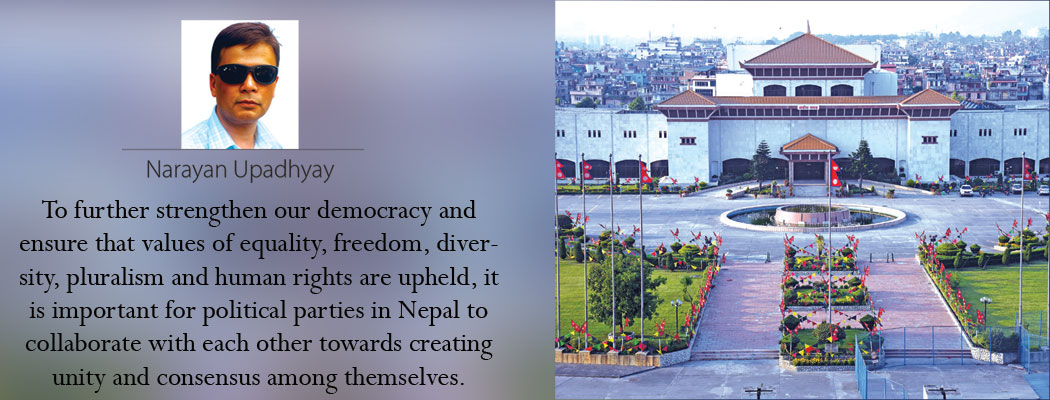
Democracy is an essential and successful form of governance accepted by many countries around the world, and Nepal has been able to make significant strides towards achieving this in a relatively short period of time. To further strengthen our democracy and ensure that values of equality, freedom, diversity, pluralism and human rights are upheld, it is important for political parties in Nepal to collaborate with each other towards creating unity and consensus among themselves. Through dedicated efforts towards creating democratic institutions and addressing the challenges faced by our nation along the way, Nepal stands a chance to become a model for democracy worldwide.
(Upadhyay is managing editor of this daily)




-original-thumb.jpg)