- Thursday, 28 May 2026

Unions Give Workers Voice In Crisis

The past year has been marked by protests, demonstrations and intense collective bargaining across Europe, as trade unions have been fighting to protect the wellbeing of their members. The picture is grim all over the continent. With inflation at levels not experienced for more than 40 years, real wages have fallen precipitously.
In-work poverty is exploding, as the cost-of-living crisis is squeezing those on low and middle incomes. Inequality is booming. Record profits for big business are going into shareholders’ pockets, rather than much-needed investments in the twin green and digital transitions.
Higher wages
With the campaign ‘Together. In Action. For Higher Wages’, industriAll Europe and its members have called for wages to be raised in line with inflation plus productivity gains. We have also called for anti-crisis measures — public policies which are essential, alongside wages policy, to tackle the root causes of the cost-of-living crisis and deal with the consequences of the energy crisis in industrial workplaces. By standing united and co-ordinating our actions, we have sent a strong signal to employers and policy-makers that industrial workers in Europe are fighting this battle side by side.
The campaign has been carried out at all levels. We have made five core demands of European employers’ associations, European Union policy-makers and other stakeholders, which include a pay rise that guarantees decent living standards, fair taxes on companies and the wealthy, support for workers affected by the cost-of-living crisis, financial support for companies struggling with energy costs, with guarantees to save jobs and raise wages, and sectoral bargaining so workers can win better pay.
The ‘Brussels bubble’ of EU opinion is dominated by business and industry lobbies which push for conservative, employer-friendly policies. Take the austerity imposed after the 2008 crash, which decentralised collective bargaining in many member states and led through wage freezes and cuts to a recession. Making workers’ voices heard through our campaign has, therefore, been crucial.
The campaign has given our members the opportunity to exchange views on the situation in each country, on collective-bargaining demands and employers’ tactics. This has been of particular relevance in big industrial regions, where employers try to play workers and their trade unions in neighbouring countries off against one another.
The best example was industriAll Europe’s participation in the launch of the collective-bargaining negotiations for the metal and electrical industry in Gelsenkirchen, Nordrhein-Westfalen, and at the collective-bargaining committee meeting in Sprockhövel. The federation’s general secretary, Luc Triangle, stressed that IG Metall’s demand for an 8 per cent wage increase in Germany was not isolated but in line with those from unions in neighbouring countries: the FNV confederation in the Netherlands was asking for a wage increase to compensate for 12 per cent inflation; in Austria, the production union PRO-GE was demanding a pay rise of 10.6 per cent.
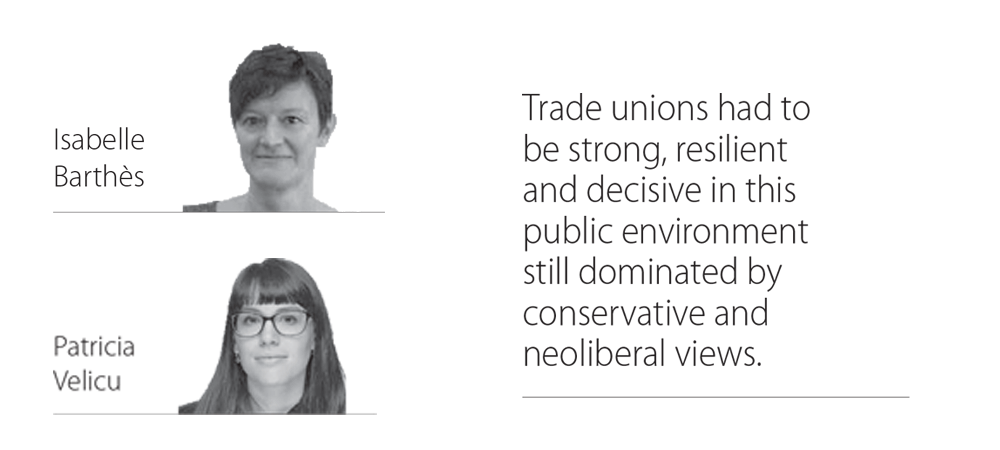
Such exchanges of information gave industriAll Europe’s members reassurance, amid immense pressure from employers and conservative voices. Across Europe, employers adopted a very aggressive narrative of wage ‘moderation’, appealing to unions’ ‘responsibility’ to restrain their demands and warning against a ‘wage-price spiral’. Trade unions had to be strong, resilient and decisive in this public environment still dominated by conservative and neoliberal views. The figures have however been on our side: after an entire year of employers’ warnings against such a spiral, there are still no signs of it.
While in most countries wages are in fact falling far behind inflation — meaning a real pay cut for millions of workers — many big companies continue to book record profits. These are not however being invested: dividends are growing faster than inflation while private investment as a share of gross domestic product continues to decline. Chief executives have meanwhile scooped the pool: United States data covering the largest firms indicate a growth of remuneration of more than 1,000 per cent over the past 40 years, nearly 100 times the rate for average workers.
Company profits reached new highs in the second quarter of 2022. Strong order books and better-than-expected results have been evident not only in energy, but also the steel, automotive and pharmaceutical industries. Those making money from the crisis should pay for it. They have a responsibility to pay decent wages — and their fair share of taxes. The EU has finally proposed to introduce a minimum corporation tax of 15 per cent for large companies but more needs to be done. Austerity should be avoided at all costs, especially in an environment where social unrest and the far right are on the rise.
Achievements
The collective struggle has paid off for some, as some of our members have scored important achievements over recent months, winning significant wage increases through collective agreements. The FNV won an 11 per cent increase in the metals sector (duration 18 months). PRO-GE and GPA in Austria secured a 7.4 per cent increase in the metals/technology sector and a monthly lump sum of €75 (duration 12 months). In Belgium, workers will receive an automatic indexation resulting in an 11 per cent rise. And IG Metall achieved an increase of 8.5 per cent, plus a one-off tax-free bonus of €3,000, in the metals/electrical sector.
(Barthès is deputy general secretary of industriAll Europe and Velicu is senior policy adviser at industriAll Europe.)
- Social Europe