- Thursday, 28 May 2026

Thoughts On Afghanistan
Liladhar Upadhyaya
Afghanistan, a beautiful country in South Asia, has been in flux for a long time regarding her political system, social order, economic progress and peace. The situation in this country is taken as evidence of how a skewed political system can shatter the dreams of peace-loving people in the region and beyond.
Moreover, the conflict of interest between the world powers has also become a challenge to maintain peace and order in this country. Extremist forces like the Taliban have become a daunting challenge to govern the nation in democratic manner. The same has posed a threat to ensuring human rights.
The recapture of Kabul on August 15, 2021 by the Taliban forces has given rise to issues pertaining to the nation's political stabiliy, socio-economic well being and Afghani people's deep seated desire to enjoy peace, security, and all forms of human and democratic rights.
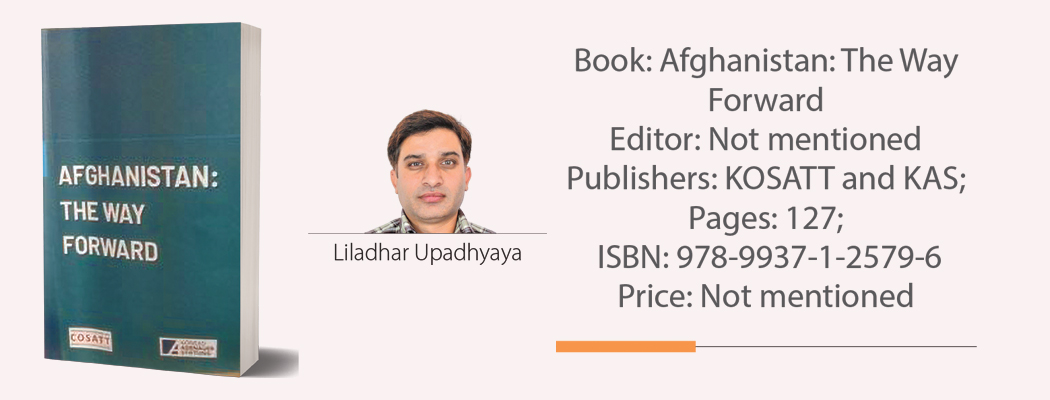
The book named 'Afghanistan: The Way Forward,' published by Consortium of South Asian Think Tanks (COSATT) and the Political Dialogue Asia Programme, Konrad Adenauer Stiftung (KAS), is a compilation of valuable articles penned by noted diplomats, peacemakers, scholars and security experts.
The articles included in this book have not only depicted the situation of Afghanistan but also have tried to analyse the security threat for the South Asian Region and beyond. Providing a way forward for the conflict-hit country and its people is a principal objective of the authors incorporated in the book as well as the publisher(s) of the book.
Stating the purpose of publishing this book, KOSATT Convener Dr. Nischal N. Pandey said that he wanted to dedicate this book to the brothers and sisters of Afghanistan. Expressing concern about the aggravating situation in the country, Pandey stated, "Afghanistan is an old nation of many centuries famous for its brave and resilient people who have endured decades of conflict, instability and turmoil. This has made them even stronger."
In his conclusion, former ambassador and former chief editor of The Rising Nepal English Daily Yuba Nath Lamsal stated that Afghanistan is politically ungovernable, financially in a mess, and socially chaotic.
If the ethnic divide is not addressed, new conflicts between various ethnic groups are likely to emerge in Afghanistan. In his article, 'Lessons from Afghanistan', Lamsal suggests that the solution imposed from outside is a temporary one. Solutions to be generated within the country shall be viable to lead the country towards peace, stability and development.
Dipankar Banerjee, a retired major general, floats the idea that Afghan situations provide opportunities for a new approach to regional cooperation.
Afghanistan has given new insight which needs an approach and engagement that will be based on regional cooperation for a new era, Banerjee concludes in the article entitled 'Taliban's Return to Afghanistan- Implications for the Region' citing the adverse consequences of COVID-19 pandemic, global geo-political impact of the Ukraine War and a reversal to the earlier era of terrorism with Taliban's return in Afghanistan are serious challenges.
Assessment of the rights situation of vulnerable communities-- women and children -- is another aspect of the book. Afghan people are destined to suffer from 40 years of war, recurring natural disasters, chronic poverty, drought and the COVID-19 pandemic. Moreover, the women and children rights in Afghanistan are also unmanageable and left unaddressed.
Afghan rights activist Lailuma Nasiri indicates that the humanitarian situation in Afghanistan has been marked by escalating humanitarian needs as 24.4 million people, more than half of the Afghan population, are in humanitarian need.
Nasiri's article entitled 'Women and Children Rights in Afghanistan: A brief on pre and post Taliban Situation' makes recommendation for restoration of the legal system and legal framework and relevant institutions that ensure women's rights including laws that guarantee women's rights to education, mobility, employment, health care and free expression and the rights of millions of girls to education must be respected.
Observing Pak-Afghan ties under Taliban, Islamabad based assistant professor Salma Malik states that the security and stability of Pakistan and Afghanistan are linked to each other, and both countries are affected in case of any internal or external developments.
Malik suggests balanced and pragmatic approach to Pakistan regarding Afghan issue. As the Taliban consolidate their power at home and interact with a global audience, Islamabad needs to prudently assess and bilaterally deliberate key critical concerns that include counter-terrorism, border fencing, trade, river water sharing as well as the most critical refugee problem, Malik concludes.
Another critical issue in Afghanistan is the refugee problem. Assistant editor of 'The Times of India', Rudroneel Ghosh states that there is urgent need to prioritize the Afghan refugee crisis, which has only worsened since the Taliban takeover.
Ghosh suggests a high-level regional inter-governmental coordination mechanism for host countries in is imperative to not only support the Afghan refugees spread across Iran, Pakistan, India and the Central Asian Republics, but also to lay the foundation for cooperation among these countries on security issues emanating from Afghanistan.
Ghosh's article entitled 'Afghan Refugees: Rehabilitation, Support and a Regional Cooperation Model in the Aftermath of Taliban Takeover of Afghanistan' concludes that regional countries in South and Central Asia must band together to help Afghan refugees and address security concerns arising from Afghanistan.
Contributors of the book include Hernaikh Singh and Shavinyaa Vijaykumarr, D. Suba Chandran, Mallika Joseph, Smruti S. Pattanaik, Nihar R. Nayak, Binoj Basnyat, Abigail Miriam Fernandez, Akriti Sharma, and Veera Lamichhane.
All articles in the book under review are somehow interlinked in terms of human rights, humanity, security, peace and order within conflict hit Afghanistan and beyond.
Consequences being faced and to be faced by the neighbouring countries are also a matter of concern of the authors. The durable solution for Afghanistan and its people is a prime matter of objective in
the book.
The Book has become able to create a multi-verse discourse for Afghani people by trying to identify core problems of the country and its future course. However, the challenging matter is how to transform problems into constructive solutions, which is the need of the hour for Afghanistan.
Likewise, Afghanistan gives several lessons to other countries of South Asia and beyond. They should be aware of possible security threats as well as rights violations of the people. Timely address of the problems can be helpful to avert possible conflict. The book, published in precise form, will be considered a good reference for researchers, academia, governmental and non-governmental agencies, and activists.
(Upadhyaya is a journalist at TRN)




-original-thumb.jpg)