- Thursday, 28 May 2026

Women Journalists Vent Against Taliban

Necessity is the mother of creation. The imposition of fundamentalist regime in Afghanistan has led to the creation of a new form of journalism by Afghan women journalists in exile. Since 2021 the Taliban have been back in power in this beautiful South Asian Country. They were ruling Afghanistan from 1996 till 2001. Then for almost 20 years the US had their forces were there and in August of 2021 the NATO pulled out. Since then, the Islamic Emirate is back in power and among the various stringent ruling strategies, their main concern is to control the freedom of women and girls.
In 2022, they banned girl’s education completely. They have also issued a circular that women cannot be employed by international organisations. The media within Afghanistan is under scrutiny and most of the journalists who there cannot exercise freedom of expression. In such a situation how can the news and facts of what is happening be circulated to inform the people within the country and outside? There is a void in Afghan media now. Although there are journalists still there, they cannot work freely. The women journalists who still are within the country are in worse conditions. Their voice is often ignored.
Women’s stories
In December 2021, just after four months of the Taliban takeover, according to Reporters Without Borders, four out of five women journalists have lost their jobs. Reporter Without Borders also reports that from 11 out of 34 provinces in Afghanistan women journalists have been erased. Such a situation has led to the establishment of Zan Times “We want to do our own narrative to tell stories of Afghan women, especially when Afghan is now under a regime that is wiping off all women professionals,” Zahra Nader, Editor-in-chief of Zan Times, informed me via a WhatsApp chat. Zan Times is a volunteer-run newsroom by Afghan women journalists in exile. Zahra feels that this is the right time to be the women’s voice. Zahra established Zan Times in August 2022 one year after the Taliban’s takeover. It is mostly run by the women volunteers who are in exile. She uses her savings to pay the reporters in Afghanistan as it is difficult for people who are hungry to work for free. Most of Zahra’s colleagues at Zan Times are outside Afghanistan and are working voluntarily to continue to get the facts out of Afghanistan.
One story they published on December 18, 2022 related to the fact that in the last 48 hours, five women and girls attempted or died by suicide in Nimraz and Ghor provinces of Afghanistan, according to the hospital registrations there. Two teens died in Ghor while three attempts occurred in just one 24-hour period in Nimraz, sources told Zan Times as per reporter Mahsa Elham, whose name was changed to protect her identity.
Zahra says that Zan means woman and Zan Times is their way of resisting the Taliban, and speaking their truth. After its launch in August 2022 they have produced more than 50 stories, covering human rights violations, especially those affecting women, LGBTQ community and the environment. They work with both journalists inside Afghanistan and in exile. Most of them are in exile, a group of seven journalists (five women) are working with Zahra and her team from Afghanistan. There are a total of 17 people working both part time and full time, and they work with a group of mainly women journalists in Afghanistan. Due to security threats to their colleagues in Afghanistan, they use pen names.
Fact checking is an important part of journalism, so is the protection of sources. So how does Zan Times do this? They are using what they call community reporting. Their colleagues are mostly reporting on what is happening in their communities. They do not publish news unless two independent sources confirm it. Working as a journalist within Afghanistan is criminalised under the Taliban. However, Zan Times fact checks and does not run stories until and unless they are sure of its authenticity.
The 32-year-old Zahra says she has lived through four regime coups in her life-time. During the first takeover by the Taliban, she was just six years old. Currently she is in exile in Canada from where she runs Zan Times. Since 2011 she was working mostly with the local media. In 2016 she joined The New York Times bureau in Kabul. She was the first Afghan woman journalist to work with mainstream English language international media in Afghanistan. Now in exile, she is continuing journalism via Zan Times, with a motive of getting the voice of Afghan women out from the country.
Challenging profession
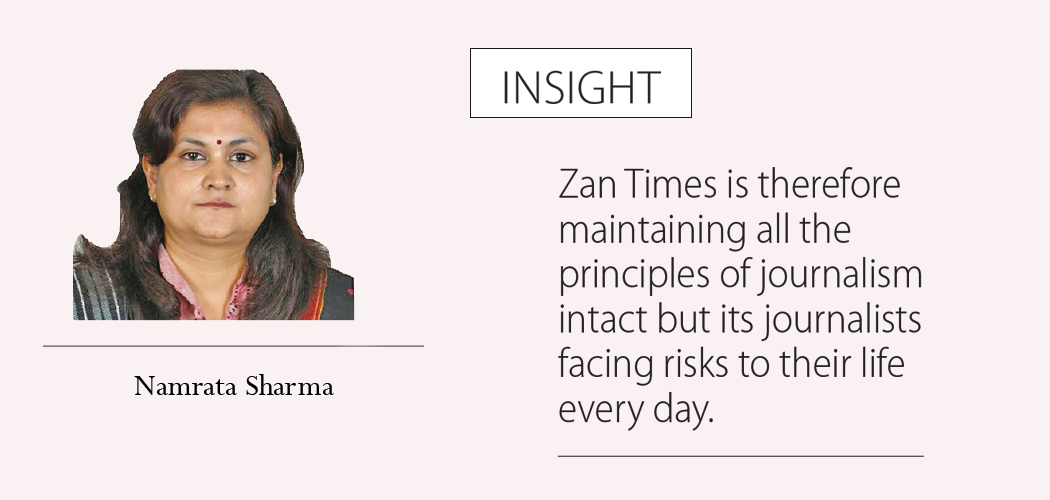
This journalism is very risky and challenging for her. Zan Times has already published several investigative reports. They hide the identity of their sources and reporters inside Afghanistan so that no one in Afghanistan know whom they are working with. None of their reporters are connected with each other in Afghanistan. They are connected with the Zan Times team outside the country, so even if they are caught, which they pray never happens, they don’t know who else is connected with them. Zan Times is therefore maintaining all the principles of journalism intact but its journalists facing risks to their life every day as they courageously and skilfully go about their work.
Together with Zahra, Freshta Ghani is Zan Times Editor in exile in Tajikistan and Kreshma is an investigative reporter and news editor in exile in Turkey. The fact that these three journalists are managing Zan Times on a volunteer basis is an amazing work. To run a news room from different countries while in exile with little funding and tracking and managing reporters and sources in a country ruled by the Taliban tells a lot about this new and daring form of journalism.
(Sharma is a journalist and rights advocate. namrata1964@yahoo.com twitter handle: NamrataSharmaP)


-original-thumb.jpg)