- Thursday, 11 June 2026

The Eight Billion Mark And Beyond

The world population hit the eight billion mark on November 15, which is both a milestone and a challenge. It took 11 years for the world to get an additional one billion population. The world population was seven billion in 2011. The history of world population shows that the world population was five million in 8,000 BC, when agriculture emerged. The population grew to 200 million in 1 AD with a growth rate of 0.05 per cent. (Some say the figure was 300 million or even 600 million.)
A sharp change in the demographic patterns emerged after the Industrial Revolution. In 1800, the world population hit the one billion mark. Since then, the world population has been rising. It took 130 years for the world population to reach two billion in 1930. Afterwards, the world population reached three billion in 1960 (after 30 years), four billion in 1974 (after 14 years) and five billion in 1987 (after 13 years). During the 20th century, the world population grew from 1.65 billion to 6 billion.
Projections
The United Nations has made projections for population growth. According to the projections, the world population will grow to 8.5 billion in 2030, to 9.7 billion in 2050 and to 10.4 billion in the 2080s. The world population will be 10.4 billion till 2100. However, the US-based Institute for Health Metrics and Evaluation estimated in 2020 that the world population would max out by 2064 without reaching even 10 billion and decline to 8.8 billion by 2100.
As per the UN projections, 61 countries or areas will experience a reduction in population by one per cent or more in the 2022-2050 period owing to declining fertility rates and, in some cases, increasing emigration. Likewise, over half of the increase in world population will be in eight African and Asian countries: the Democratic Republic of Congo, Egypt, Ethiopia, Nigeria, Tanzania, India, Pakistan and the Philippines. Sub-Saharan African countries will account for half of the increase in population in Africa through 2050.
However, the population growth rates have been declining since 1950. In the 1960s, the population growth rate was 2 per cent. At present, it is 0.84 per cent. The population growth rates in 2017, 2018, 2019 and 2020 were 1.12 per cent, 1.1 per cent, 1.08 per cent and 1.05 per cent, respectively. Fertility rates have declined remarkably in recent decades in many countries. The fertility rates are below 2.1 per cent per woman in two thirds of the world. This is the approximate level required to attain zero growth in population in the long run for a population with low mortality. It may be noted that some countries have lower birth rates to such an extent that they may not be in a position to maintain their populations.
Owing to advances in the medical bailiwick, birth control, nutrition, personal hygiene, better education and life expectancy has also increased in recent times. The global life expectancy was 72.8 years in 2019 as against 63.8 years in 1990. However, the life expectancy situation in poor countries was worse than that of developed countries. In 2021, the life expectancy for LDCs lagged seven years behind the global average. In 2021, when the COVID-19 pandemic was raging, the global life expectancy rate plummeted to 71 years. The pandemic may have produced short-term reductions in pregnancies and births but there is little evidence of an impact on fertility. The global life expectancy is projected to reach 77.2 years in 2050.
Increase in population generates myriads of problems. Poverty, hunger, malnutrition and starvation are the major offshoot of population growth. Problems with providing better healthcare and quality education also arise when the population explodes. Moreover, there are challenges of taking care of older people.
The resources available in the world are limited. Man is overexploiting the resources, which are depleting day by day. On the other hand, anthropogenic activities are making the world virtually an inhospitable place to live in by giving rise to climate change and other such phenomena. This was also discussed by the world leaders during the COP 27 conference held in Egypt. The Sustainable Development Goals relating especially to health, education and gender equality are the key to reducing fertility rates and decelerating population growth.
Inequality
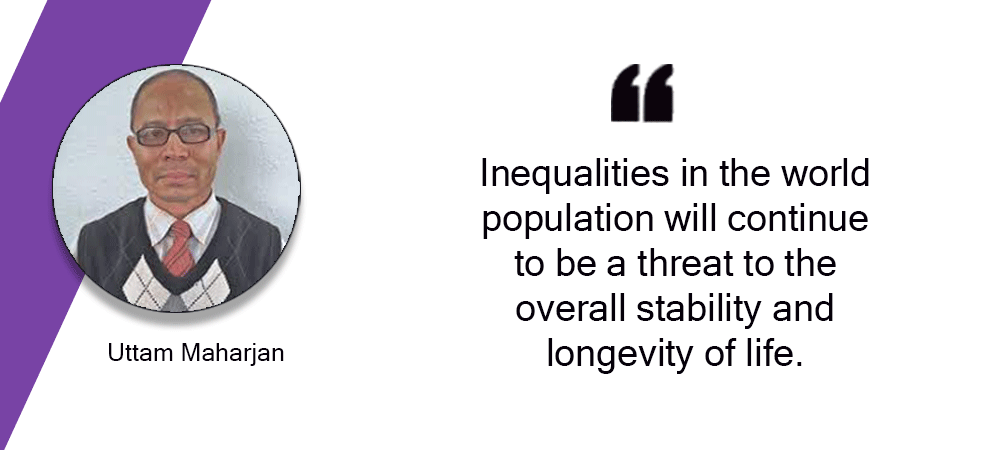
Inequalities in population are also something to ponder over. While some countries are coping with population growth, others are struggling to maintain their populations. In this regard, it would be germane to quote UN Secretary General Antonio Guterres, who says that inequalities in the world population will continue to be a threat to the overall stability and longevity of life.
Nepal has a population of 29.192 million as per the census conducted in 2078 BS. According to the 2068 BS census, the population was 26.494 million. The population jumped by 10.18 per cent over the decade. As per the UN estimates, the population was 30.4 million on 15 November, when the global population hit the eight billion mark. The population of the country is 0.38 per cent of the world population. The country ranks 49th in the world in terms of population. The life expectancy is 71.74 years with the infant mortality at 23.4 per thousand live births and the under-5 mortality at 27.7 per thousand live births. The population of the country is projected to reach 35.32 million by 2050. It may, however, be expected that the population growth rate will come down with better education, consciousness and medical facilities.
(Maharjan has been regularly writing on contemporary issues for this daily since 2000. uttam.maharjan1964@gmail.com)