- Monday, 25 May 2026

Speaker Aryal Must Uphold House Dignity
 Nilam Sangroula
Nilam Sangroula
Nilam Sangroula
In a nation long fraught with corruption and political stagnation, Nepal's Generation Z has emerged not just as the country's largest demographic but as the fierce architects of a new dawn- demanding accountability, transparency, good governance, and a future where the voices of youth are no longer trampled but lead the way. The Gen Zers are said to be digitally native, globally connected, zero tolerance on casteism and marginalisation, and always consider a harbinger for societal changes. They called for a protest on the 8th and 9th of September, in response to the restrictions imposed on prominent social media platforms and messaging apps, which forced the downfall of then Prime Minister KP Sharma Oli’s government.
The latent causes of the uprising, which boiled over the streets, however, were the nation’s long-standing problems such as nepotism, institutionalised corruption, unemployment, and, political and economic stagnation. Sushila Karki, former Chief Justice, was appointed as the country’s new interim prime minister to conduct free and fair elections. The early general election was held on 5 March 2026. The election delivered a clear and, to many, and to me, surprising result. The parliament meeting of 5th April 2026 offered a concluding chisel to the formation of the House of Representatives (HoR) by appointing Dol Prasad Aryal as the Speaker of the HoR. Aryal was elected unchallenged as the Speaker on Sunday, 5th April 2026, according to Article 91 of the Constitution of Nepal 2015. Now he's the Speaker, deciding which daily "Order of Business" to set and deciding when and which bills are introduced and debated.
Impartiality
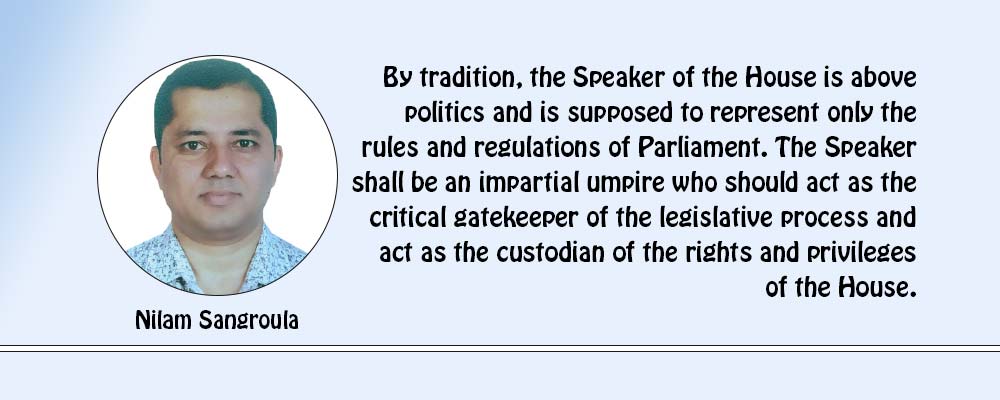
By tradition, the Speaker of the House is above politics and is supposed to represent only the rules and regulations of Parliament. The Speaker shall be an impartial umpire who should act as the critical gatekeeper of the legislative process and act as the custodian of the rights and privileges of the House. The job of the Speaker is to ensure the legislative process toes the line with the constitution and under established rules. Alas, the democratic parliament hardly saw such Speakers who were above politics and represented only the rules and regulations of Parliament. Many of the Speakers in Nepal run into controversies as they failed to maintain the neutrality and impartiality of the parliamentary affairs. However, early Speakers like Krishna Prasad Bhattarai and Daman Nath Dhungana were able to establish benchmarks for the speaker’s impartiality and upholding parliamentary dignity.
When the ruling party obtained a two-thirds majority in parliament, the challenges for the Speaker may stem from the ruling party itself because the majority executive may take the reins of power to enact sweeping changes that may undermine democratic values. When the Speaker belongs to the same party, impartiality may suffer, and executives may play dominant roles over parliamentary affairs. It could be hard for the Speaker to remain neutral amid party loyalty. The real role of the Speaker stems from this ordeal to uphold the supremacy of Parliament. From this understanding, the Speaker represents the views of those minorities that have entrusted them with the responsibility of speaking on their behalf.
This implies that the Speaker is not supposed to be viewed as only representing the view of the ruling party or the party to which the Speaker belongs. The speaker has an opportunity to keep the majority tyranny at bay where the two-thirds majority tries to sideline minorities. Speaker Aryal has to consider two indispensable conditions of being a good Speaker: independence in dealing with the executive and impartiality in dealing with all elected members. Speaker Aryal must defend the rights and privileges of all members without exception. The purpose of a position is to incorporate all political groups, beliefs, and ideologies. This assertion is in line with the principles of the deliberative democratic theory.
Political neutrality
In democratic countries, once elected as a Speaker, the incumbent must detach himself/herself from political membership and government activity in order to guarantee political neutrality and to run the House impartially. Detachment is not just from the membership of the party but from the behaviour as well. Speaker Aryal has had abundant opportunities to emulate John Bercow of the United Kingdom, who held the position of Speaker of the House of Commons from 2009 to 2019. As a conservative, he blocked Prime Minister Boris Johnson’s Brexit deal and expressed his skepticism about military intervention against Syria.
He has an opportunity to recall history where Daman Nath Dhungana, the first Speaker after the restoration of democracy, strengthened the independence of parliament by granting opposition ample opportunities to raise their voice to ensure consensus on government-backed legislations. In a nutshell, the Speaker plays an important role in ensuring a vibrant and healthy parliamentary democracy. Impartiality of the Speaker is a key requirement to cut the mustard in parliamentary democracy. He is expected to shoot for the stars by making our parliament orderly, transparent and accountable.
(The author is a PhD Scholar at the Noida International University (NIU), India)

-original-thumb.jpg)