- Monday, 25 May 2026

Ensure Mobility Rights For The Disabled

The right to independent mobility is not a privilege to negotiate; it is a fundamental human right associated with every individual, regardless of ability. This is not aspirational rhetoric; it is strongly enshrined in both international and national law, the result of sustained advocacy and struggle by the disability community over many decades.
Under the United Nations Convention on the Rights of Persons with Disabilities (UNCRPD), Article 20 obliges states to take effective measures to ensure personal mobility with the highest possible degree of independence for persons with disabilities. Article 9 reinforces that accessibility is the non-negotiable foundation upon which this right rests. Crucially, the Convention does not limit accessibility to the physical environment; it extends to transport, communication, and information, requiring all to be fully accessible to all users.
Commitments
Nepal, through its domestic legislation, has aligned itself with these commitments. The Act Relating to the Rights of Persons with Disabilities 2017 explicitly guarantees mobility rights on an equal basis with others, mandating accessible infrastructure, inclusive urban planning, and affordable mobility aids. The law is clear. The grey area lies in willpower. Beyond the government, the private sector and social entities involved in shaping the built environment, whether as developers or watchdogs, must also take responsibility for ensuring accessibility that enables safe movement, approach, and use without discrimination.
The reality on the ground, however, tells a far more troubling story. Over the years, Nepal’s major cities have made visible efforts: roads have been expanded, accessibility features introduced, and the language of inclusion has entered policy discourse. These changes do enhance mobility not only for persons with disabilities, but also for the elderly, pregnant women, children, and anyone navigating the urban environment. Universal design, when properly implemented, uplifts society as a whole and is essential for sustainable development.
But here is the uncomfortable truth: much of this progress remains cosmetic. Take tactile footpaths, often hailed as a hallmark of accessibility. In theory, they are designed to guide visually impaired individuals safely and independently. In practice, they are frequently poorly planned, badly executed, and dangerously maintained. Electrical poles are planted directly in the middle of tactile lines. Left out open drains and ditches run alongside or even across walkways. Broken edges, uneven surfaces, and sudden gaps between pavement sections are common.
These are not minor oversights; they are systemic failures. One must ask: do the engineers, contractors, and officials responsible for these projects truly understand their purpose? Do they know who uses these paths and how? The so-called “accessible” footpaths, particularly in narrow spaces, have in many cases become hazards rather than solutions. These are not isolated incidents; they are routine.
A few days ago, a blind woman was narrating her story about how she narrowly escaped serious injury after falling into an open ditch. Not long ago, a blind student collided with poorly placed wires, injuring his face. Others are less fortunate, suffering broken limbs or requiring rescue simply for attempting to walk independently. Such Infrastructures, indeed, are equally risky for those who require walking alone during nighttime as well.
Wheelchair users, along with those using crutches or walkers, are often forced to navigate dangerously uneven paths and obstructed roadside conditions that effectively confine them rather than enable them. Without the active participation of persons with disabilities and other marginalised groups in economic and social life, national goals such as poverty eradication, equitable access to rights, and the vision of a “Happy Nepali” society cannot be realised. Independence and safe mobility are central to these aspirations.
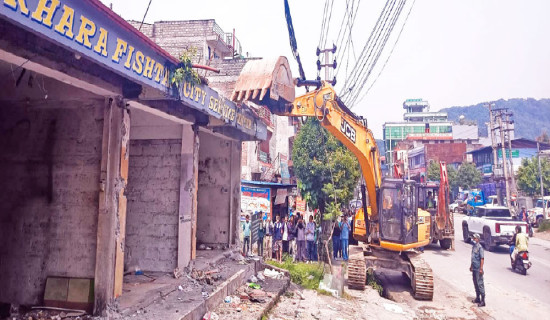
A major flaw that lies in the development of such infrastructure is the development without consultation with people with disabilities, who are the true experts on their own needs and lived experiences. Encroachment further compounds the danger. Street vendors occupy footpaths with impunity, forcing pedestrians into traffic despite municipal control efforts. Beggars, stray animals, and unmanaged urban vendors turn already fragile pathways into obstacle courses. An insensitive public not respecting others’ rights exacerbates the situation further. For someone relying on a white cane or a human guide, these conditions are not merely inconvenient; they are life-threatening. People with low vision are particularly vulnerable to such hazards quietly.
Introducing modern designs or innovations in public spaces cannot be a one-time, symbolic act driven by emotion. It requires continuous, comprehensive effort and meaningful consultation with the communities affected to avoid fundamental flaws. Flaws and lapses can occur in the course of action knowingly or unknowingly, but the willingness to identify and correct them promptly is what truly matters.
Where, then, is accountability? Responsibility is diffused across agencies, blurred between local governments and federal departments. Traffic police, though visible on the streets, are neither adequately trained nor mandated to safeguard accessibility. Monitoring is weak, maintenance is neglected and enforcement is weak. Ramification is a system in which everyone is involved, yet no one is answerable.
Silence
This silence extends beyond the government. Civil society, including some disability rights organisations, often confines its advocacy to conferences and formal events, speaking the language of rights without confronting the harsh realities outside. Media outlets, including social platforms, are relentless in covering political drama and power struggles, but rarely spotlight these everyday injustices that quietly strip citizens of dignity and independence. Nepal prides itself on being a democratic, inclusive, rights-based society. But rights are not proven in legislation alone; they are measured on the streets: in the safety of a sidewalk, in the confidence of a person walking without fear.
Yes, tactile paving represents progress and significantly eases mobility. But progress without a clear proposal, safety, without consultation with intended beneficiaries and without accountability is a disaster. Independent mobility cannot remain a promise on paper. It must become a lived reality—safe, functional and dignified. Until then, the question is not whether Nepal has recognised the right to mobility, but whether it is willing to truly achieve it.
(The author is an inclusive development expert.)